
Last letters from the living dead man
David Patterson (Spirit) Hatch
THE CLASSIC COLLECTION · 1910
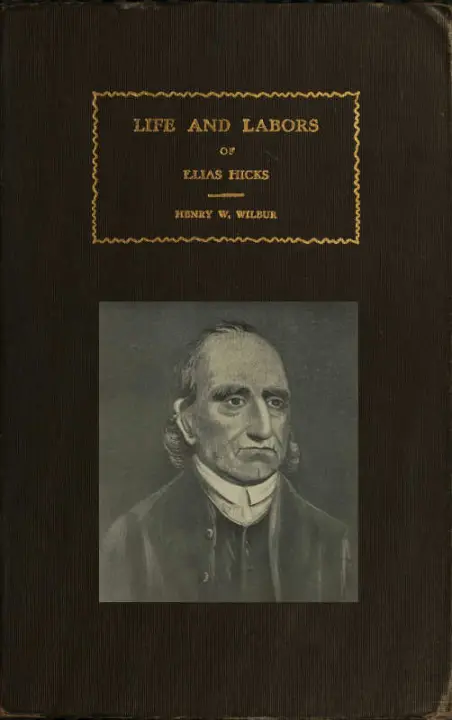
"The Life and Labors of Elias Hicks" by Henry Watson Wilbur is a biographical account written in the early 20th century. The book focuses on the life of Elias Hicks, a prominent figure in the Society of Friends (Quakers), exploring his spiritual journey, ministry, and the complexities surrounding his beliefs and practices within the context of his times. It delves into the details of his upbringing, his spiritual convictions, and the conflicts that arose within the religious community during his lifetime. The opening of the book introduces readers to the early life and background of Elias Hicks, illustrating his formative years in a Quaker household on Long Island. It highlights the influence of his ancestry and environment on his character and beliefs, detailing his struggles with youthful distractions and eventual commitment to a life of ministry. As the narrative unfolds, readers gain insight into Hicks' deep spiritual contemplations, his dedication to Quaker principles, and the challenges he faced in aligning his understanding of faith with the expectations of his community. The initial chapters set the stage for a profound exploration of Hicks as both a man of faith and a significant historical figure within the Quaker movement.
Introduction adapted from the source catalogue; source summaries may be automatically generated.
Free to read · English · 74,079 words · No account needed
MAKE TIME FOR A GOOD BOOK
On by default. Untick to stop anonymous reading totals. Each page counts after 10 seconds in view. How this works.
Anonymous counting is on unless you have switched it off.
Hicks, Elias, apostolic Christian, 7;
his type of Quakerism, 7;
reading Scriptures, 12;
reference to old folks, 13;
objects to flower bed, 13;
sells wheat at low price to neighbors, 14;
favors disciplinary equality for women, 15;
birth, 18;
reference to parents, 11, 19;
death of mother, 20;
reference to singing and running horses, 20;
apprenticed to learn carpenter's trade, 22;
on dancing, 22-23;
on hunting, 23-24;
reference to possibly lost condition, 23;
statement regarding his marriage, 24;
marriage application in monthly meeting, 25;
takes up residence in Jericho, 26;
a surveyor, 27;
appears in the ministry, 28-29;
regard for discipline, 29;
recorded a minister, 30;
passes through military lines in Revolutionary War, 31;
makes first long religious journey, 32;
visits Nine Partners, Vermont, etc., 34;
visits New England, 35;
visits Philadelphia and Baltimore Yearly Meetings, 36;
first sermon against slavery, 36;
letter from Easton, Md., 37;
visit to states south of New York, 38;
visit to Canada, 40;
visit New England meetings, 42;
goes to Ohio, 43;
at Baltimore Y. M., 44;
starts on last long religious journey, 46;
meets opposition at Westland, 47;
experience at Brownsville, 47;
at Mt. Pleasant, O., 48-49;
attends Ohio Y. M., 49-50;
disturbance at Flushing, O., 50;
attends Indiana Y. M., 52;
trouble at West Grove, Pa., 53;
extent of his travels, 56;
ideas about the ministry, 57;
speaks of his own ministry, 58;
against premeditation, 59;
measuring the ministry, 60-61;
imitates court crier, 62;
advice touching meetings and ministry, 63;
is frequently indisposed, 64;
his Jericho property, 69;
statement about his wife, 71;
as a father, 72;
letters to his wife, 76-83;
on the slavery question, 84-94;
various opinions, 95;
on the joys of labor, 97;
ideas regarding railroads, 98;
ideas about Thanksgiving, 102;
opposes Freemasonry, 103;
some points of doctrine, 107-120;
has trouble in Philadelphia, 126-128;
writes letter to Philadelphia elders, 132;
in the time of unsettlement, 139-151;
three sermons reviewed, 152-160;
is visited by Anna Braithwaite, 162;
writes to Dr. Atlee, 164;
writes to Anna Braithwaite, 169;
in Dutchess County with Ann Jones, 171-176;
contact with T. Shillitoe, 184-185;
at Mt. Pleasant and Short Creek, O., 186-187;
disowned by Westbury and Jericho Monthly Meeting, 189;
ideas about disownment, 193-194;
at Rose and Hester Streets, New York, 195;
remarks on reception by Friends, 196;
assumes the humorous role, 196;
received by Friends after long western trip, 197;
death of wife, 198;
visits Dutchess County, 199;
preaches in statehouse, Albany, 200;
letter to Johnson Legg, 201;
his dying testimony, 204;
critics of, 202-210;
a logical thinker, 211;
his kindness to poor, 213-214;
deals with corn thief, 214;
his dying testimony against slavery, 214;
sufferings for peace principles, 215-216;
helps organize charity society, 216-217;
putting off harness, 218-225;
his last traveling minute, 220;
attends his last monthly meeting, 220-221;
suffers stroke of paralysis, 221;
his death, 221;
his funeral, 221;
last letter to Hugh Judge, 222
Hicks, Elias, Jr., son of E. H., 73
Hicks, Elizabeth, daughter of E. H., 72;
picture of, facing, 97 ...
Hicks, Sir Ellis, reference to, 17
Hicks Family, the, 71
Hicks, Jonathan, son of E. H., 73
Hicks, John, son of E. H., 72
Your reading position is saved on this browser. Take it to another device with a library code. Reading pages adapt to text, rather than matching a printed edition.
BEHIND THE BOOK
This eBook is for the use of anyone anywhere in the United States and most other parts of the world at no cost and with almost no restrictions whatsoever. You may copy it, give it away or re-use it under the terms of the Project Gutenberg License included with this eBook or online at www.gutenberg.org. If you are not located in the United States, you will have to check the laws of the country where you are located before using this eBook. Read the source licence.
The original source file, including credits and licence, is retained by this library. Request an original-format copy at no charge. Please include the book title and Project Gutenberg identifier #50374.
KEEP YOUR CURIOSITY GOING
David Patterson (Spirit) Hatch

David Patterson (Spirit) Hatch

David Patterson (Spirit) Hatch
Cécile Tormay

Moritz Busch
John L. Ransom