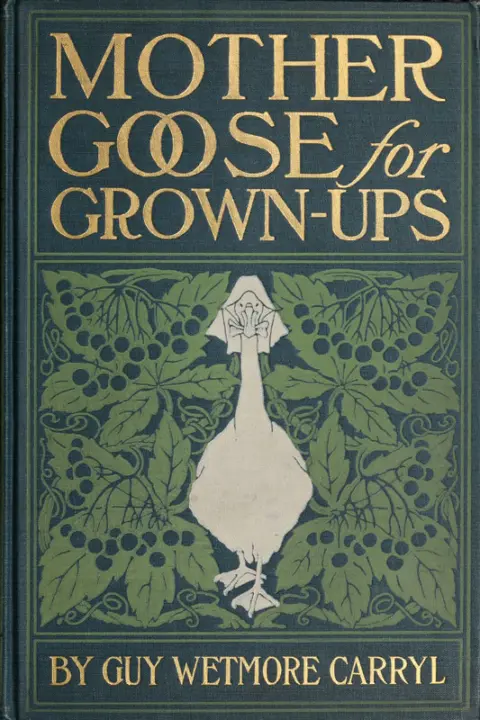
Mother Goose for Grown-ups
Guy Wetmore Carryl
THE CLASSIC COLLECTION · 1902
"The Lieutenant-Governor: A Novel" by Guy Wetmore Carryl is a political fiction novel written in the early 20th century. The narrative centers around Lieutenant-Governor John Hamilton Barclay, who is positioned in a complex political landscape alongside the experienced Governor Elijah Abbott. Their relationship is fraught with mutual distrust and differing principles, setting the stage for a tale that explores themes of power, political reform, and personal ideals. The opening of the novel introduces us to the offices of the Governor and the Lieutenant-Governor, highlighting the tension between the two characters, particularly as they navigate the political landscape of Alleghenia. Barclay finds himself disillusioned and powerless in his role, as Abbott embodies the corrupt political machinery, causing frustration for the idealistic young man. The narrative hints at the upcoming conflict involving labor unrest, particularly surrounding Peter Rathbawne and a group of laborers he has discharged, which threatens to erupt into a strike. As the story unfolds, Barclay's internal struggles with his sense of duty and the expected loyalty towards the principles of reform become increasingly evident, suggesting a deeper exploration of moral dilemmas in the realm of politics.
Introduction adapted from the source catalogue; source summaries may be automatically generated.
Free to read · English · 44,569 words · No account needed
MAKE TIME FOR A GOOD BOOK
On by default. Untick to stop anonymous reading totals. Each page counts after 10 seconds in view. How this works.
Anonymous counting is on unless you have switched it off.
"You will permit me to be the best judge of what the welfare of the commonwealth may be," he retorted. "Whatever lawlessness exists--and I think you have grossly exaggerated its extent, Colonel Broadcastle--is due to the selfish obstinacy of one man. In my opinion, Mr. Rathbawne is entirely in the wrong. He had fair warning, which he did not choose to heed. If his property suffers at the hands of the strikers, he has only himself to blame."
"It is not a question of Mr. Rathbawne, or of any other individual," said Broadcastle, "but of the integrity of the state of Alleghenia!"
"The integrity of the state of Alleghenia," answered the Governor dryly, "has been intrusted, by the vote of her citizens, to me, as chief executive."
"An action," exclaimed the Colonel, "which I venture to predict they will shortly have reason most bitterly to regret!"
Governor Abbott rose abruptly to his feet.
"This interview is at an end, Colonel Broadcastle," he said, bringing his fist down upon the table with a thud. "I take exception to your remarks, from first to last. I consider myself fully competent to deal with the situation, and you may depend, sir, I shall do so at my own time, and in my own way. If Mr. Peter Rathbawne supposes that he can defy reason and justice at will, and that the state authorities are prepared to support him, he is grossly and fatally mistaken. Gentlemen, I have the honor to bid you good-day!"
For a quarter-minute, the two men stood facing each other, without speaking. It was observable that the eyes of neither flinched. Then--
"It is my earnest hope, Elijah Abbott," said the Colonel slowly, "to see you impeached by a righteously indignant community, and committed for a term of years to the State's Prison at Mowberly, for rank malfeasance in office!"
The Governor shrugged his shoulders.
"Your record and your position protect you, Colonel Broadcastle," he said, with something of his usual suavity. "Will you have the goodness to retire?"
As the Citizens' Committee left the room the Lieutenant-Governor turned on his heel, passed into his office, and closed the door.
For a long time he sat motionless at his desk, with his temples in his hands, staring at a frame upon the opposite wall, which contained the emblazoned arms of Alleghenia. These were a hand holding even balances, upon a circular shield, supported by the nude figures of two young men, representing Art and Labor. Above, upon a scroll, were the words, "Justitia. Lex. Integritas."
It was not only bad heraldry, but indifferently appropriate symbolism.
Your reading position is saved on this browser. Take it to another device with a library code. Reading pages adapt to text, rather than matching a printed edition.
Guy Wetmore Carryl
Guy Wetmore Carryl
Guy Wetmore Carryl
Guy Wetmore Carryl
BEHIND THE BOOK
This eBook is for the use of anyone anywhere in the United States and most other parts of the world at no cost and with almost no restrictions whatsoever. You may copy it, give it away or re-use it under the terms of the Project Gutenberg License included with this eBook or online at www.gutenberg.org. If you are not located in the United States, you will have to check the laws of the country where you are located before using this eBook. Read the source licence.
The original source file, including credits and licence, is retained by this library. Request an original-format copy at no charge. Please include the book title and Project Gutenberg identifier #30448.
KEEP YOUR CURIOSITY GOING
Coulson Kernahan

Maurice Baring
Frances Wright
Cécile Tormay

Frederic Jesup Stimson

W. H. P. (William Henry Pope) Jarvis