THE CLASSIC COLLECTION✦The letters of Queen Victoria, vol. 3, 1854-1861CLASSIC FREE BOOKS
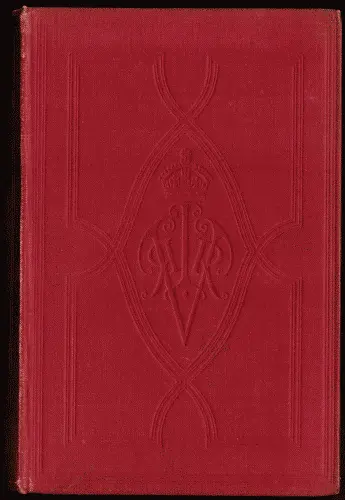
The letters of Queen Victoria, vol. 3, 1854-1861
Queen of Great Britain Victoria
THE CLASSIC COLLECTION · 1907
"The Letters of Queen Victoria: A Selection from her Majesty's Correspondence" edited by Arthur Christopher Benson and Viscount Esher is a historical account compiled in the early 20th century. This collection encompasses select correspondence from Queen Victoria between the years 1837 and 1861, providing insight into her thoughts, feelings, and the events she experienced during her reign. The opening of the work introduces the reader to Queen Victoria’s personal reflections and royal duties at the onset of the year 1844. She writes to her uncle, the King of the Belgians, about various familial and political matters, revealing her sentiments about family life, her children, and significant political events such as a parliamentary crisis and diplomatic relations with France. The letters not only depict her emotional world but also serve as a window into the political landscape of the time, highlighting Queen Victoria's role as a monarch involved in the intricacies of governance and international relations.
Introduction adapted from the source catalogue; source summaries may be automatically generated.
Free to read · English · 192,778 words · No account needed
MAKE TIME FOR A GOOD BOOK
On by default. Untick to stop anonymous reading totals. Each page counts after 10 seconds in view. How this works.
Anonymous counting is on unless you have switched it off.
I think it is time to conclude my long letter.
If the French are angry at this visit, let their dear King and their Princes come; they will be sure of a truly affectionate reception on our part. The one which Emperor Nicholas has received is cordial and civil, mais ne vient pas du c[oe]ur.
I humbly beg that any remarks which may not be favourable to our great visitor may not go beyond you and Louise, and not to Paris. Ever your devoted Niece,
[Footnote 13: The Emperor Nicholas of Russia had just arrived
on a visit to England.]
[Footnote 14: Frederick Augustus II.]
[Pageheading: THE REVIEW]
[Pageheading: THE QUEEN'S IMPRESSIONS]
[Pageheading: THE CZAR NICHOLAS]
Queen Victoria to the King of the Belgians.
Buckingham Palace, 11th June 1844.
MY DEAREST UNCLE,--I received your very kind and long letter of the 7th on Sunday, and thank you very much for it. I am delighted that my accounts interested you, and I shall try and give you some more to-day, which you will see come from an unbiassed and impartial mind, and which I trust therefore will be relied upon. The excitement has ceased as suddenly as it had begun, and I am still confused about it. I will go back to where I last left you. The Revue[15] on the 5th was really very interesting, and our reception as well as that of the Emperor most enthusiastic. Louise tells me you had a review the same day, and that it also was so hot. Our children were there, and charmed. On the 6th we went with the Emperor and King to the races,[16] and I never saw such a crowd; again here the reception was most brilliant. Every evening a large dinner in the Waterloo Room, and the two last evenings in uniforms, as the Emperor disliked so being en frac, and was quite embarrassed in it. On the 7th we took him and the King back here, and in the evening had a party of 260 about. On Saturday (8th) my Angel took the Emperor and King to a very elegant breakfast[17] at Chiswick, which I for prudence' sake did not go to, but was very sorry for it. In the evening we went to the Opera (not in State), but they recognised us, and we were most brilliantly received. I had to force the Emperor forward, as he never would come forward when I was there, and I was obliged to take him by the hand and make him appear; it was impossible to be better bred or more respectful than he was towards me. Well, on Sunday afternoon at five, he left us (my Angel accompanied him to Woolwich), and he was much affected at going, and really unaffectedly touched at his reception and stay, the simplicity and quietness of which told upon his love of domestic life, which is very great. I will now (having told all that has passed) give you my opinion and feelings on the subject, which I may say are Albert's also. I was extremely against the visit, fearing the gene, and bustle, and even at first, I did not feel at all to like it, but by living in the same house together quietly and unrestrainedly (and this Albert, and with great truth, says is the great advantage of these visits, that I not only see these great people but know them), I got to know the Emperor and he to know me. There is much about him which I cannot help liking, and I think his character is one which should be understood, and looked upon for once as it is. He is stern and severe--with fixed principles of duty which nothing on earth will make him change; very clever I do not think him, and his mind is an uncivilised one; his education has been neglected; politics and military concerns are the only things he takes great interest in; the arts and all softer occupations he is insensible to, but he is sincere, I am certain, sincere even in his most despotic acts, from a sense that that is the only way to govern; he is not, I am sure, aware of the dreadful cases of individual misery which he so often causes, for I can see by various instances that he is kept in utter ignorance of many things, which his people carry out in most corrupt ways, while he thinks that he is extremely just. He thinks of general measures, but does not look into detail. And I am sure much never reaches his ears, and (as you observed), how can it? He asked for nothing whatever, has merely expressed his great anxiety to be upon the best terms with us, but not to the exclusion of others, only let things remain as they are.... He is I should say, too frank, for he talks so openly before people, which he should not do, and with difficulty restrains himself. His anxiety to be believed is very great, and I must say his personal promises I am inclined to believe; then his feelings are very strong; he feels kindness deeply--and his love for his wife and children, and for all children, is very great. He has a strong feeling for domestic life, saying to me, when our children were in the room: "Voila les doux moments de notre vie." He was not only civil, but extremely kind to us both, and spoke in the highest praise of dearest Albert to Sir Robert Peel, saying he wished any Prince in Germany had that ability and sense; he showed Albert great confidence, and I think it will do great good, as if he praises him abroad it will have great weight. He is not happy, and that melancholy which is visible in the countenance made me sad at times; the sternness of the eyes goes very much off when you know him, and changes according to his being put out (and he can be much embarrassed) or not, and also from his being heated, as he suffers with congestions to the head. My Angel thinks that he is a man inclined too much to give way to impulse and feeling, which makes him act wrongly often. His admiration for beauty is very great, and put me much in mind of you, when he drove out with us, looking out for pretty people. But he remains very faithful to those he admired twenty-eight years ago; for instance, Lady Peel, who has hardly any remains left. Respecting Belgium he did not speak to me, but to Albert and the Ministers. As for unkindly feeling towards you, he disclaims positively any, saying he knew you well, and that you had served in the Russian Army, etc., but he says those unfortunate Poles are the only obstacle, and that he positively cannot enter into direct communication with Belgium as long as they are employed. If you could only somehow or other get rid of them, I am sure the thing would be done at once. We all think he need not mind this, but I fear he has pledged himself. He admired Charlotte's picture. Pour finir, I must say one more word or two about his personal appearance. He puts us much in mind of his and our cousins the Wuertembergs, and has altogether much of the Wuertemberg family about him. He is bald now, but in his Chevalier Garde Uniform he is magnificent still, and very striking. I cannot deny that we were in great anxiety when we took him out lest some Pole might make an attempt, and I always felt thankful when we got him safe home again. His poor daughter is very ill, I fear. The good King of Saxony[18] remains another week with us, and we like him much. He is so unassuming. He is out sight-seeing all day, and enchanted with everything. I hope that you will persuade the King to come all the same in September. Our motives and politics are not to be exclusive, but to be on good terms with all, and why should we not? We make no secret of it.
Your reading position is saved on this browser. Take it to another device with a library code. Reading pages adapt to text, rather than matching a printed edition.
Queen of Great Britain Victoria
Queen of Great Britain Victoria
BEHIND THE BOOK
This eBook is for the use of anyone anywhere in the United States and most other parts of the world at no cost and with almost no restrictions whatsoever. You may copy it, give it away or re-use it under the terms of the Project Gutenberg License included with this eBook or online at www.gutenberg.org. If you are not located in the United States, you will have to check the laws of the country where you are located before using this eBook. Read the source licence.
The original source file, including credits and licence, is retained by this library. Request an original-format copy at no charge. Please include the book title and Project Gutenberg identifier #24780.
KEEP YOUR CURIOSITY GOING

David Patterson (Spirit) Hatch

David Patterson (Spirit) Hatch

David Patterson (Spirit) Hatch
Cécile Tormay

Moritz Busch
John L. Ransom