
The Writing of News A Handbook with Chapters on Newspaper Correspondence and Copy Reading
Charles G. (Charles Griffith) Ross
THE CLASSIC COLLECTION · 1864
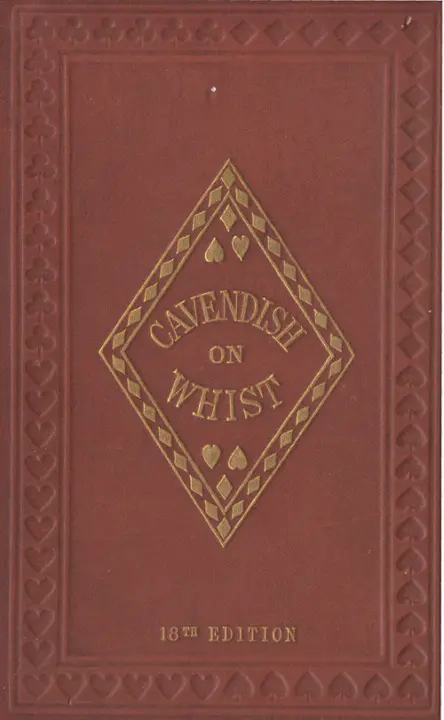
"The Laws and Principles of Whist Stated and Explained" by Cavendish is a comprehensive treatise on the card game Whist, written in the late 19th century. This work aims to address common deficiencies in existing texts about Whist by providing not just the rules, but also valuable principles behind the gameplay, including strategic illustrations through complete hands. It serves both novices and seasoned players seeking to improve their understanding of the game. The opening of the book features an illustrated frontispiece and dedicates itself to the historical context of Whist, followed by a preface explaining the author's intentions. The author notes that existing materials often present principles as arbitrary conventions without adequate justification, which this work seeks to remedy. The preface encourages readers to familiarize themselves with the fundamental rules of play before delving into the principles outlined in the book, effectively setting the stage for a detailed exploration of Whist’s mechanics and strategic concepts.
Introduction adapted from the source catalogue; source summaries may be automatically generated.
Free to read · English · 56,826 words · No account needed
MAKE TIME FOR A GOOD BOOK
On by default. Untick to stop anonymous reading totals. Each page counts after 10 seconds in view. How this works.
Anonymous counting is on unless you have switched it off.
Cotton's work was afterwards incorporated with Seymour's Court-Gamester (first published 1719). The earlier editions contain no Whist, but after the two books were united (about 1734), Seymour says, "Whist, vulgarly called whisk. The original denomination of this game is Whist, [here Seymour is mistaken] or the silent game at cards." And again, "Talking is not allowed at Whist; the very word implies 'Hold your Tongue.'"
Dr. Johnson does not positively derive Whist from the interjectio silentium imperans; he cautiously explains Whist to be "a game at cards, requiring close attention and silence." Nares, in his "Glossary," has "Whist, an interjection commanding silence;" and he adds, "That the name of the game of Whist is derived from this, is known, I presume, to all who play or do not play." Skeat ("Etymological Dictionary of the English Language, 1882") gives, "Whist, hush, silence; a game at cards * * * named from the silence requisite to play it attentively."
Chatto, however, ("Facts and Speculations on the Origin and History of Playing Cards, 1848"), suggests that whisk is derived by substitution from ruff, both of them signifying a piece of lawn used as an ornament to the dress.
The best modern etymologists are of opinion that, whisk and whist, being, like whisper, whistle, wheeze, hush and hist, words of imitative origin, it makes no difference which form is first found. So the received derivation from silence, having a good deal of evidence in its favour, may be accepted until some more conclusive arguments than Chatto's are brought against it.
While Whist was undergoing the changes of name and character already specified, there was for a time associated with it another title, viz., swabbers or swobbers. Fielding, in his "History of the life of the late Mr. Jonathan Wild, the Great," records that when the ingenious Count La Ruse was domiciled with Mr. Geoffrey Snap, in 1682, or, in other words, was in a spunging-house, the Count beguiled the tedium of his in-door existence by playing at Whisk-and-Swabbers, "the game then in the chief vogue." Swift, in "The Intelligencer" (No. v, Dublin, 1728), ridicules Archbishop Tenison for not understanding the meaning of swabbers. "There is a known Story of a Clergy-Man, who was recommended for a Preferment by some great Man at Court, to A. B. C'T. His Grace said, he had heard that the Clergy-Man used to play at Whisk and Swobbers, that as to playing now and then a Sober Game at Whisk for pastime, it might be pardoned, but he could not digest those wicked Swobbers, and it was with some pains that my Lord S----rs could undeceive him." Johnson defines swobbers as "four privileged cards used incidentally in betting at Whist." In Captain Francis Grose's "Classical Dictionary of the Vulgar Tongue" (1785), swabbers are stated to be "The ace of hearts, knave of clubs, ace and duce of trumps at Whist." The Hon. Daines Barrington (writing in 1786), says that at the beginning of the century, whisk was "played with what were called Swabbers, which were possibly so termed, because they, who had certain cards in their hand, were entitled to take up a share of the stake, independent of the general event of the game." This was probably the true office of the swabbers, the etymology of the word showing it to be allied to sweep, swoop, swab, swap, and to be first cousin to sweepstakes. Swabbers soon went out of general use, but they may still linger in some local coteries. R. B. Wormald writes thus respecting them in 1873:--Being driven by stress of weather to take shelter in a sequestered hostelry on the Berkshire bank of the Thames, he found four persons immersed in the game of Whist: "In the middle of the hand, one of the players, with a grin that almost mounted to a chuckle, and a vast display of moistened thumb, spread out upon the table the ace of trumps; whereupon the other three deliberately laid down their hands, and forthwith severally handed over the sum of one penny to the fortunate holder of the card in question. On enquiry, we were informed that the process was technically known as a 'swap' (qy. swab or swabber), and was de rigueur in all property constituted whist circles."
Your reading position is saved on this browser. Take it to another device with a library code. Reading pages adapt to text, rather than matching a printed edition.
BEHIND THE BOOK
This eBook is for the use of anyone anywhere in the United States and most other parts of the world at no cost and with almost no restrictions whatsoever. You may copy it, give it away or re-use it under the terms of the Project Gutenberg License included with this eBook or online at www.gutenberg.org. If you are not located in the United States, you will have to check the laws of the country where you are located before using this eBook. Read the source licence.
The original source file, including credits and licence, is retained by this library. Request an original-format copy at no charge. Please include the book title and Project Gutenberg identifier #51039.
KEEP YOUR CURIOSITY GOING
Charles G. (Charles Griffith) Ross
Hannah Webster Foster

Emily Lawless
Edwin Hamlin Carr

Charles De Lano Hine
Andrew Ure