
The Writing of News A Handbook with Chapters on Newspaper Correspondence and Copy Reading
Charles G. (Charles Griffith) Ross
THE CLASSIC COLLECTION · 1864
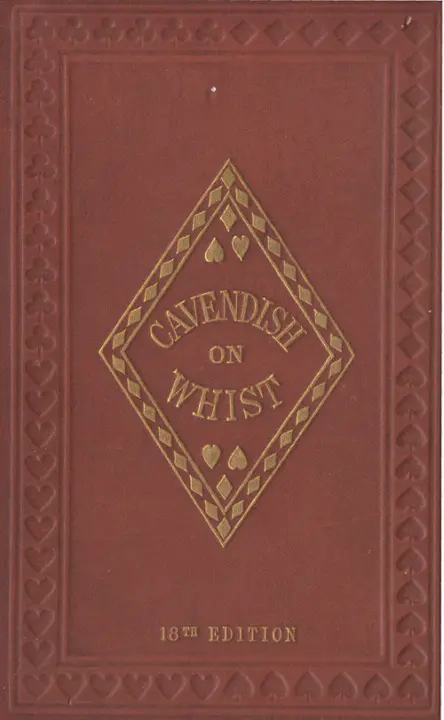
"The Laws and Principles of Whist Stated and Explained" by Cavendish is a comprehensive treatise on the card game Whist, written in the late 19th century. This work aims to address common deficiencies in existing texts about Whist by providing not just the rules, but also valuable principles behind the gameplay, including strategic illustrations through complete hands. It serves both novices and seasoned players seeking to improve their understanding of the game. The opening of the book features an illustrated frontispiece and dedicates itself to the historical context of Whist, followed by a preface explaining the author's intentions. The author notes that existing materials often present principles as arbitrary conventions without adequate justification, which this work seeks to remedy. The preface encourages readers to familiarize themselves with the fundamental rules of play before delving into the principles outlined in the book, effectively setting the stage for a detailed exploration of Whist’s mechanics and strategic concepts.
Introduction adapted from the source catalogue; source summaries may be automatically generated.
Free to read · English · 56,826 words · No account needed
MAKE TIME FOR A GOOD BOOK
On by default. Untick to stop anonymous reading totals. Each page counts after 10 seconds in view. How this works.
Anonymous counting is on unless you have switched it off.
When ace is led from ace and four or more small cards, after leading the ace, lead the original fourth-best, i.e., the card you would have led if opening with a small card. Thus, in trumps, with ace, knave, nine, eight, seven, an advanced player would begin the eight. In plain suits, the ace would be first led. The second lead of an American Leader would be the eight, the original fourth-best, and not the seven.
By following this method, you inform your partner that you invariably remain with exactly two cards higher than the second card led, as shown by the following tabulated example:--
Lead| |Then|
From Ace,| Knv, 9,| 8, | 7
" Ace,| Knv, 9,| 8, | 7, 5
" Ace,| Knv, 9,| 8, | 7, 5, 3
" Ace,| Knv, 9,| 8, | &c., &c., &c.
By leading in this way you not infrequently tell your partner what your remaining high cards are. Thus, with the above combination, if king, queen come out on the second round, and your partner holds the ten, he knows to a certainty that you command the suit, a fact about which he would have been in doubt had you continued with the lowest.
The same rule, when a high card is followed by a low card, applies to king led from king, queen, and small ones, when the king wins the trick; and to ten, led from king, knave, ten and one or more small ones, when the ten wins the trick. These are all the possible cases. With king, knave, ten, nine, if the nine wins the first trick, the leader goes on with a high card.
When you remain with TWO HIGH INDIFFERENT CARDS, lead the HIGHER if you opened a SUIT OF FOUR; THE LOWER if you opened a SUIT OF FIVE or more. (See Analysis of Leads in Detail, p. 64).
The typical example is the combination of ace, queen, knave, and one or more small cards. With four in suit, ace, then queen is led. But with more than four in suit, the knave is led after the ace, because then, if your partner remains with king and one small card, you are strong enough to invite him to win your trick in order to unblock your long suit.
In the same way, if queen is led from queen, knave, ten and small, you proceed with the knave, holding only ten and one small. But, with knave, ten and more than one small, you continue with the ten, the lower of two indifferent high cards, to induce your partner to win it, and so to unblock your suit, should he remain with ace and one small one, or with king and one small one.
Your reading position is saved on this browser. Take it to another device with a library code. Reading pages adapt to text, rather than matching a printed edition.
BEHIND THE BOOK
This eBook is for the use of anyone anywhere in the United States and most other parts of the world at no cost and with almost no restrictions whatsoever. You may copy it, give it away or re-use it under the terms of the Project Gutenberg License included with this eBook or online at www.gutenberg.org. If you are not located in the United States, you will have to check the laws of the country where you are located before using this eBook. Read the source licence.
The original source file, including credits and licence, is retained by this library. Request an original-format copy at no charge. Please include the book title and Project Gutenberg identifier #51039.
KEEP YOUR CURIOSITY GOING
Charles G. (Charles Griffith) Ross
Hannah Webster Foster

Emily Lawless
Edwin Hamlin Carr

Charles De Lano Hine
Andrew Ure