
The Writing of News A Handbook with Chapters on Newspaper Correspondence and Copy Reading
Charles G. (Charles Griffith) Ross
THE CLASSIC COLLECTION · 1864
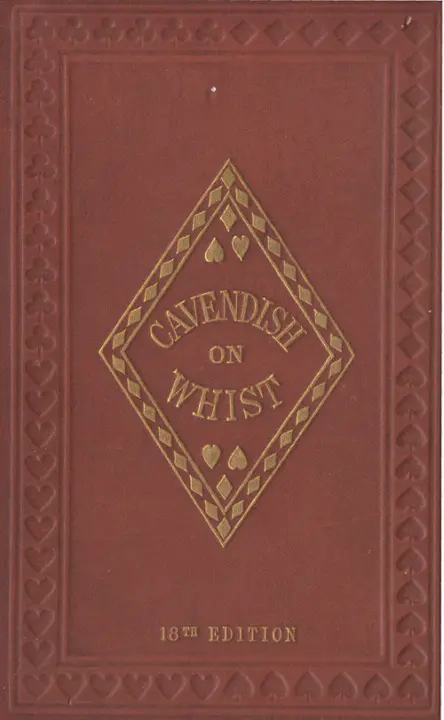
"The Laws and Principles of Whist Stated and Explained" by Cavendish is a comprehensive treatise on the card game Whist, written in the late 19th century. This work aims to address common deficiencies in existing texts about Whist by providing not just the rules, but also valuable principles behind the gameplay, including strategic illustrations through complete hands. It serves both novices and seasoned players seeking to improve their understanding of the game. The opening of the book features an illustrated frontispiece and dedicates itself to the historical context of Whist, followed by a preface explaining the author's intentions. The author notes that existing materials often present principles as arbitrary conventions without adequate justification, which this work seeks to remedy. The preface encourages readers to familiarize themselves with the fundamental rules of play before delving into the principles outlined in the book, effectively setting the stage for a detailed exploration of Whist’s mechanics and strategic concepts.
Introduction adapted from the source catalogue; source summaries may be automatically generated.
Free to read · English · 56,826 words · No account needed
MAKE TIME FOR A GOOD BOOK
On by default. Untick to stop anonymous reading totals. Each page counts after 10 seconds in view. How this works.
Anonymous counting is on unless you have switched it off.
REMARK (Trick 3).--Y is justified in playing a forward game. He has four trumps (see pp. 122, 123), ace of the opponent's suit, and a fine heart suit: and his partner has declared strength in diamonds by choosing that suit for his original lead.
REMARK (Trick 6).--Y is justified in playing a false card here, notwithstanding General Principle 12 (p. 108). The heart is a forced lead, and the card led (the ten) is obviously A's best. Y's scheme is to take another round of trumps, and then to underplay in hearts (see p. 101); so he puts on the ace to deceive B as to the position of the king.
TRICKS 9 to 13.--Z leads the king of clubs, to which Y discards the two of diamonds. Z then leads the knave of hearts, on which Y puts the king; the queen falls (see the hands below); Y brings in the hearts; and
YZ win five by cards.
(Y's hand is given above.)
A'S HAND. | B'S HAND. | Z'S HAND. Ace, Kg, 5 ♠|9, 8, 6 ♠|Qn, 4, 2 ♠ 10, 2 ♡|Qn, 7, 4 ♡|Knv, 9, 3 ♡ Knv, 8, 7, 6, 5 ♣|10, 9, 2 ♣|Kg, Qn, 4 ♣ Ace, 8, 6 ♢|10, 9, 7, 3 ♢|Qn, Knv, 5, 4 ♢
A and B both play the hand badly. At Trick 6, A, in the face of an adverse trump lead and the command of his suit (clubs) against him, should lead the ace of diamonds to make the third trick and save the game. At Trick 8, B should put on his queen of hearts. He is fairly taken in by Y's dark play at Trick 6; but he ought not to have allowed himself to be so. He should have argued that Y, who has been playing a very strong game, would not be likely to put on ace second hand merely for the purpose of getting the lead or of making sure of a trick. Further, if A's lead was a forced one, from weakness (hearts being the only suit in which B can be strong), Z is sure to finesse if he has king, knave, or even king, nine. So B's best chance of making the queen is to put it on (see p. 102).
Defensive trump lead, and playing to the score.
REMARK (Trick 1).--A defensive trump lead, to avoid opening a three
card suit.
REMARK (Trick 4).--A's finesse is unlucky. He is, however, clearly justified in not parting with the command of trumps, as, even if the finesse does not succeed, he remains with the last trump, will be led up to in one of his guarded suits, and will, in all probability, bring in his partner's diamonds.
TRICKS 9 to 13.--A leads the queen of diamonds, and finds his partner with the entire command of diamonds (see B's hand below).
Your reading position is saved on this browser. Take it to another device with a library code. Reading pages adapt to text, rather than matching a printed edition.
BEHIND THE BOOK
This eBook is for the use of anyone anywhere in the United States and most other parts of the world at no cost and with almost no restrictions whatsoever. You may copy it, give it away or re-use it under the terms of the Project Gutenberg License included with this eBook or online at www.gutenberg.org. If you are not located in the United States, you will have to check the laws of the country where you are located before using this eBook. Read the source licence.
The original source file, including credits and licence, is retained by this library. Request an original-format copy at no charge. Please include the book title and Project Gutenberg identifier #51039.
KEEP YOUR CURIOSITY GOING
Charles G. (Charles Griffith) Ross
Hannah Webster Foster

Emily Lawless
Edwin Hamlin Carr

Charles De Lano Hine
Andrew Ure