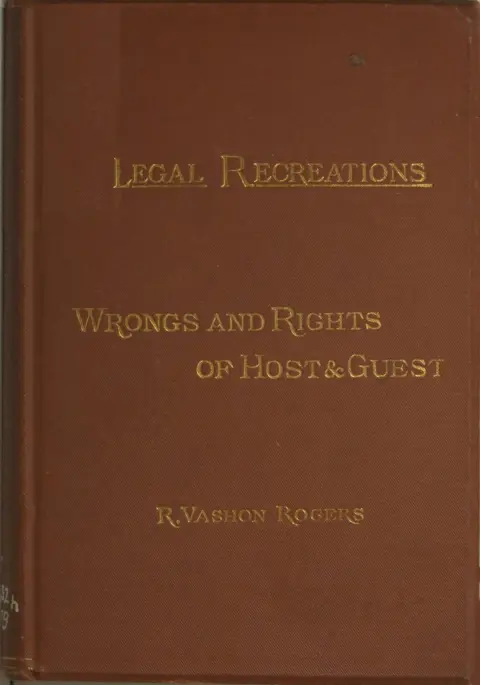
The Law of Hotel Life; or, the Wrongs and Rights of Host and Guest
R. Vashon (Robert Vashon) Rogers
THE CLASSIC COLLECTION · 1876
"The Law of the Road; or, Wrongs and Rights of a Traveller" by R. Vashon Rogers is a humorous legal guide that explores the rights and liabilities of travelers, especially concerning transport via carriages and railroads, written in the late 19th century. The text aims to provide both entertainment and practical legal knowledge to everyday travelers while blending elegant extracts from legal literature with amusing anecdotes. The opening of the work sets the scene on New Year's Day, where the protagonist, Eldon, finds himself in a series of comedic legal dilemmas caused by his reckless servant John, who causes various accidents while driving. Through a lively conversation with his wife, Elizabeth, Eldon delves into legal principles concerning liability for the actions of servants, rights of pedestrians, and the peculiarities of driving on Sundays. The narrative employs wit and a conversational tone to discuss legalities, providing readers not only insights into the law of the roads but also engaging them with relatable domestic humor.
Introduction adapted from the source catalogue; source summaries may be automatically generated.
Free to read · English · 66,834 words · No account needed
MAKE TIME FOR A GOOD BOOK
On by default. Untick to stop anonymous reading totals. Each page counts after 10 seconds in view. How this works.
Anonymous counting is on unless you have switched it off.
“But,” said the lady, who during the delivery of the judgment had time to recover her senses and her ticket, “but my friend here could vouch for me that I spoke the truth.”
“Ah, my dear madam, do not deceive yourself; reflect that in Massachusetts it was decided that if carriers require passengers to buy tickets before going on board, and to deliver them up on going off, and the passenger loses his ticket, he must on landing pay again;[347] and in Curtis v. G. T. R. Co.,[348] that ornament of the Canadian bench, Draper, C. J., remarked that he supposed that a man who produced no ticket, but asserted that he had paid his fare and had lost his ticket and therefore declined to pay again, would--though a by-stander corroborated the assertion--be deemed refusing to pay, within the meaning of the Acts.”
“I do not see what the Acts have to do with it. I never saw anything about such things in the Acts,” said the lady, getting rather puzzled over the matter.
“What, madam, do you read such things? I should have imagined that a fair creature like yourself would have found them too dry to read.”
“No sir; I am a member of the association of the Church of the New Jerusalem, and I read the Acts of the Apostles as well as every other part of the Bible,” eagerly responded the lady.
Amid broad smiles, giggling he-hes, hearty ha-has, guffawing ho-hos, the Q. C. hastened to explain.
“Oh, my dear madam, I meant no allusion to Holy Writ; I meant 31 Vic., chapter 68, commonly called the Railway Act of 1868, which says at section 20: ‘Any passenger refusing to pay the fare, may by the conductor of the train and the servants the company be put off the cars, with his luggage, at any usual stopping-place, or near any dwelling-house, as the conductor elects, the conductor first stopping the train and using no unnecessary force.’”
[313] Great Northern Rw. v. Shepherd, 8 Ex. 30.
[314] Jordan v. Fall River Rw., 5 Cush. 69.
[315] Orange County Bank v. Brown, 9 Wend. 85; Weed v. Saratoga & Sch. Rw., 19 Wend. 534; Duffy v. Thompson, 4 E. D. Smith, 178.
[316] Osborn v. Gillett, L. R., 8 Ex. 92.
[317] Deedes v. Graham, 20 Grant, 258, 270.
[318] Grant v. Newton, 1 E. D. Smith, 95; Chicago and Aurora Rw. v.
Thompson, 19 Ill. 578.
[319] Red on Railways, vol. ii., pp. 56-58.
[320] Camden & Amboy Rw. v. Baldauf, 16 Penn. St. (4 Harris), 67; see also Walker v. Jackson, 10 M. & W. 161, as to not inquiring contents, and Crouch v. L. & N. W. Rw., 14 C. B. 255, as to right to inquire.
[321] Butterworth v. Brownlow, 34 L. J. C. P. 267.
[322] Gibbon v. Paynton, 4 Burr. 2298.
[323] Clay v. Willan, 1 H. B. 298.
[324] Bradley v. Waterhouse, 3 C. & P. 318.
[325] Batson v. Donavan, 4 B. &. Ald. 37.
Your reading position is saved on this browser. Take it to another device with a library code. Reading pages adapt to text, rather than matching a printed edition.
R. Vashon (Robert Vashon) Rogers
BEHIND THE BOOK
This eBook is for the use of anyone anywhere in the United States and most other parts of the world at no cost and with almost no restrictions whatsoever. You may copy it, give it away or re-use it under the terms of the Project Gutenberg License included with this eBook or online at www.gutenberg.org. If you are not located in the United States, you will have to check the laws of the country where you are located before using this eBook. Read the source licence.
The original source file, including credits and licence, is retained by this library. Request an original-format copy at no charge. Please include the book title and Project Gutenberg identifier #69664.
KEEP YOUR CURIOSITY GOING
Wilfrid Scawen Blunt
Wilfrid Scawen Blunt

E. W. (Edgar Watson) Howe
Francis Greenleaf Allinson & Anne C. E. (Anne Crosby Emery) Allinson
Cyrenus Cole

John Martineau