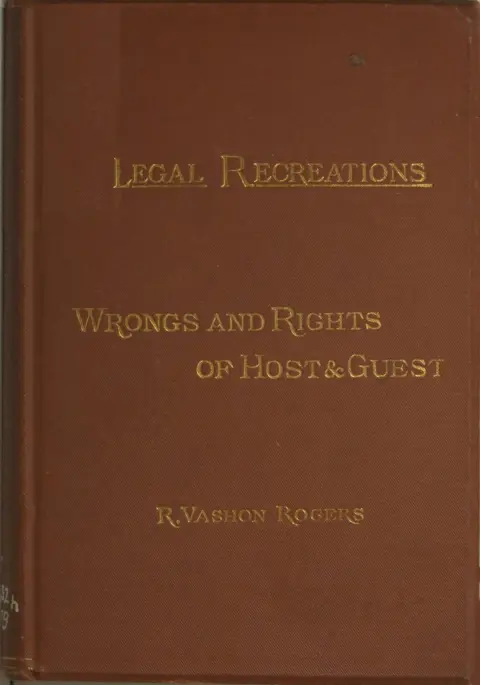
The Law of Hotel Life; or, the Wrongs and Rights of Host and Guest
R. Vashon (Robert Vashon) Rogers
THE CLASSIC COLLECTION · 1876
"The Law of the Road; or, Wrongs and Rights of a Traveller" by R. Vashon Rogers is a humorous legal guide that explores the rights and liabilities of travelers, especially concerning transport via carriages and railroads, written in the late 19th century. The text aims to provide both entertainment and practical legal knowledge to everyday travelers while blending elegant extracts from legal literature with amusing anecdotes. The opening of the work sets the scene on New Year's Day, where the protagonist, Eldon, finds himself in a series of comedic legal dilemmas caused by his reckless servant John, who causes various accidents while driving. Through a lively conversation with his wife, Elizabeth, Eldon delves into legal principles concerning liability for the actions of servants, rights of pedestrians, and the peculiarities of driving on Sundays. The narrative employs wit and a conversational tone to discuss legalities, providing readers not only insights into the law of the roads but also engaging them with relatable domestic humor.
Introduction adapted from the source catalogue; source summaries may be automatically generated.
Free to read · English · 66,834 words · No account needed
MAKE TIME FOR A GOOD BOOK
On by default. Untick to stop anonymous reading totals. Each page counts after 10 seconds in view. How this works.
Anonymous counting is on unless you have switched it off.
“I think that it was in that case that Chief Justice Macaulay remarked, that the accident having happened unaccountably, and without any proximate or active cause to account for it, constituting as the cases say some evidence of negligence, it rested with the company to explain and reconcile it with perfect innocence on their part. It has been held, too, in England, that the plaintiff is not bound to show specifically in what the negligence of the company consisted; but that if some inevitable fatality caused the accident, it is for the company to prove it.[492] In New York, too, the same view is taken.”[493]
“Wal, stranger, what is yer law about this yer in the old country? Not that I care three shakes of a dead possum’s tail about the old country, and all yer lawyers and judges with their horse-tail wigs, but still I calkerlate I kind o’ like to know what they do say on this here point; as it appears to me that the great Amerikin eagle has got rather mixed up.” And to add emphasis to his query, our friend of the land of wooden nutmegs fired from between his teeth a perfect feu de joie of extract of nicotine.
Thus appealed to, I cleared my throat, pulled up my shirt-collar, crossed my legs, assumed as authoritative an expression of countenance as Dame Nature ever permits me to do, and thus began:--
“So long ago as the days of Sir James Mansfield it was held[494] that there is a decided difference between a contract to carry goods and one to carry passengers. In the former case the carrier is liable for his freight in any event, but he does not warrant the safety of his passengers. His undertaking as to them extends no further than this, that as far as human care and foresight can go he will provide for their safe conveyance. So, if the breaking of a coach is purely accidental the injured traveller will have no remedy for the misfortune he has encountered. The contract made by a general carrier of passengers is to take due care to carry his living freight safely; and it does not amount to a warranty that the carriage or car shall be in all respects perfect for its purpose, i. e., free from all defects likely to cause a catastrophe, although those defects were such that no skill, care, or foresight could have detected their existence.[495] The obligation to use all due and proper care is founded on reasons obvious to any one with a semi-optic; but to impose on the carrier the burden of a warranty that everything he necessarily uses is absolutely without spot or blemish and free from defects likely to cause peril--when from the nature of things defects must exist which no skill can detect, and the effects of which no care or foresight can avert--would be to compel a man by implication of law and not by his own will to promise the performance of an impossible thing, and would be directly opposed to the maxims of law, ‘Lex non cogit ad impossibilia,’ ‘Nemo tenetur ad impossibilia.’ [Here the audience coughed.] ‘Due care,’ however, undoubtedly means (having reference to the nature of the contract to carry) a high degree of care, and casts on carriers the duty of exercising all vigilance to see that whatever is required for the safe conveyance of their passengers is in fit and proper order. But the duty to take due and proper care, however widely construed, however vigorously enforced, will not, as that man Readhead sought to do, subject a railway company to the plain injustice of being compelled by law to make reparation for a disaster arising from a latent defect in the machinery which they are obliged to use, which no human skill or care could have prevented or detected, or eye descried unless of ‘the patent double million magnifyin’ gas microscopes of hextra power kind’ to which Mr. Weller, Jr., refers. In that case, the accident was caused by the breaking of the tire of one of the wheels of the carriage, owing to a latent defect in it, which was not attributable to any fault on the part of the manufacturers, nor was it discoverable previously to the breakage. The rule laid down in that case (Readhead’s) seems to be that although the carrier of passengers may be responsible for deficiencies caused by want of skill or care in the manufacture of the carriages used, he is not to be so held when the defect could not have been avoided in the making, or detected on examination. It is so extremely improbable that such a case should happen, that the practical difference between this and the New York rule of absolute responsibility[496] is not of much importance, although the theoretical difference is. But the rule in New York does not seem to be fully approved of even on this side of the Atlantic.[497] The truth seems to be that carriers of persons must be held to the utmost degree of care, vigilance, and precaution, but not to such a degree of vigilance as would be wholly inconsistent with the mode of conveyance adopted and render it impracticable. Nor is the utmost degree of care which the human mind is capable of imagining required. Such a rule would require such an expenditure of money and employment of hands so as to render everything safe, as would prevent all persons of ordinary prudence from engaging in that kind of business. But the rule does necessitate that the highest degree of practicable care and diligence that is consistent with the mode of transportation adopted, should be used.”[498]
Your reading position is saved on this browser. Take it to another device with a library code. Reading pages adapt to text, rather than matching a printed edition.
R. Vashon (Robert Vashon) Rogers
BEHIND THE BOOK
This eBook is for the use of anyone anywhere in the United States and most other parts of the world at no cost and with almost no restrictions whatsoever. You may copy it, give it away or re-use it under the terms of the Project Gutenberg License included with this eBook or online at www.gutenberg.org. If you are not located in the United States, you will have to check the laws of the country where you are located before using this eBook. Read the source licence.
The original source file, including credits and licence, is retained by this library. Request an original-format copy at no charge. Please include the book title and Project Gutenberg identifier #69664.
KEEP YOUR CURIOSITY GOING
Wilfrid Scawen Blunt
Wilfrid Scawen Blunt

E. W. (Edgar Watson) Howe
Francis Greenleaf Allinson & Anne C. E. (Anne Crosby Emery) Allinson
Cyrenus Cole

John Martineau