THE CLASSIC COLLECTION✦The WebCLASSIC FREE BOOKS
The Web
Emerson Hough
THE CLASSIC COLLECTION · 1904
"The Law of the Land" by Emerson Hough is a novel written in the early 20th century. The story likely explores themes of societal change and individual agency set against the backdrop of the Southern United States. The narrative introduces us to central characters, including Miss Lady, a vibrant young woman navigating her identity, and John Eddring, a gentleman from the South, whose lives intertwine amid emerging social dynamics. The opening of the novel paints a picture of the genteel life at an old Southern plantation, inviting readers into the world of Miss Lady as she dances, filled with youthful exuberance. However, this idyllic setting is soon disrupted by the arrival of her mother, who hints at the pressures and expectations facing young women like Miss Lady. As the chapter unfolds, the story shifts between the domestic sphere and the broader implications of change brought about by the railroad's arrival, which symbolizes modernity intruding on traditional life. Eddring's presence and his profession suggest that the narrative will delve into the complexities and conflicts arising from these societal transformations, hinting at deeper questions of fate, choice, and the negotiation between personal desires and social responsibilities.
Introduction adapted from the source catalogue; source summaries may be automatically generated.
Free to read · English · 88,048 words · No account needed
MAKE TIME FOR A GOOD BOOK
On by default. Untick to stop anonymous reading totals. Each page counts after 10 seconds in view. How this works.
Anonymous counting is on unless you have switched it off.
"Well, now, Sar' Ann," said he, "the Cunnel done tol' me hit was all right. He said some of ouah stock like enough git kilt, 'cause you know these heah bottoms is growed up so close like, with cane an' all that, that any sort of critters like to git out where it's open, so's they kin sort o' look around like, you know. Why, I done seen four deer trails whils' we was a-comin' up this mawnin', and I seen whah a b'ah had come out an' stood on the track. Now, as fer cows, an' as fer niggers, why, it stands to reason that some of them is shore goin' to git kilt, that's all."
"An' you men is goin' to stand that from the railroad? Why don't you make them pay for whut gits kilt?"
"Well, now, Sar' Ann," said her husband, conciliatorily, "that's just whut I was goin' to say. The time the fust man come down through heah to talk about buildin' the railroad, he done said, like I tol' you Cunnel Blount said, that we might git some stock kilt fer a little while, till things kind o' got used to it, you know; but he 'lowed that the railroad would sort o' pay for anything that got kilt like, you know."
"Pay! The railroad goin' to pay you!" Again the remorseless sunbonnet followed its victim and fixed him with its focus. "Pay you! I didn't notice no money layin' on the track where we come along this mawnin', did you? Yes, I reckon it's goin' to pay you, a whole heap!" The scorn of this utterance was limitless, and Jim Bowles felt his insignificance in the untenable position which he had assumed.
"Well, I dunno," said he, vaguely, and sighed softly; all of which irritated Mrs. Bowles to such an extent that she flounced suddenly around to get a better gaze upon her master. In this movement, her foot struck the pail of milk which had been sitting near, and overturned it.
"Jinny," she called out, "you, Jinny!"
"Yassam," replied Jinny, from some place on the gallery.
"Come heah," said Mrs. Bowles. "Git me another pail o' melk. I done
spilled this one."
"Yassam," replied Jinny, and presently returned with the refilled
vessel.
"Well, anyway," said Jim Bowles at length, rising and standing with hands in pockets, inside the edge of the shade line of the evergreens, "I heard that thah was a man come down through heah a few days ago. He was sort of takin' count o' the critters that done got kilt by the railroad kyahs."
"That so?" said Sarah Ann, somewhat mollified.
Your reading position is saved on this browser. Take it to another device with a library code. Reading pages adapt to text, rather than matching a printed edition.
Emerson Hough
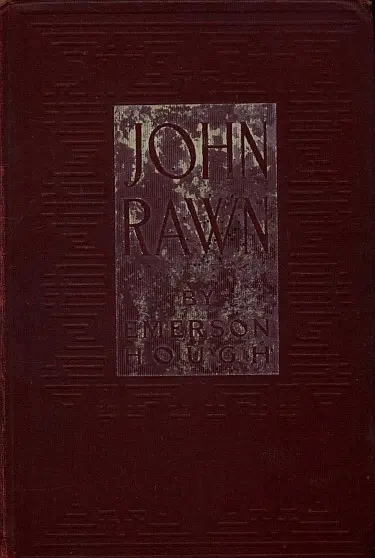
Emerson Hough
Emerson Hough
Emerson Hough
BEHIND THE BOOK
This eBook is for the use of anyone anywhere in the United States and most other parts of the world at no cost and with almost no restrictions whatsoever. You may copy it, give it away or re-use it under the terms of the Project Gutenberg License included with this eBook or online at www.gutenberg.org. If you are not located in the United States, you will have to check the laws of the country where you are located before using this eBook. Read the source licence.
The original source file, including credits and licence, is retained by this library. Request an original-format copy at no charge. Please include the book title and Project Gutenberg identifier #6431.
KEEP YOUR CURIOSITY GOING
Coulson Kernahan

Maurice Baring
Frances Wright
Cécile Tormay

Frederic Jesup Stimson

W. H. P. (William Henry Pope) Jarvis