THE CLASSIC COLLECTION✦The law of the road; or, wrongs and rights of a travellerCLASSIC FREE BOOKS
The law of the road; or, wrongs and rights of a traveller
R. Vashon (Robert Vashon) Rogers
THE CLASSIC COLLECTION · 1879
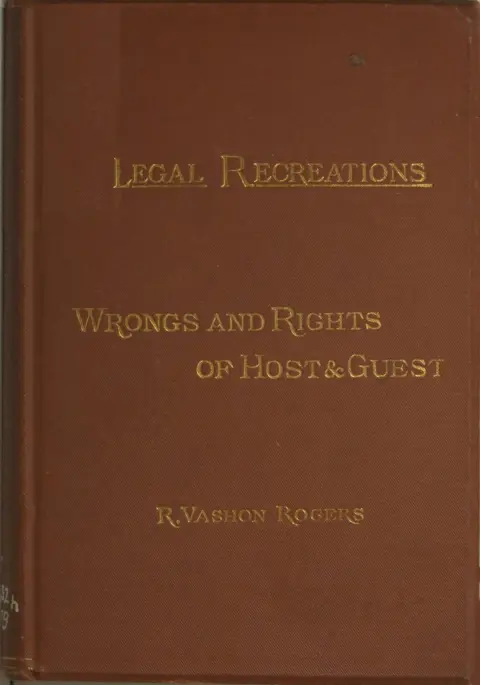
"The Law of Hotel Life; or, the Wrongs and Rights of Host and Guest" by R. Vashon Rogers Jr. is a satirical narrative written in the late 19th century. The text explores the experiences of a newlywed couple as they navigate the unconventional and often comical landscape of hospitality laws and innkeeping. Through their various encounters with innkeepers and other guests, it seems the book will delve into the rights and responsibilities of both hosts and guests in the context of accommodations. At the start of the narrative, we are introduced to a married couple embarking on their honeymoon, who plan to stay at a village inn. Their enthusiasm is quickly tempered by the stark reality of their accommodations, which are far from luxurious. The husband, a lawyer, educates his wife on historical and legal aspects of inns and hotels while they encounter rude innkeepers, unsatisfactory food, and various unpleasantries that bring humor and irony to their situation. The couple's discussions highlight the legal implications of hospitality, while also portraying their personal experiences filled with quirks and misunderstandings, setting the stage for further exploration of the intrinsic laws that govern hotel life.
Introduction adapted from the source catalogue; source summaries may be automatically generated.
Free to read · English · 51,591 words · No account needed
MAKE TIME FOR A GOOD BOOK
On by default. Untick to stop anonymous reading totals. Each page counts after 10 seconds in view. How this works.
Anonymous counting is on unless you have switched it off.
Our return drive was as pleasant as that of the preceding day, except that we might well have exclaimed, in the words of the poet:
“How the dashed dry dust,
Nebulous nothing,
Nettled our nasal
Nostrils, you noodles!”
En route, we stopped at a little wayside inn for luncheon. On the table the pièce de resistance was beefsteak.
“I never,” observed De G., “see beefsteak but I think of poor old George
III.”
“Had he a particular penchant for it?” I asked.
“Not that. But once, when his intellect was sadly clouded, he was breakfasting at Kew, and the conversation turned on the great scarcity of beef in England. ‘Why don’t the people plant more beef?’ asked his majesty. Of course he was told that beef could not be raised from seed or slips; but he seemed incredulous, and, taking some pieces of steak, he went out into the garden and planted them. Next morning he visited the spot to see if the beef had sprouted, and finding some snails crawling about, he took them for small oxen, and joyfully exclaimed to his wife: ‘Here they are; here they are, Charlotte--horns and all!’”
“Poor fellow--poor fellow!”
By and by, apple dumplings appeared. “Ha!” I exclaimed, “here are more reminders of the poor old king! How his Britannic majesty used to puzzle over the problem of how the apples got inside the pastry.”
“The Chinese cooks would have bewildered him still more with some of their ingenious performances,” remarked De Gex.
“In what respect?” queried the ladies.
“At a recent banquet in San Francisco, an orange was placed beside the plate of each guest. The fruit, to an ordinary observer, appeared like any other oranges; but, on being cut open, they were found to contain, mirabile dictu----”
“What?” asked my wife.
“Excuse me, I should not have quoted Latin. They were found to contain five different kinds of delicate jellies. Of course, every one was puzzled, first of all, to find how the jelly got in; and giving up that as a conundrum too difficult to be solved, he found himself in a worse quandary over the problem as to how the pulpy part of the orange got out. Colored eggs were served up, and inside of them were found nuts, jellies, meats, and confectionery.”
“Wonderful men those Celestials!” I exclaimed. “They must have got such notions from the banqueting table of Jove himself.”
“I thought they indulged in nothing nicer than cats or dogs, rats or mice, with an occasional dash of bird’s-nest soup,” said Mrs. De Gex.
“Altogether a mistaken notion,” returned her husband.
Your reading position is saved on this browser. Take it to another device with a library code. Reading pages adapt to text, rather than matching a printed edition.
BEHIND THE BOOK
This eBook is for the use of anyone anywhere in the United States and most other parts of the world at no cost and with almost no restrictions whatsoever. You may copy it, give it away or re-use it under the terms of the Project Gutenberg License included with this eBook or online at www.gutenberg.org. If you are not located in the United States, you will have to check the laws of the country where you are located before using this eBook. Read the source licence.
The original source file, including credits and licence, is retained by this library. Request an original-format copy at no charge. Please include the book title and Project Gutenberg identifier #66992.
KEEP YOUR CURIOSITY GOING
Coulson Kernahan

Maurice Baring
Frances Wright
Cécile Tormay

Frederic Jesup Stimson

W. H. P. (William Henry Pope) Jarvis