THE CLASSIC COLLECTION✦The law of the road; or, wrongs and rights of a travellerCLASSIC FREE BOOKS
The law of the road; or, wrongs and rights of a traveller
R. Vashon (Robert Vashon) Rogers
THE CLASSIC COLLECTION · 1879
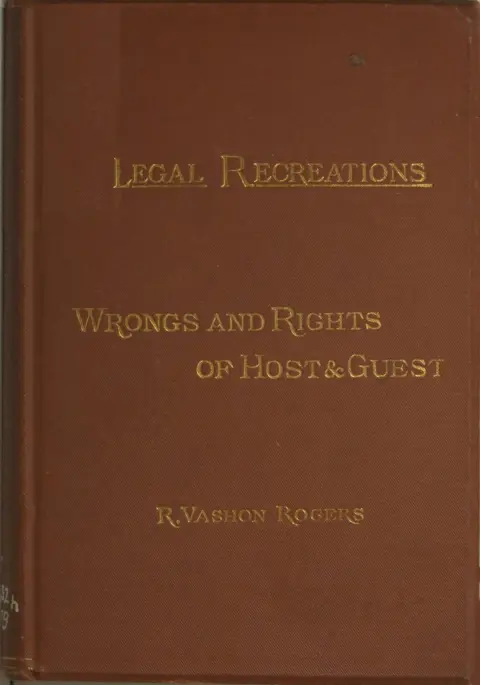
"The Law of Hotel Life; or, the Wrongs and Rights of Host and Guest" by R. Vashon Rogers Jr. is a satirical narrative written in the late 19th century. The text explores the experiences of a newlywed couple as they navigate the unconventional and often comical landscape of hospitality laws and innkeeping. Through their various encounters with innkeepers and other guests, it seems the book will delve into the rights and responsibilities of both hosts and guests in the context of accommodations. At the start of the narrative, we are introduced to a married couple embarking on their honeymoon, who plan to stay at a village inn. Their enthusiasm is quickly tempered by the stark reality of their accommodations, which are far from luxurious. The husband, a lawyer, educates his wife on historical and legal aspects of inns and hotels while they encounter rude innkeepers, unsatisfactory food, and various unpleasantries that bring humor and irony to their situation. The couple's discussions highlight the legal implications of hospitality, while also portraying their personal experiences filled with quirks and misunderstandings, setting the stage for further exploration of the intrinsic laws that govern hotel life.
Introduction adapted from the source catalogue; source summaries may be automatically generated.
Free to read · English · 51,591 words · No account needed
MAKE TIME FOR A GOOD BOOK
On by default. Untick to stop anonymous reading totals. Each page counts after 10 seconds in view. How this works.
Anonymous counting is on unless you have switched it off.
“My husband, remember
‘Brevity’s the soul of wit,
And tediousness the limbs and outward flourishes,’
and be brief. How can my poor brain hold all that you have said?”
“Don’t be alarmed, my dear, there is doubtless plenty of room in your brain yet. But I was going on to say that though there is a tendency in these degenerate days to lessen the great responsibility once imposed upon these publicans and sinners, and to insist upon greater care on the part of the guests, still statutes limiting the common-law liability of innkeepers should not be extended to include property not fairly within the terms of the acts. Where, for instance, as in the New York act, money, jewels, or ornaments are exempted, then all property of a different kind, including all things useful and necessary for the comfort and convenience of the guest--all things usually carried and worn as part of the ordinary apparel and outfit, as well as all things ordinarily used or suitable to be used by travelers in doors or out, are left in statu quo ante the statute.”
“And what may that be?” asked Mrs. L.
“At the risk of the innkeeper.”[191]
“But would not a watch be considered a jewel or an ornament?”
“The law is very watchful--”
“Very watchful, indeed, when it has so many watch cases that it considers pretty little Genevas neither jewels nor ornaments,” murmured my wife sotto voce.
“The law is very watchful,” I went on, “over benighted travelers, and has decided that it is not;[192] nor is a watch and chain,[193] although, by the way, the Wisconsin judges have decided that an innkeeper is not liable for the loss of a silver or a gold watch not handed over for safe keeping, their act speaking of articles of gold and silver manufacture.[194] The exemption is intended to apply only to such an amount of money and to such jewels and ornaments or valuables, as the landlord himself, if a prudent person and traveling, would put in a safe (if convenient) when retiring at night. No one, possessed of half a grain of that scarce commodity, common sense, would suppose that it was the intention of the act to exempt the hotel proprietors from their old common-law liability, unless the traveler emptied his pockets of every cent of money and deposited it, with his watch and pencil-case, in the safe, for perchance he might want these identical articles ere sweet sleep his eyelids closed.[195] If, however, the innkeeper has complied with the requirements of the act, he is not liable for jewelry stolen from the bedroom, even though the guest has not been guilty of negligence, provided he has had time and opportunity to make the deposit.[196] My old friend, Mrs. Rosenplanter, was terribly unfortunate in this respect. In July, 1863, she and her worthy spouse were en route from Trenton Falls to Saratoga, and arrived at the Delavan House, Albany, at three in the afternoon. As dinner was on the table, they at once dressed and went to dine. In about twenty minutes they returned to their room and found that in the meantime their trunk had been broken open and $300 worth of jewelry taken out. My friend sued the proprietor, but the court ungallantly considered that she had had sufficient time and opportunity to make the deposit, (though she had not been there an hour) and so could not recover; although the judge admitted that no person, under such circumstances, would have been likely to have handed over his valuables to the innkeeper, and that there must always be a brief period after the arrival of a guest before he can make the deposit, and that during those golden moments the statute affords the publican no protection. And, by the way, I remember that in this case the court seemed to think that if a guest, on retiring for the night, removes a watch or jewelry from his person, or leaves money in his pocket, and neglects to deposit the same in the safe, the hotel-keeper, if he has complied with the act, is exempt from all liability in case of loss.”[197]
Your reading position is saved on this browser. Take it to another device with a library code. Reading pages adapt to text, rather than matching a printed edition.
BEHIND THE BOOK
This eBook is for the use of anyone anywhere in the United States and most other parts of the world at no cost and with almost no restrictions whatsoever. You may copy it, give it away or re-use it under the terms of the Project Gutenberg License included with this eBook or online at www.gutenberg.org. If you are not located in the United States, you will have to check the laws of the country where you are located before using this eBook. Read the source licence.
The original source file, including credits and licence, is retained by this library. Request an original-format copy at no charge. Please include the book title and Project Gutenberg identifier #66992.
KEEP YOUR CURIOSITY GOING
Coulson Kernahan

Maurice Baring
Frances Wright
Cécile Tormay

Frederic Jesup Stimson

W. H. P. (William Henry Pope) Jarvis