THE CLASSIC COLLECTION✦The law of the road; or, wrongs and rights of a travellerCLASSIC FREE BOOKS
The law of the road; or, wrongs and rights of a traveller
R. Vashon (Robert Vashon) Rogers
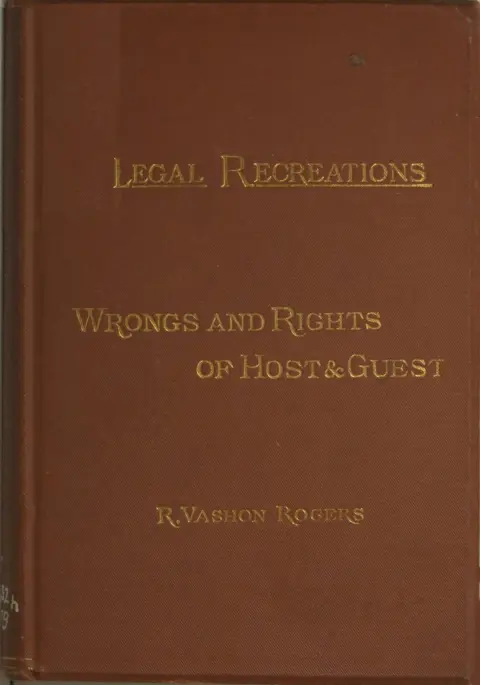
THE CLASSIC COLLECTION · 1879
"The Law of Hotel Life; or, the Wrongs and Rights of Host and Guest" by R. Vashon Rogers Jr. is a satirical narrative written in the late 19th century. The text explores the experiences of a newlywed couple as they navigate the unconventional and often comical landscape of hospitality laws and innkeeping. Through their various encounters with innkeepers and other guests, it seems the book will delve into the rights and responsibilities of both hosts and guests in the context of accommodations. At the start of the narrative, we are introduced to a married couple embarking on their honeymoon, who plan to stay at a village inn. Their enthusiasm is quickly tempered by the stark reality of their accommodations, which are far from luxurious. The husband, a lawyer, educates his wife on historical and legal aspects of inns and hotels while they encounter rude innkeepers, unsatisfactory food, and various unpleasantries that bring humor and irony to their situation. The couple's discussions highlight the legal implications of hospitality, while also portraying their personal experiences filled with quirks and misunderstandings, setting the stage for further exploration of the intrinsic laws that govern hotel life.
Introduction adapted from the source catalogue; source summaries may be automatically generated.
Free to read · English · 51,591 words · No account needed
MAKE TIME FOR A GOOD BOOK
On by default. Untick to stop anonymous reading totals. Each page counts after 10 seconds in view. How this works.
Anonymous counting is on unless you have switched it off.
“What do they consider gaming?” asked a rakish looking individual, who seemed as if he understood practically what it was.
“Playing at any game for money,[161] or beer, or money’s worth;[162] or even exhibiting betting lists.”[163]
“That seems precious hard,” quoth the rake.
“In one case an innkeeper was punished for allowing his own private friends to play at cards for money in his own private room, on the licensed premises.”[164]
“Not much liberty in England,” remarked the youth.
“That was almost as bad as the tavernkeeper who was fined by some energetic Yorkshire magistrate for being drunk in his own bed, in his own house!”[165] observed another.
“Farewell to the fond notion that an Englishman’s house is his castle!” melodramatically exclaimed the youth.
“But please allow me to say that Lust, J., held, in a very recent case, that although an innkeeper, if drunk on his own premises while they are open, is as much amenable to the penalty as if he was found drunk upon the highway, yet it could never have been intended that an innkeeper who is drunk in his own bedroom should be liable any more than a person--not a publican--found drunk in his own private house,”[166] said the Englishman.
“And what, pray, may be the unlawful games which are so strictly forbidden inside the tavern--the poor man’s home?” asked the youth.
“Dice, ace of hearts, faro, basset, hazard, passage, or any game played with dice, or with any instrument, engine, or device in the nature of dice, having figures or numbers thereon, and roulette, or rolly-polly; and bull-baiting, bear-baiting, badger-baiting, dog-fighting, cock-fighting, and all such games, are unlawful,” replied the Englishman.
“Surely, you have not got through the black list yet,” ironically
remarked our rake.
“Those mentioned, and the game of puff and dart, if played for money or money’s worth,[167] and lotteries and sweepstakes, except in cases of art unions, where works of art are given as prizes, are all the games I remember, that are prohibited by the Statutes of Henry VIII, George II, and her present Majesty.”
“May I ask what games you are permitted to indulge in? I do not see that any are left, except the ‘grinning through a halter,’ spoken of in The Spectator, in which highly intellectual and moral contest the rule is
“‘The dreadfullest grinner
To be the winner.’
“Backgammon and all games played upon backgammon boards,[168] quoits, tennis, and all games of mere skill, are perfectly lawful, unless played for money or money’s worth.”[169]
“And what of billiards?”
“Oh, that is not unlawful unless played for money.”[170]
Your reading position is saved on this browser. Take it to another device with a library code. Reading pages adapt to text, rather than matching a printed edition.
BEHIND THE BOOK
This eBook is for the use of anyone anywhere in the United States and most other parts of the world at no cost and with almost no restrictions whatsoever. You may copy it, give it away or re-use it under the terms of the Project Gutenberg License included with this eBook or online at www.gutenberg.org. If you are not located in the United States, you will have to check the laws of the country where you are located before using this eBook. Read the source licence.
The original source file, including credits and licence, is retained by this library. Request an original-format copy at no charge. Please include the book title and Project Gutenberg identifier #66992.
KEEP YOUR CURIOSITY GOING
Coulson Kernahan

Maurice Baring
Frances Wright
Cécile Tormay

Frederic Jesup Stimson

W. H. P. (William Henry Pope) Jarvis