THE CLASSIC COLLECTION✦The Theory of Social RevolutionsCLASSIC FREE BOOKS
The Theory of Social Revolutions
Brooks Adams
THE CLASSIC COLLECTION · 1896
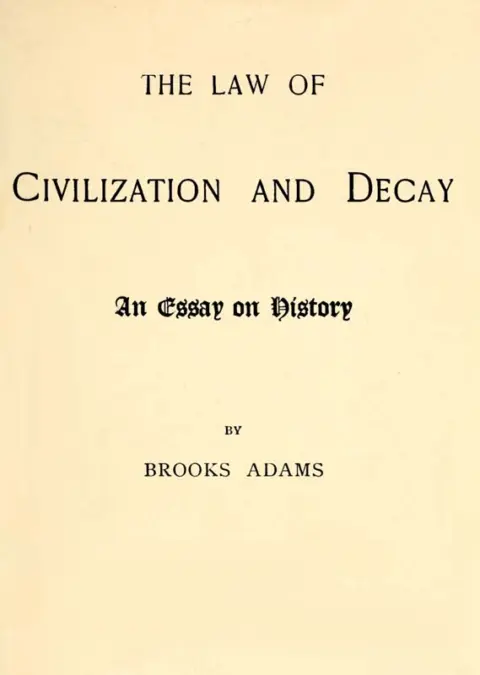
"The Law of Civilization and Decay: An Essay on History" by Brooks Adams is a work of history privately published in 1895. Adams argues that civilizations follow a predictable cycle of rise and fall, driven by economic and social forces. As societies centralize and accelerate through industrialization, imaginative energy transforms into capital accumulation, causing profound shifts in human temperament and power. Through examples spanning from Rome to modern empires, Adams traces how commercial centers migrate and civilizations decay, suggesting that humanity's fate follows iron laws as inevitable as natural selection itself.
Introduction adapted from the source catalogue; source summaries may be automatically generated.
Free to read · English · 107,746 words · No account needed
MAKE TIME FOR A GOOD BOOK
On by default. Untick to stop anonymous reading totals. Each page counts after 10 seconds in view. How this works.
Anonymous counting is on unless you have switched it off.
He was answered with acclamations, and on February 2, 1049, he was enthroned as Leo IX. His first act was to make Hildebrand his minister.
The legend tells of the triumph of Cluny as no historical facts could do. Ten years later, in the reign of Nicholas II., the theocracy made itself self-perpetuating through the assumption of the election of the pope by the college of cardinals, and in 1073 Hildebrand, the incarnation of monasticism, was crowned under the name of Gregory VII.
With Hildebrand’s election, war began. The council of Rome, held in 1075, decreed that holy orders should not be recognized where investiture had been granted by a layman, and that princes guilty of conferring investiture should be excommunicated. The council of the next year, which excommunicated the emperor, also enunciated the famous propositions of Baronius--the full expression of the theocratic idea:--
“That the Roman pontiff alone can be called universal.
“That he alone can depose or reconcile bishops.
“That his legate, though of inferior rank, takes precedence of all bishops in council, and can pronounce sentence of deposition against them.
“That all princes should kiss the pope’s feet alone.
“That he may depose emperors.
“That his judgments can be overruled by none, and he alone can overrule the judgments of all.
“That he can be judged by no one.
“That the Roman Church never has, and never can err, as the
Scriptures testify.
“That by his precept and permission it is lawful for subjects
to accuse their princes.
“That he is able to absolve from their allegiance the subjects
of the wicked.”[97]
The monks had won the papacy, but the emperor still held his secular clergy, and, at the diet of Worms, where he undertook to depose Hildebrand, he was sustained by his prelates. Without a moment of hesitation the enchanter cast his spell, and it is interesting to see, in the curse which he launched at the layman, how the head of monasticism had become identified with the spirit which he served. The priest had grown to be a god on earth.
“So strong in this confidence, for the honour and defence of your Church, on behalf of the omnipotent God, the Father, the Son, and the Holy Ghost, by your power and authority, I forbid the government of the German and Italian kingdoms, to King Henry, the son of the Emperor Henry, who, with unheard-of arrogance, has rebelled against your Church. I absolve all Christians from the oaths they have made, or may make to him, and I forbid that any one should obey him as king.”[98]
Your reading position is saved on this browser. Take it to another device with a library code. Reading pages adapt to text, rather than matching a printed edition.
BEHIND THE BOOK
This eBook is for the use of anyone anywhere in the United States and most other parts of the world at no cost and with almost no restrictions whatsoever. You may copy it, give it away or re-use it under the terms of the Project Gutenberg License included with this eBook or online at www.gutenberg.org. If you are not located in the United States, you will have to check the laws of the country where you are located before using this eBook. Read the source licence.
The original source file, including credits and licence, is retained by this library. Request an original-format copy at no charge. Please include the book title and Project Gutenberg identifier #44908.
KEEP YOUR CURIOSITY GOING

David Patterson (Spirit) Hatch
Cécile Tormay

Moritz Busch
Coulson Kernahan
John L. Ransom

Ralph Waldo Emerson