THE CLASSIC COLLECTION✦The Theory of Social RevolutionsCLASSIC FREE BOOKS
The Theory of Social Revolutions
Brooks Adams
THE CLASSIC COLLECTION · 1896
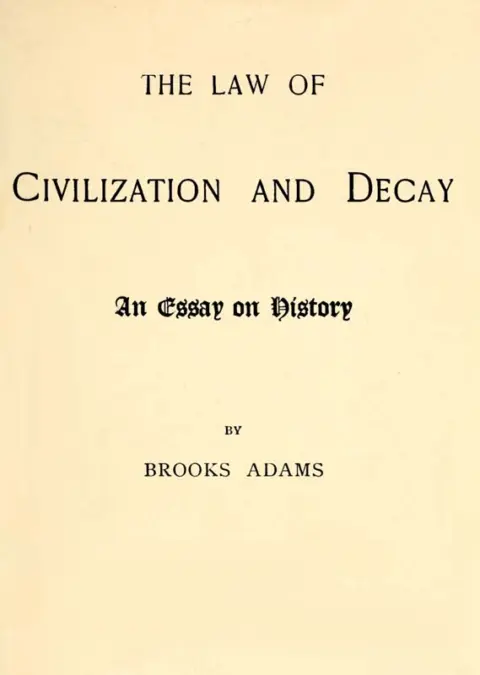
"The Law of Civilization and Decay: An Essay on History" by Brooks Adams is a work of history privately published in 1895. Adams argues that civilizations follow a predictable cycle of rise and fall, driven by economic and social forces. As societies centralize and accelerate through industrialization, imaginative energy transforms into capital accumulation, causing profound shifts in human temperament and power. Through examples spanning from Rome to modern empires, Adams traces how commercial centers migrate and civilizations decay, suggesting that humanity's fate follows iron laws as inevitable as natural selection itself.
Introduction adapted from the source catalogue; source summaries may be automatically generated.
Free to read · English · 107,746 words · No account needed
MAKE TIME FOR A GOOD BOOK
On by default. Untick to stop anonymous reading totals. Each page counts after 10 seconds in view. How this works.
Anonymous counting is on unless you have switched it off.
[394] Études sur l’Histoire de l’Art, Vitet, i. 200.
[395] L’Art de Batir chez les Byzantins, Choisy, 5, 6.
[396] Recherches pour servir à l’Histoire de la Peinture et de la Sculpture Chrétiennes en Orient, Bayet, 99.
[397] Ibid., 99.
[398] Buildings of Justinian, Procopius, trans. by Stewart,
i. 1.
[399] Ibid.
[400] Dictionnaire de l’Architecture, Art. “Peinture.”
[401] Entretiens, i. 102.
Acre: siege of 130;
defence of by Templars 171.
Alaric: served in Roman army 61.
Alexander, Emperor of Russia: breach with Napoleon 324.
Alexis: treats with crusaders 139;
death of 143.
Anastasius: wealth of 51;
builds long wall 51.
Anglicanism, see Church of England.
Antwerp: rise of 201;
centre of exchanges 201;
sack of 287.
Architecture: Italian 88;
Gothic 89;
Byzantine 89;
Saracenic 90;
crusading 100;
Greek and Roman 372;
Byzantine 375 et seq.;
Gothic 378;
modern 382;
see Ogive.
Armada: defeated by yeomen 256;
loss of 287.
Army, see Police.
Art: decline of 380, 381;
see Architecture.
Articles, ecclesiastical: Six 232, 268;
Forty-two 262;
Lambeth 268.
Attila: ransoms Constantinople 50;
vision of 63.
Aureus: depreciation of 27;
passes by weight 31.
Baldwin, Count of Edessa: 105;
King of Jerusalem 105.
Baldwin, Emperor of the East: 146;
reproved by Innocent 147.
Bank of England: incorporated 303;
early issues of 319;
suspends cash payments 327;
policy of prior to 1810 327;
resumes specie payments 330;
hoards gold 331–333;
paper in panic of 1825 335;
Bank Act of 1844 336;
suspension of Bank Act 344.
Bank of Genoa: 168.
Bank of Venice: 168, 169.
Bankers: mediæval 168;
increase of English country after 1760 319;
poor credit of 320;
increase issues in 1823 333;
rise of great modern houses 321;
policy of 328;
supremacy of 344;
absolute government by 353.
Barbarians: imported by Roman emperors 39;
lack of in modern times 363;
formed strength of Roman armies 363;
want of weakness in modern civilization 364;
see Coloni.
Boadicea: revolt of 37.
Boleyn, Anne: 212;
sweating sickness 226;
crowned 230.
Boleyn, Thomas: character and rise of 213.
Boniface VIII.: character of 172;
quarrel with Philip 173;
bulls of 174, 175;
seized at Anagni 177.
Bosra: retreat from 119;
miracle at 119, 120.
Boulton, Matthew: rise of 314;
partnership with Watt 316;
debts of 316.
Bullion Committee: 328, 329.
Burleigh, Lord: rise of 213;
hostile to adventurers 256;
family of typical landlords 267.
Cæsar: army of 363.
Capital: centres at Constantinople 28;
Mill’s definition of 313;
accelerates movement 314;
accumulates at London 319;
see England and London.
Carthusians: martyrdom of 221.
Cecil, see Burleigh.
Champagne: fairs of 158;
centres of Eastern trade 158;
decline of 201.
Chantries: confiscation of 259.
Child, Sir Josiah: rise of 294;
estimates England’s wealth 295.
Church, Catholic: see Early Christian;
becomes dominant in Italy 63;
secular character of mediæval clergy of 71;
secular clergy of 73;
claims of under Hildebrand 75;
makes papacy self-perpetuating 75;
emancipates itself from civil power 76, 77;
schism of with Constantinople 78;
character of clergy of at Reformation 264, 265;
miracles of, see Miracles, Cluny, Convents.
Church, Early Christian: socialistic 60;
acquires wealth in third century 60;
officially recognized 61;
favours barbarians 62;
subservient to Roman emperors 62;
based on miracles 63 et seq.;
imaginative 373;
poverty of 373;
art of 374.
Church, Eastern: remains subject to the emperors 78–88;
architecture of 89;
plundered 145;
art of 376.
Your reading position is saved on this browser. Take it to another device with a library code. Reading pages adapt to text, rather than matching a printed edition.
BEHIND THE BOOK
This eBook is for the use of anyone anywhere in the United States and most other parts of the world at no cost and with almost no restrictions whatsoever. You may copy it, give it away or re-use it under the terms of the Project Gutenberg License included with this eBook or online at www.gutenberg.org. If you are not located in the United States, you will have to check the laws of the country where you are located before using this eBook. Read the source licence.
The original source file, including credits and licence, is retained by this library. Request an original-format copy at no charge. Please include the book title and Project Gutenberg identifier #44908.
KEEP YOUR CURIOSITY GOING

David Patterson (Spirit) Hatch
Cécile Tormay

Moritz Busch
Coulson Kernahan
John L. Ransom

Ralph Waldo Emerson