THE CLASSIC COLLECTION✦The Theory of Social RevolutionsCLASSIC FREE BOOKS
The Theory of Social Revolutions
Brooks Adams
THE CLASSIC COLLECTION · 1896
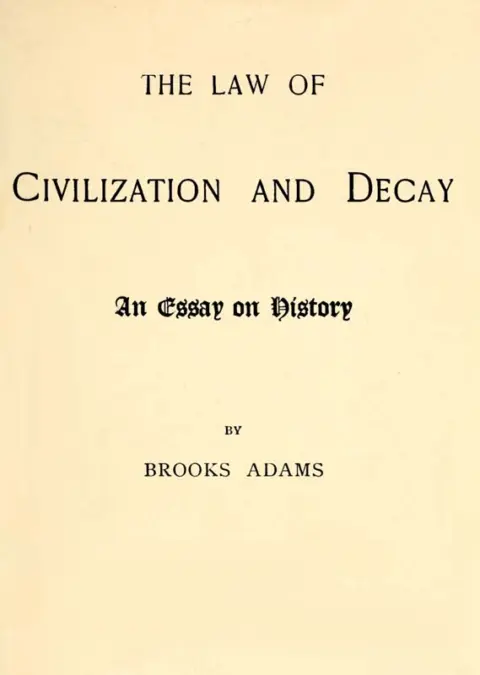
"The Law of Civilization and Decay: An Essay on History" by Brooks Adams is a work of history privately published in 1895. Adams argues that civilizations follow a predictable cycle of rise and fall, driven by economic and social forces. As societies centralize and accelerate through industrialization, imaginative energy transforms into capital accumulation, causing profound shifts in human temperament and power. Through examples spanning from Rome to modern empires, Adams traces how commercial centers migrate and civilizations decay, suggesting that humanity's fate follows iron laws as inevitable as natural selection itself.
Introduction adapted from the source catalogue; source summaries may be automatically generated.
Free to read · English · 107,746 words · No account needed
MAKE TIME FOR A GOOD BOOK
On by default. Untick to stop anonymous reading totals. Each page counts after 10 seconds in view. How this works.
Anonymous counting is on unless you have switched it off.
[255] Ibid., ix. No. 1005.
[256] Cal. x. No. 364.
[257] Ibid., No. 1191.
[258] Ibid., No. 364.
[259] Ibid., No. 1191.
[260] Rites of Durham, Surtees Soc., 86.
[261] Wright, 260.
[262] Ellis, 1st Series, ii. 99.
[263] Wright, 261, 262.
[264] Ellis, 1st Series, ii. 99.
[265] Agriculture and Prices, iv. 64.
[266] 6 Henry VIII., c. 5; 7 Henry VIII., c. 1.
[267] Jewel of Joy, Becon. Also England in the Reign of
Henry VIII., Early Eng. Text Soc., Extra Ser., No. xxxii. p.
75.
[268] First Sermon before Edward VI. Sermons of Bishop Latimer, ed. of Parker Soc., 100, 101.
[269] 22 Henry VIII., c. 12.
[270] 27 Henry VIII., c. 25.
[271] 1 Edward VI., c. 3.
[272] Brit. Mus., Cole MS. xii. 41. Cited in Henry VIII. and the English Monasteries, Gasquet, ii. 514, note.
[273] Eccl. Mem., ii. pt. 1, 260.
[274] Sermon on Rebellion, Cranmer, Miscellaneous Writings and
Letters, 194–6.
[275] Sermon on Rebellion, Cranmer, Miscellaneous Writings and
Letters, 195, 196.
[276] Cal. ix. No. 193.
[277] Eccl. Mem., ii. pt. 1, 152.
[278] 5 and 6 Edw. VI., c. 2.
[279] Cromwell’s Letters and Speeches, Carlyle, Speech XI.
[280] Raleigh to Burleigh, Life of Sir Walter Raleigh,
Edwards, ii. 76, letter xxxiv.
[281] The Reformation of the Church of England, ii. 68.
[282] History of England, v. 432.
[283] Gorham’s Reformation Gleanings, 61.
[284] Ridley’s disputation at Oxford in 1554, Acts and
Monuments, vi. 474.
[285] A Godly Letter to the Faithful, Works, iii. 176.
[286] Ibid., 177.
[287] A Faithful Admonition, Works, iii. 283.
[288] Ibid., iii. 281, 282.
[289] On True Obedience, Heywood’s ed., 73.
[290] The Institution of a Christian Man, Preface, Formularies of Faith of Henry VIII., Lloyd, 26.
[291] See Burnet’s History of the Reformation, Records, part
I. book iii. quest. 9.
[292] S. P. Dom. Eliz. vol. 176, No. 69.
[293] Zurich Letters, 1st Series, 287.
[294] Towchinge the bill and the booke exhibited in the Parliament 1586 for a further reformation of the Churche, S. P. Dom. Eliz. 199, No. 1.
[295] History of the Non-jurors, Lathbury, 50.
[296] See History of the Reformation, Burnet, Pocock’s ed. Records, part I. book iii. quest 9.
[297] History of England, ch. 1.
[298] History of England, ch. iii.
[299] Ibid., ch. vi.
[300] History of England, ch. xiv.
[301] Queen’s conference upon Graunt of a Subsedy, etc., 1584. State Papers, Dom. Eliz., 176, No. 69.
[302] History of England, ch. iii.
[303] Cal. x., No. 570.
[304] Ambassades, v. 150. Quotation from History of the Church of England, Dixon, iv. 450.
[305] Pretended Divorce of Henry VIII., Harpsfield, Camden
Society, 291.
[306] Burnet’s History of the Reformation, Pocock’s ed., i.
428.
[307] Ibid., iii. 376.
[308] Blunt’s Reformation, i. 475.
[309] Anglican Schism, Sander, Lewis’ trans., 181. Also Pretended Divorce of Henry VIII., Harpsfield, 290.
[310] Acts and Monuments, v. 230.
[311] Agriculture and Prices, Rogers, v. 804.
[312] History of England, viii. 425.
[313] Influence of the Sea Power upon History, Mahan, 41.
[314] English Seamen of the Sixteenth Century, 6.
[315] Anderson’s History of Commerce, i. 400.
[316] S. P. Dom. Eliz., 53.
[317] Wealth of Nations, book 4, ch. i.
[318] Discourse of Trade, Child, ed. 1775, 8.
[319] History of England, ch. iii.
[320] Discourse of Trade, Josiah Child, ed. 1775, 8, 9, 10.
[321] Ibid., Pref. xxxi.
[322] Ibid., 41.
[323] American Biography, Sparks, ii. 388.
[324] Wealth of Nations, bk. iv. c. 3, pt. 1.
[325] Thurloe’s State Papers, v. 433, 434.
[326] Annals of the Coinage of Britain, Ruding, iii. 378.
Your reading position is saved on this browser. Take it to another device with a library code. Reading pages adapt to text, rather than matching a printed edition.
BEHIND THE BOOK
This eBook is for the use of anyone anywhere in the United States and most other parts of the world at no cost and with almost no restrictions whatsoever. You may copy it, give it away or re-use it under the terms of the Project Gutenberg License included with this eBook or online at www.gutenberg.org. If you are not located in the United States, you will have to check the laws of the country where you are located before using this eBook. Read the source licence.
The original source file, including credits and licence, is retained by this library. Request an original-format copy at no charge. Please include the book title and Project Gutenberg identifier #44908.
KEEP YOUR CURIOSITY GOING

David Patterson (Spirit) Hatch
Cécile Tormay

Moritz Busch
Coulson Kernahan
John L. Ransom

Ralph Waldo Emerson