THE CLASSIC COLLECTION✦The Theory of Social RevolutionsCLASSIC FREE BOOKS
The Theory of Social Revolutions
Brooks Adams
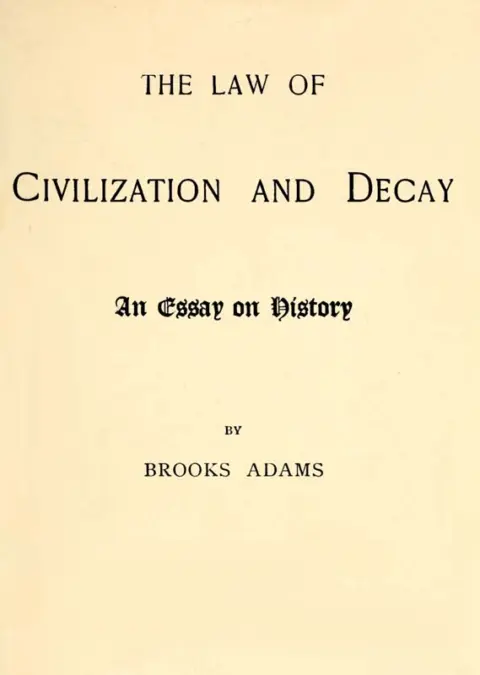
THE CLASSIC COLLECTION · 1896
"The Law of Civilization and Decay: An Essay on History" by Brooks Adams is a work of history privately published in 1895. Adams argues that civilizations follow a predictable cycle of rise and fall, driven by economic and social forces. As societies centralize and accelerate through industrialization, imaginative energy transforms into capital accumulation, causing profound shifts in human temperament and power. Through examples spanning from Rome to modern empires, Adams traces how commercial centers migrate and civilizations decay, suggesting that humanity's fate follows iron laws as inevitable as natural selection itself.
Introduction adapted from the source catalogue; source summaries may be automatically generated.
Free to read · English · 107,746 words · No account needed
MAKE TIME FOR A GOOD BOOK
On by default. Untick to stop anonymous reading totals. Each page counts after 10 seconds in view. How this works.
Anonymous counting is on unless you have switched it off.
In Paris an imitation of this trophy was erected to the greatest captain of France, and the column of the Place Vendôme serves to mark the grave of the modern martial blood. Raised in 1810, almost at the moment when Nathan Rothschild became despot of the London Stock Exchange, the tide from thence ran swiftly, and, since Sedan, the present generation has drained to the lees the cup of realism.
No poetry can bloom in the arid modern soil, the drama has died, and the patrons of art are no longer even conscious of shame at profaning the most sacred of ideals. The ecstatic dream, which some twelfth-century monk cut into the stones of the sanctuary hallowed by the presence of his God, is reproduced to bedizen a warehouse; or the plan of an abbey, which Saint Hugh may have consecrated, is adapted to a railway station.
Decade by decade, for some four hundred years, these phenomena have grown more sharply marked in Europe, and, as consolidation apparently nears its climax, art seems to presage approaching disintegration. The architecture, the sculpture, and the coinage of London at the close of the nineteenth century, when compared with those of the Paris of Saint Louis, recall the Rome of Caracalla as contrasted with the Athens of Pericles, save that we lack the stream of barbarian blood which made the Middle Age.
[Footnotes]
[1] History of Rome, Mommsen, Dickson’s trans., i. 288, 290.
[2] History of Rome, Niebuhr, Hare’s trans., i. 576. Niebuhr has been followed in the text, although the “nexum” is one of the vexed points of Roman law. (See Über das altrömische Schuldrecht, Savigny.) The precise form of the contract is, however, perhaps, not very important for the matter in hand, as most scholars seem agreed that it resembled a mortgage, the breach of whose condition involved not only the loss of the pledge, but the personal liberty of the debtor. See Gaius, iv. 21.
[3] History of Rome, Niebuhr, Hare’s trans., ii. 599. But compare Aulus Gellius, xx. 1.
[4] Ibid., i. 582.
[5] History of Rome, Niebuhr, Hare’s trans., i. 583.
[6] History of Rome, Mommsen, Dickson’s trans., i. 472.
[7] Livy, xlv. 18.
[8] History of Rome, Niebuhr, Hare’s trans., i. 583.
[9] Ibid., ii. 603.
[10] History of Rome, Niebuhr, Hare’s trans., i. 574.
[11] Preface to Virginia.
[12] History of Rome, Mommsen, Dickson’s trans., i. 484.
[13] See History of Rome, Mommsen, Dickson’s trans., i.
298–9.
[14] See History of Rome, Niebuhr, Hare’s trans., iii. 22,
30.
[15] Preface to Virginia, Macaulay.
[16] Histoire de l’Esclavage, Wallon, ii. 38.
[17] Suet. Aug., ii. 41.
[18] Tacitus, Ann., ii. 48.
[19] Ann., vi. 39.
[20] Ibid., iv. 21.
[21] Sat., iii. 164.
[22] L’Invasion Germanique, Fustel de Coulanges, 146–157.
[23] Diod. xxxiv. 38. On the subject of the Sicilian slavery, see Histoire de l’Esclavage, Wallon, ii. 300 et seq.
Your reading position is saved on this browser. Take it to another device with a library code. Reading pages adapt to text, rather than matching a printed edition.
BEHIND THE BOOK
This eBook is for the use of anyone anywhere in the United States and most other parts of the world at no cost and with almost no restrictions whatsoever. You may copy it, give it away or re-use it under the terms of the Project Gutenberg License included with this eBook or online at www.gutenberg.org. If you are not located in the United States, you will have to check the laws of the country where you are located before using this eBook. Read the source licence.
The original source file, including credits and licence, is retained by this library. Request an original-format copy at no charge. Please include the book title and Project Gutenberg identifier #44908.
KEEP YOUR CURIOSITY GOING

David Patterson (Spirit) Hatch
Cécile Tormay

Moritz Busch
Coulson Kernahan
John L. Ransom

Ralph Waldo Emerson