THE CLASSIC COLLECTION✦The Theory of Social RevolutionsCLASSIC FREE BOOKS
The Theory of Social Revolutions
Brooks Adams
THE CLASSIC COLLECTION · 1896
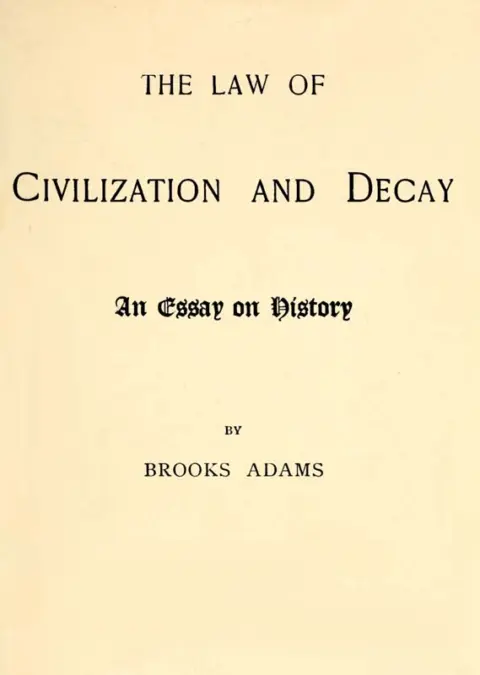
"The Law of Civilization and Decay: An Essay on History" by Brooks Adams is a work of history privately published in 1895. Adams argues that civilizations follow a predictable cycle of rise and fall, driven by economic and social forces. As societies centralize and accelerate through industrialization, imaginative energy transforms into capital accumulation, causing profound shifts in human temperament and power. Through examples spanning from Rome to modern empires, Adams traces how commercial centers migrate and civilizations decay, suggesting that humanity's fate follows iron laws as inevitable as natural selection itself.
Introduction adapted from the source catalogue; source summaries may be automatically generated.
Free to read · English · 107,746 words · No account needed
MAKE TIME FOR A GOOD BOOK
On by default. Untick to stop anonymous reading totals. Each page counts after 10 seconds in view. How this works.
Anonymous counting is on unless you have switched it off.
Year by year, as society consolidated, the economic type was propagated; and, as the pressure of a contracting currency stimulated these men to action, the demand for cheap religion grew fiercer. London, the monied centre, waxed hotter and hotter, and a single passage from the Supplicacyon for Beggers shows how bitter the denunciations of the system of paying for miracles became:--
“Whate money pull they yn by probates of testamentes, priuy tithes, and by mennes offeringes to theyre pilgrimages, and at theyre first masses? Euery man and childe that is buried, must pay sumwhat for masses and diriges to be song for him, or elles they will accuse the dedes frendes and executours of heresie. whate money get they by mortuaries, by hearing of confessions ... by halowing of churches, altares, superaltares, chapelles, and bells, by cursing of men and absoluing theim agein for money?”[196]
One of the ballads of Cromwell’s time ridiculed, in this manner, all the chief pilgrimages of the kingdom:--
“Ronnying hyther and thyther,
We cannot tell whither,
In offryng candels and pence
To stones and stockes,
And to olde rotten blockes,
That came, we know not from whense.
“To Walsyngham a gaddyng,
To Cantorbury a maddyng,
As men distraught of mynde;
With fewe clothes on our backes,
But an image of waxe,
For the lame and for the blynde.
“Yet offer what ye wolde,
Were it otes, syluer, or golde
Pyn, poynt, brooche, or rynge,
The churche were as then,
Such charitable men,
That they would refuse nothyng.”[197]
But the war was not waged with words alone. At the comparatively early date of 1393, London had grown so unruly that Richard assumed the government of the city himself. First he appointed Sir Edward Darlington warden, but Sir Edward proving too lenient, he replaced him with Sir Baldwin Radington. Foxe, very frankly, explained why:--
“For the Londoners at that time were notoriously known to be favourers of Wickliff’s side, as partly before this is to be seen, and in the story of Saint Alban’s more plainly doth appear, where the author of the said history, writing upon the fifteenth year of King Richard’s reign, reporteth in these words of the Londoners, that they were ‘not right believers in God, nor in the traditions of their forefathers; sustainers of the Lollards, depravers of religious men, withholders of tithes, and impoverishers of the common people.’
“... The king, incensed not a little with the complaint of the bishops, conceived eftsoons, against the mayor and sheriffs, and against the whole city of London, a great stomach; insomuch, that the mayor and both the sheriffs were sent for, and removed from their office.”[198]
Your reading position is saved on this browser. Take it to another device with a library code. Reading pages adapt to text, rather than matching a printed edition.
BEHIND THE BOOK
This eBook is for the use of anyone anywhere in the United States and most other parts of the world at no cost and with almost no restrictions whatsoever. You may copy it, give it away or re-use it under the terms of the Project Gutenberg License included with this eBook or online at www.gutenberg.org. If you are not located in the United States, you will have to check the laws of the country where you are located before using this eBook. Read the source licence.
The original source file, including credits and licence, is retained by this library. Request an original-format copy at no charge. Please include the book title and Project Gutenberg identifier #44908.
KEEP YOUR CURIOSITY GOING

David Patterson (Spirit) Hatch
Cécile Tormay

Moritz Busch
Coulson Kernahan
John L. Ransom

Ralph Waldo Emerson