THE CLASSIC COLLECTION✦The Theory of Social RevolutionsCLASSIC FREE BOOKS
The Theory of Social Revolutions
Brooks Adams
THE CLASSIC COLLECTION · 1896
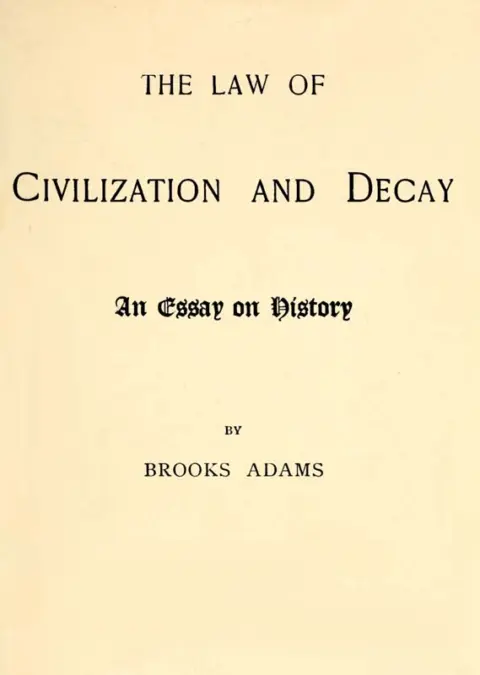
"The Law of Civilization and Decay: An Essay on History" by Brooks Adams is a work of history privately published in 1895. Adams argues that civilizations follow a predictable cycle of rise and fall, driven by economic and social forces. As societies centralize and accelerate through industrialization, imaginative energy transforms into capital accumulation, causing profound shifts in human temperament and power. Through examples spanning from Rome to modern empires, Adams traces how commercial centers migrate and civilizations decay, suggesting that humanity's fate follows iron laws as inevitable as natural selection itself.
Introduction adapted from the source catalogue; source summaries may be automatically generated.
Free to read · English · 107,746 words · No account needed
MAKE TIME FOR A GOOD BOOK
On by default. Untick to stop anonymous reading totals. Each page counts after 10 seconds in view. How this works.
Anonymous counting is on unless you have switched it off.
The laity paid the priesthood fees because of their supernatural powers, and the possession of these powers was chiefly demonstrated by the miracle of the mass. Wickliffe, with a leader’s eye, saw where the enemy was vulnerable, and the last years of his life were passed in his fierce controversy with the mendicants upon transubstantiation. Even at that early day he presented the issue with incomparable clearness: “And thou, then, that art an earthly man, by what reason mayst thou say that thou makest thy maker?”[190]
The deduction from such premises was inexorable. The mass had to be condemned as fetish worship, and with it went the adoration of relics.
“Indeed, many nominal Christians are worse than pagans; for it is not so bad that a man should honour as God, for the rest of the day, the first thing he sees in the morning, as that regularly that accident should be really his God, which he sees in the mass in the hands of the priest in the consecrated wafer.”[191]
Wickliffe died December 30, 1384, and ten years later the Lollards had determined to resist all payments for magic. They presented their platform to Parliament in 1395, summed up in their Book of Conclusions. Some of these “conclusions” are remarkably interesting:--
5th.--“That the exorcisms and hallowings, consecrations and blessings, over the wine, bread, wax, water, oil, salt, incense, the altar-stone, and about the church-walls, over the vestment, chalice, mitre, cross, and pilgrim-staves, are the very practices of necromancy, rather than of sacred divinity.
7th.--“We mightily affirm ... that spiritual prayers made in the church for the souls of the dead ... is a false foundation of alms, whereupon all the houses of alms in England are falsely founded.
8th.--“That pilgrimages, prayers, and oblations made unto blind crosses or roods, or to deaf images made either of wood or stone, are very near of kin unto idolatry.”[192]
When Lord Cobham, the head of the Lollard party, was tried for heresy in 1413, Archbishop Arundel put him four test questions. First, whether he believed, after the sacramental words had been spoken, any material bread or wine remained in the sacrament; fourth, whether he believed relic worship meritorious.
His answers did not give satisfaction, and they roasted him in chains, in Saint Giles’s Fields, in 1418.
A hundred years of high commercial activity followed Cobham’s death. The discovery of America, and of the sea passage to India, changed the channels of commerce throughout the world, human movement was accelerated, gunpowder made the attack overwhelming; centralization took a prodigious stride, scepticism kept pace with centralization, and in 1510 Erasmus wrote thus, and yet remained in the orthodox communion:--
Your reading position is saved on this browser. Take it to another device with a library code. Reading pages adapt to text, rather than matching a printed edition.
BEHIND THE BOOK
This eBook is for the use of anyone anywhere in the United States and most other parts of the world at no cost and with almost no restrictions whatsoever. You may copy it, give it away or re-use it under the terms of the Project Gutenberg License included with this eBook or online at www.gutenberg.org. If you are not located in the United States, you will have to check the laws of the country where you are located before using this eBook. Read the source licence.
The original source file, including credits and licence, is retained by this library. Request an original-format copy at no charge. Please include the book title and Project Gutenberg identifier #44908.
KEEP YOUR CURIOSITY GOING

David Patterson (Spirit) Hatch
Cécile Tormay

Moritz Busch
Coulson Kernahan
John L. Ransom

Ralph Waldo Emerson