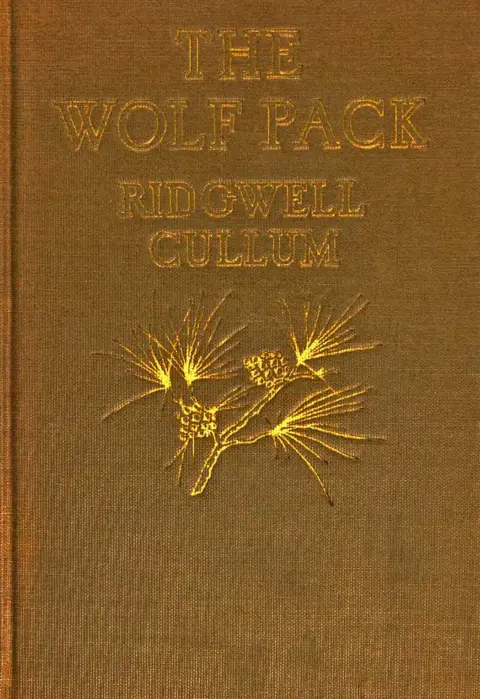
The wolf pack
Ridgwell Cullum
THE CLASSIC COLLECTION · 1914
"The Law-Breakers" by Ridgwell Cullum is a novel written in the early 20th century. The narrative is set against the backdrop of the Canadian prairie during a time of lawlessness and prohibition, focusing on the struggles between law enforcement and criminals. Most prominently, the story revolves around Inspector Stanley Fyles, who is determined to uphold the law in a territory rife with contraband and illicit activities. The opening of the novel introduces Inspector Fyles as he patrols a dusty train platform in a harsh summer heat, awaiting the arrival of a freight train carrying contraband liquor. He engages in a conversation with the railroad agent, Huntly, establishing the tense atmosphere of both comical and serious elements as they discuss the unreliable schedules of local freights and the increasing challenges posed by illegal traffic. We also glimpse the motivations and personalities of other characters, including the outlaws who intend to execute a daring robbery on the moving cargo. The stage is set for a gripping story of crime, duty, and the chase that will entangle both lawmen and outlaws in their relentless pursuit of justice and survival in the wild Prairie landscape.
Introduction adapted from the source catalogue; source summaries may be automatically generated.
Free to read · English · 133,013 words · No account needed
MAKE TIME FOR A GOOD BOOK
On by default. Untick to stop anonymous reading totals. Each page counts after 10 seconds in view. How this works.
Anonymous counting is on unless you have switched it off.
His air was too much for the girl's sense of humor. She laughed as she shifted the folded easel, and japanned tin box she was carrying, from one hand to the other.
"Oh, dear, oh, dear," she cried, stifling her mirth. "And--and I do so hate hawks. They're such villains, and--and the valley's full of them. But there, the valley is full of everything bad--isn't it?"
Bill was smoothing out the paper absent mindedly. Helen's reference
had reminded him of his purpose. Her presence somehow made it
difficult.
But Helen went on without apparently noticing his awkwardness.
"Tell me, Mr. Bryant, what was it brought you out this way, when you ought to be worrying around getting wise to--to the ranching business?" she demanded.
Bill flung back his broad shoulders, and, with the movement, seemed to fling off every care. He laughed cordially.
"Say, you make me laugh," he cried. "Now if I was to tell you what had brought me this way, you'd sure get mad." Then he discovered the things she was carrying for the first time. "Say, can't I carry those things?" he cried, reaching out and possessing himself of them without ceremony. "Why, it's a paint box, and--and easel," he cried in awe-struck tones. "I didn't guess you--painted."
Helen was frankly delighted with him, but she promptly denied the
charge.
"Paint? 'Daub,' you mean. Guess Charlie tried to knock painting into my--my thick head. But he had to quit it after I reached the daubing stage. I don't think he guesses I'll ever win prizes at it," she went on, moving up toward the pine. "Still, I might sell some of my daubs among the worst drinking cases in the village."
But Bill felt the outrage of such possibilities.
"I'll buy 'em all," he cried. "Just name your price, I'd--I'd like to collect works of art," he added enthusiastically.
Helen turned abruptly and glared.
"How dare you laugh at me?" she cried, in mock anger. "I--I might have paid you to take one away, but I just won't--now. So there. Works of art! How dare you? And what are you hugging that old piece of paper to death for? Give it to me. Perhaps it's somebody's love letter. Though folks don't generally write love letters on blue paper. It suggests something too legal."
Bill yielded up the paper with a good-natured smile.
"It's all mussed and dirty," he said, in a sort of apology.
"That's up to me," cried Helen. "Anyway a woman's curiosity don't mind
dirt."
She smoothed the paper carefully as she paused at the foot of the
pine. Bill looked around.
"Is this where you paint?" he asked.
Your reading position is saved on this browser. Take it to another device with a library code. Reading pages adapt to text, rather than matching a printed edition.
Ridgwell Cullum
Ridgwell Cullum
Ridgwell Cullum
Ridgwell Cullum
BEHIND THE BOOK
This eBook is for the use of anyone anywhere in the United States and most other parts of the world at no cost and with almost no restrictions whatsoever. You may copy it, give it away or re-use it under the terms of the Project Gutenberg License included with this eBook or online at www.gutenberg.org. If you are not located in the United States, you will have to check the laws of the country where you are located before using this eBook. Read the source licence.
The original source file, including credits and licence, is retained by this library. Request an original-format copy at no charge. Please include the book title and Project Gutenberg identifier #29958.
KEEP YOUR CURIOSITY GOING
Coulson Kernahan

Maurice Baring
Frances Wright
Cécile Tormay

Frederic Jesup Stimson

W. H. P. (William Henry Pope) Jarvis