THE CLASSIC COLLECTION✦The Bishop’s purseCLASSIC FREE BOOKS
The Bishop’s purse
Cleveland Moffett & Oliver Herford
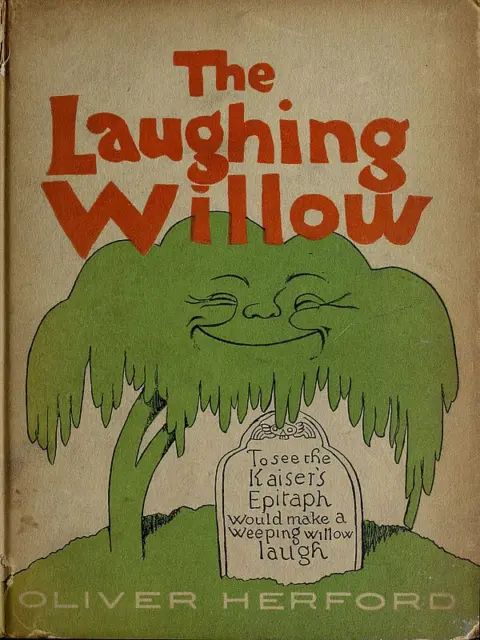
THE CLASSIC COLLECTION · 1918
"The Laughing Willow" by Oliver Herford is a collection of whimsical verses and illustrations written during the early 20th century. The book features a variety of satirical and humorous poems that comment on contemporary society and politics, utilizing a lighthearted and entertaining approach. It touches on themes of war, human behavior, and whimsical observations of life. In "The Laughing Willow," Herford presents an assortment of verses that blend humor with sharp wit, often critiquing the socio-political landscape of his time, particularly in relation to World War I. Through cleverly crafted epitaphs, observational humor, and playfully absurd scenarios, he addresses characters such as royalty and common folk alike. From light-hearted takes on Russian weddings to whimsical musings on animals and imaginary figures, the collection is a delightful exploration of creativity that delights, provokes thought, and elicits laughter, making it appealing to readers who appreciate clever wordplay and illustrated satire.
Introduction adapted from the source catalogue; source summaries may be automatically generated.
Free to read · English · 10,387 words · No account needed
MAKE TIME FOR A GOOD BOOK
On by default. Untick to stop anonymous reading totals. Each page counts after 10 seconds in view. How this works.
Anonymous counting is on unless you have switched it off.
Had Bobby Burns renounced his Highland lassies, And tuned his pipes to “Gentlemen’s attire,” He might in time have risen from the masses And been addressed as Robert Burns, Esquire.
If Hall Caine--............................
...........................................
...........................................
..............but why drag in Hall Caine?
Come, Chaloner, confess like a good feller
By “Gentleman and litterateur” you meant
The literary style of the Best Seller
And the strictly pure refinement of the Gent.
“The artists and writers were the first Americans to make themselves at home in this amusing Parisian resort. (The Old Café Martin.) And it was here, too, that women of the better class first tasted the delights of café life. It was considered quite a daring thing in the late eighties for be-cloaked and be-diamonded women of Fifth Avenue to sit here and sip their after-dinner coffee.” Vanity Fair.
One of those queer, artistic dives,
Where funny people had their fling.
Artists, and writers, and their wives--
Poets, and all that sort of thing.
Here, too, to view the vulgar herd
And sip the daring demi-tasse--
Be-cloaked, be-diamonded, be-furred--
Came women of the better class.
With its Parisian atmosphere,
It had a Latin Quarter ring.
Painters and journalists came here--
Actors, and all that sort of thing.
Here, too, to watch the Great Ungroomed
And sip the dangerous demi-tasse,
Be-furred, be-feathered and be-plumed,
Came women of the better class.
Here Howells dined--Saint Gaudens, Nast,
Kipling, Mark Twain and Peter Dunne,
Nell Terry, and not least though last
One Robert Louis Stevenson.
And mingling with that underworld,
To sip the devilish demi-tasse,
Be-cloaked, be-diamonded, be-pearled,
Came women of the better class.
Like geese to see the lions fed,
They came--be-jewelled and be-laced,
Only to find the lions fled.
“My Word!” cried they, “What wretched taste!”
Ermined and minked and Persian-lambed,
Be-puffed (be-painted, too, alas!)
Be-decked, be-diamonded--be-damned!
The women of the better class.
A Pipe Dream
Well I recall how first I met
Mark Twain--an infant barely three
Rolling a tiny cigarette
While cooing on his nurse’s knee.
Since then in every sort of place
I’ve met with Mark and heard him joke,
Yet how can I describe his face?
I never saw it for the smoke.
At school he won a smokership,
At Harvard College (Cambridge, Mass.)
His name was soon on every lip,
They made him “smoker” of his class.
Who will forget his smoking bout
With Mount Vesuvius--our cheers--
When Mount Vesuvius went out
And didn’t smoke again for years?
The news was flashed to England’s King,
Who begged Mark Twain to come and stay,
Offered him dukedoms--anything
To smoke the London fog away.
Your reading position is saved on this browser. Take it to another device with a library code. Reading pages adapt to text, rather than matching a printed edition.
Cleveland Moffett & Oliver Herford
Oliver Herford
Oliver Herford
Oliver Herford
BEHIND THE BOOK
This eBook is for the use of anyone anywhere in the United States and most other parts of the world at no cost and with almost no restrictions whatsoever. You may copy it, give it away or re-use it under the terms of the Project Gutenberg License included with this eBook or online at www.gutenberg.org. If you are not located in the United States, you will have to check the laws of the country where you are located before using this eBook. Read the source licence.
The original source file, including credits and licence, is retained by this library. Request an original-format copy at no charge. Please include the book title and Project Gutenberg identifier #56357.
KEEP YOUR CURIOSITY GOING

Eric Mackay
Edmund Gosse
Sophia Margaretta Hensley
Gilbert Parker
George MacDonald

Elizabeth Bibesco