THE CLASSIC COLLECTION✦An outlaw’s diary: the CommuneCLASSIC FREE BOOKS
An outlaw’s diary: the Commune
Cécile Tormay
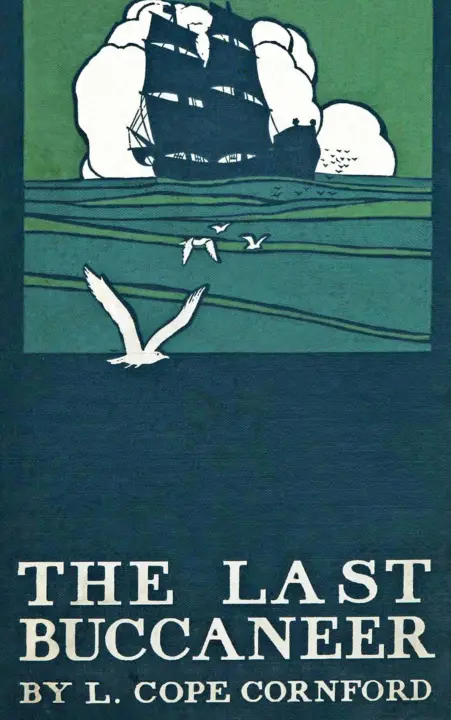
THE CLASSIC COLLECTION · 1902
"The Last Buccaneer: or, The Trustees of Mrs A" by L. Cope Cornford is a historical novel written in the early 20th century. Set against the backdrop of early 18th-century maritime adventures, the story revolves around the lives of several characters, including Brandon Pomfrett, a young clerk with dreams of adventure, and Captain Dawkins, a man with a mysterious past and seafaring prowess. The narrative explores themes of piracy, treasure hunting, and the moral dilemmas faced by those entangled in these pursuits. The opening of the novel introduces readers to Brandon Pomfrett, a clerk yearning for excitement beyond his mundane life in Bristol. As he meets Captain Dawkins, a burly mariner, the two are drawn into an adventure revolving around a long-lost treasure map ignited by a mysterious bottle. They soon find themselves embroiled in schemes that point toward buccaneering exploits, navigating the complex motivations of various characters, including the unscrupulous Mr. Gamaliel. The tone is infused with a sense of foreboding and intrigue, hinting at the consequences of their quests for fortune amid the treacherous currents of the sea and the darker elements of human ambition.
Introduction adapted from the source catalogue; source summaries may be automatically generated.
Free to read · English · 60,757 words · No account needed
MAKE TIME FOR A GOOD BOOK
On by default. Untick to stop anonymous reading totals. Each page counts after 10 seconds in view. How this works.
Anonymous counting is on unless you have switched it off.
“Why, then, if he don’t--and I reckon he don’t--that’s a good thing for you and me, shipmate,” Dawkins went on, with great deliberation. “And why, says you? Why is this same old Dawkins, this poor old broken-down forsaken buccaneer on his beam-ends, a-talking like this here? That’s what you’re a-thinking, shipmate, at this blessed minute. Has he took leave of his senses, owing to hunger and disapp’intment, and the blessed sun, or what not, you’re asking of yourself.” Dawkins paused in this singular adjuration, his little eyes glowing under his penthouse brows, took a step forward, laid his hand on Pomfrett’s breast, and spoke low. “It’s true,” says he. “The bottle’s true. So far as I know, mind ye, that is. So far as I know, and I’ll swear it on the Book. I didn’t find that there same bottle, nor that message, mind ye, but I found another bottle and another message, and then I lost ’em ashore in a island port. Drunk, I reckon. But not before I’d a-learned the writing by heart. Gamaliel wrote it out from what I rec’lected, so he did, and Gamaliel, he supplied the bottle. And Gamaliel, he thought it was all a bam. But,” said Mr Dawkins, with indescribable emphasis, “it ain’t!”
He fell back a step, and Pomfrett stood regarding him with amazement.
“Now, by your leave, commander, we’ll lay that pretty little ship o’ yours for Catoche Bay on the coast of Yucatan--all as we was, commander, all as we was at the start, and on the way home, too,” Dawkins ended.
And so we did. But the ship had to be provisioned for the long voyage to England; and, taking advantage of the safe anchorage and the traffic of the friendly Indians, we spent a week in Caratasca Lagoon, getting wood, water, and victuals. After all, there was no hurry. Murch had sailed for England by this time, in all likelihood; his course lay north and east of the islands, while ours lay west and north of them; and we might consider ourselves secure from Murch, who, moreover, was doubtless glad to be rid of us. But, with him went Morgan Leroux; and although the agent, in reward of his fidelity, saw a chance of retrieving a great part of his owners’ losses, he went about heavy-eyed and silent. He was never quiet, working doggedly all day at this and that; nor did he sleep much. He would walk about the camp, along the shore and back again, or, if he were on shipboard, up and down the deck at night; then he would sit down where he was and fall asleep for a little while; and then he would wake again, and again take to his restless wandering. But when we were fairly at sea his melancholy lightened a little, and when we dropped anchor in Catoche Bay, on a fine night of moonlight, he nearly forgot his woes. The glimmering surf ran about us in a half-circle, thundering upon a zone of silver beach; on either hand rose tall cliffs, all black and silver in the moonlight, and beyond, the familiar dark barrier of forest, rising upon dim hills. Here, then, was the haven we had come so far to find. On one side of the bay the forest was cleft in a black notch; a few pines straggled thence upon the beach, bordering a gleam of running water. “At a point on nothe mainland Yucatan two leagues due south from the hed of Catoche Bay, having the red rocke where the stream flows out in line with the extreemest projection of cliffe on west horn of bay.” Dawkins had the marks by heart, as he had said. Now, the crew had been told nothing of the matter; no one aboard knew of the treasure save Dawkins and Pomfrett and I; so that, if by any evil chance we found ourselves deceived, there would be the less discontent.
Your reading position is saved on this browser. Take it to another device with a library code. Reading pages adapt to text, rather than matching a printed edition.
BEHIND THE BOOK
This eBook is for the use of anyone anywhere in the United States and most other parts of the world at no cost and with almost no restrictions whatsoever. You may copy it, give it away or re-use it under the terms of the Project Gutenberg License included with this eBook or online at www.gutenberg.org. If you are not located in the United States, you will have to check the laws of the country where you are located before using this eBook. Read the source licence.
The original source file, including credits and licence, is retained by this library. Request an original-format copy at no charge. Please include the book title and Project Gutenberg identifier #74835.
KEEP YOUR CURIOSITY GOING
Cécile Tormay

Moritz Busch
Coulson Kernahan
John L. Ransom

Maurice Baring
Frances Wright