THE CLASSIC COLLECTION✦The New NationCLASSIC FREE BOOKS
The New Nation
Frederic L. (Frederic Logan) Paxson
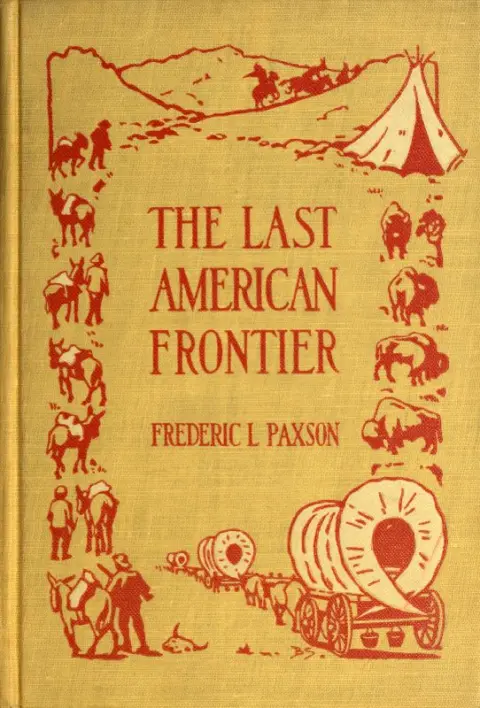
THE CLASSIC COLLECTION · 1910
"The Last American Frontier" by Frederic L. Paxson is a historical account written in the early 20th century. The book explores the final stages of westward expansion in the United States, examining the forces that shaped American history beyond the Mississippi River. It delves into the interactions between settlers, Native Americans, and various political forces, providing a comprehensive view of this pivotal era in American history. At the start of the narrative, the author sets the stage by discussing the concept of the frontier as a dynamic force in American life, defining it as a series of shifting boundaries that have allowed for continuous settlement and expansion. Paxson outlines the historical context of these frontiers, beginning with early settlers facing wilderness and Indigenous nations, emphasizing how each wave of migration has contributed to shaping the nation’s identity. The opening chapters introduce the themes of exploration, conflict, and the societal changes driven by these expanding frontiers, providing an engaging overview of the complexities surrounding the final American frontier.
Introduction adapted from the source catalogue; source summaries may be automatically generated.
Free to read · English · 96,481 words · No account needed
MAKE TIME FOR A GOOD BOOK
On by default. Untick to stop anonymous reading totals. Each page counts after 10 seconds in view. How this works.
Anonymous counting is on unless you have switched it off.
Nearly every incident in the history of Indian relations has been made the subject of investigations by the War and Interior departments. The resulting collections of papers are to be found in the congressional documents, through the indexes. They are too numerous to be listed here. The searcher should look for reports from the Secretary of War, the Secretary of the Interior, or the Postmaster-general, for court-martial proceedings, and for reports of special committees of Congress. Dunn gives some classified lists in his Massacres of the Mountains.
There is a rapidly increasing mass of individual biography and reminiscence for the West during this period. Some works of this class which have been found useful here are: W. M. Meigs, Thomas Hart Benton (Phila., 1904); C. W. Upham, Life, Explorations, and Public Services of John Charles Frémont (40th thousand, Boston, 1856); S. B. Harding, Life of George B. Smith, Founder of Sedalia, Missouri (Sedalia, 1907); P. H. Burnett, Recollections and Opinions of an Old Pioneer (N.Y., 1880; by one who had followed the Oregon trail and had later become governor of California); A. Johnson, S. A. Douglas (N.Y., 1908; one of the most significant biographies of recent years); H. Stevens, Life of Isaac Ingalls Stevens (Boston, 1900); R. S. Thorndike, The Sherman Letters (N.Y., 1894; full of references to frontier conditions in the sixties); P. H. Sheridan, Personal Memoirs (London, 1888; with a good map of the Indian war of 1867-1868, which the later edition has dropped); E. P. Oberholtzer, Jay Cooke, Financier of the Civil War (Phila., 1907; with details of Northern Pacific railway finance); H. Villard, Memoirs (Boston, 1904; the life of an active railway financier); Alexander Majors, Seventy Years on the Frontier (N.Y., 1893; the reminiscences of one who had belonged to the great firm of Russell, Majors, and Waddell); G. R. Brown, Reminiscences of William M. Stewart of Nevada (1908).
Miscellaneous works indicating various types of materials which have been drawn upon are: O. J. Hollister, The Mines of Colorado (Springfield, 1867; a miners' handbook); S. Mowry, Arizona and Sonora (3d ed., 1864; written in the spirit of a mining prospectus); T. B. H. Stenhouse, The Rocky Mountain Saints (London, 1874; a credible account from a Mormon missionary who had recanted without bitterness); W. A. Linn, The Story of the Mormons (N.Y., 1902; the only critical history of the Mormons, but having a strong Gentile bias); T. J. Dimsdale, The Vigilantes of Montana, or Popular Justice in the Rocky Mountains (2d ed., Virginia City, 1882; a good description of the social order of the mining camp).
Acton, Minnesota, Sioux massacre at, 235.
Alder Gulch mines, Idaho, 168.
Anthony, Major Scott J., 259.
Apache Indians, 247, 267, 268, 292, 312;
treaty of 1853 with, 124;
troubles with, in Arizona, 162-163;
last struggles of, against whites, 368-369.
Your reading position is saved on this browser. Take it to another device with a library code. Reading pages adapt to text, rather than matching a printed edition.
Frederic L. (Frederic Logan) Paxson
BEHIND THE BOOK
This eBook is for the use of anyone anywhere in the United States and most other parts of the world at no cost and with almost no restrictions whatsoever. You may copy it, give it away or re-use it under the terms of the Project Gutenberg License included with this eBook or online at www.gutenberg.org. If you are not located in the United States, you will have to check the laws of the country where you are located before using this eBook. Read the source licence.
The original source file, including credits and licence, is retained by this library. Request an original-format copy at no charge. Please include the book title and Project Gutenberg identifier #45699.
KEEP YOUR CURIOSITY GOING
Cécile Tormay

Moritz Busch
John L. Ransom
Frances Wright
Cécile Tormay

Mabel Potter Daggett