THE CLASSIC COLLECTION✦A journey to Central AfricaCLASSIC FREE BOOKS
A journey to Central Africa
Bayard Taylor
THE CLASSIC COLLECTION · 1854
"The Lands of the Saracen" by Bayard Taylor is a historical travelogue written in the mid-19th century. The narrative chronicles Taylor's extensive travels through regions once occupied by the Saracens, specifically Palestine, Asia Minor, Sicily, and Spain, as he aims to capture the landscapes, cultures, and experiences that characterized his journey through these historically rich areas. The opening of the text introduces the author's quarantine experience upon arriving in Beyrout. Taylor, along with his fellow traveler Mr. Harrison, describes the peculiarities and discomforts of quarantine life, interspersing accounts of local customs and the diverse fellow travelers around him. He reflects on the stark contrast of life in quarantine to the vibrant, rich culture just outside the gates, hinting at the adventures he is about to embark upon. The narrative sets an engaging tone that promises insights into both the historical significance of the regions he visits and the author's personal reflections as he navigates through the complexities of culture, politics, and human interactions during his travels.
Introduction adapted from the source catalogue; source summaries may be automatically generated.
Free to read · English · 128,794 words · No account needed
MAKE TIME FOR A GOOD BOOK
On by default. Untick to stop anonymous reading totals. Each page counts after 10 seconds in view. How this works.
Anonymous counting is on unless you have switched it off.
My walks through the city have been almost wholly confined to the bazaars, which are of immense extent. One can walk for many miles, without going beyond the cover of their peaked wooden roofs, and in all this round will find no two precisely alike. One is devoted entirely to soap; another to tobacco, through which you cough and sneeze your way to the bazaar of spices, and delightedly inhale its perfumed air. Then there is the bazaar of sweetmeats; of vegetables; of red slippers; of shawls; of caftans; of bakers and ovens; of wooden ware; of jewelry---a great stone building, covered with vaulted passages; of Aleppo silks; of Baghdad carpets; of Indian stuffs; of coffee; and so on, through a seemingly endless variety. As I have already remarked, along the line of the bazaars are many khans, the resort of merchants from all parts of Turkey and Persia, and even India. They are large, stately buildings, and some of them have superb gateways of sculptured marble. The interior courts are paved with stone, with fountains in the centre, and many of them are covered with domes resting on massive pillars. The largest has a roof of nine domes, supported by four grand pillars, which inclose a fountain. The mosques, into which no Christian is allowed to enter, are in general inferior to those of Cairo, but their outer courts are always paved with marble, adorned with fountains, and surrounded by light and elegant corridors. The grand mosque is an imposing edifice, and is said to occupy the site of a former Christian church.
Another pleasant feature of the city is its coffee shops, which abound in the bazaars and on the outskirts of the gardens, beside the running streams. Those in the bazaars are spacious rooms with vaulted ceilings, divans running around the four walls, and fountains in the centre. During the afternoon they are nearly always filled with Turks, Armenians and Persians, smoking the narghileh, or water-pipe, which is the universal custom in Damascus. The Persian tobacco, brought here by the caravans from Baghdad, is renowned for this kind of smoking. The most popular coffee-shop is near the citadel, on the banks and over the surface of the Pharpar. It is a rough wooden building, with a roof of straw mats, but the sight and sound of the rushing waters, as they shoot away with arrowy swiftness under your feet, the shade of the trees that line the banks, and the cool breeze that always visits the spot, beguile you into a second pipe ere you are aware. "El mà, wa el khòdra, wa el widj el hassàn--water, verdure and a beautiful face," says an old Arab proverb, "are three things which delight the heart," and the Syrians avow that all three are to be found in Damascus. Not only on the three Sundays of each week, but every day, in the gardens about the city, you may see whole families (and if Jews or Christians, many groups of families) spending the day in the shade, beside the beautiful waters. There are several gardens fitted up purposely for these picnics, with kiosks, fountains and pleasant seats under the trees. You bring your pipes, your provisions and the like with you, but servants are in attendance to furnish fire and water and coffee, for which, on leaving, you give them a small gratuity. Of all the Damascenes I have yet seen, there is not one but declares his city to be the Garden of the World, the Pearl of the Orient, and thanks God and the Prophet for having permitted him to be born and to live in it. But, except the bazaars, the khans and the baths, of which there are several most luxurious establishments, the city itself is neither so rich nor so purely Saracenic in its architecture as Cairo. The streets are narrow and dirty, and the houses, which are never more than two low stories in height, are built of sun-dried bricks, coated with plaster. I miss the solid piles of stone, the elegant doorways, and, above all, the exquisite hanging balconies of carved wood, which meet one in the old streets of Cairo. Damascus is the representative of all that is gay, brilliant, and picturesque, in Oriental life; but for stately magnificence, Cairo, and, I suspect, Baghdad, is its superior.
Your reading position is saved on this browser. Take it to another device with a library code. Reading pages adapt to text, rather than matching a printed edition.
Bayard Taylor
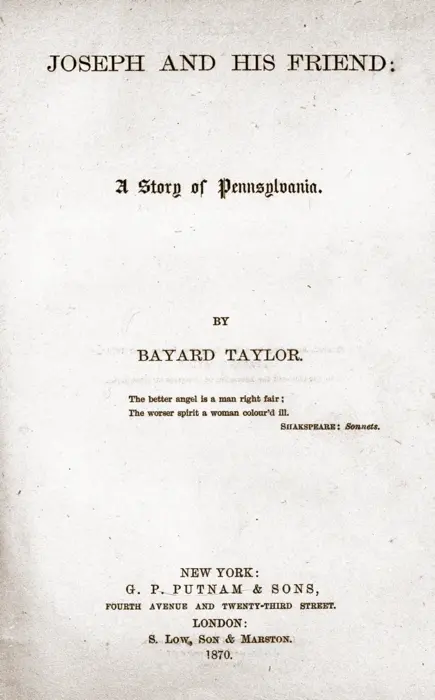
Bayard Taylor
Bayard Taylor
Bayard Taylor
BEHIND THE BOOK
This eBook is for the use of anyone anywhere in the United States and most other parts of the world at no cost and with almost no restrictions whatsoever. You may copy it, give it away or re-use it under the terms of the Project Gutenberg License included with this eBook or online at www.gutenberg.org. If you are not located in the United States, you will have to check the laws of the country where you are located before using this eBook. Read the source licence.
The original source file, including credits and licence, is retained by this library. Request an original-format copy at no charge. Please include the book title and Project Gutenberg identifier #10924.
KEEP YOUR CURIOSITY GOING
Wilfrid Scawen Blunt
Wilfrid Scawen Blunt

E. W. (Edgar Watson) Howe
Cécile Tormay

Moritz Busch
John L. Ransom