Ginevra
Susan E. (Susan Elston) Wallace
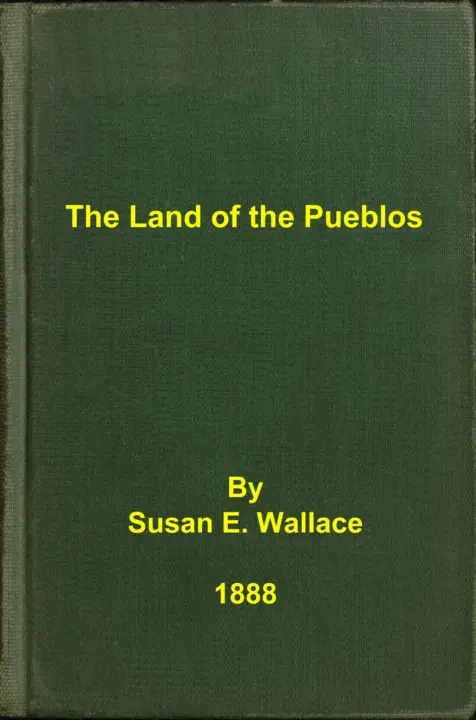
THE CLASSIC COLLECTION · 1888
"The land of the Pueblos" by Susan E. Wallace is a travelogue and historical-ethnographic account written in the late 19th century. It portrays New Mexico’s landscapes, towns, and Pueblo communities through firsthand travel, archival curiosities, and sketches of frontier life. The work interweaves Spanish exploration lore with careful observation of Pueblo history, architecture, laws, and ceremonies. Expect vivid scenes of Santa Fe, pueblo plazas and estufas, and accounts of customs, dances, and myths that shape the region’s identity.
The opening of the book gathers earlier magazine pieces into one volume, then follows the author’s arduous journey west—through sleepless nights in rail cars, a poignant vignette of a dying youth bound for Colorado air, and a punishing buckboard ride—before arriving in sun-bleached, time-worn Santa Fe. Wallace then shifts to a brisk historical survey: Cabeza de Vaca’s wanderings, Coronado’s quest for Cíbola, early descriptions of pueblos like Acoma, and a sober demystification of cliff dwellings. She sketches Pueblo continuity from those encounters to the present—their adobe architecture, estufas, pottery, and the enduring Montezuma tradition centered on Pecos’s sacred fire and “miracle tree,” a prophecy symbolically fulfilled with American occupation. Next she outlines Pueblo governance (cacique, governor, principales, and war and religious officers), communal land use and agriculture, and the language and cultural conservatism that frustrate missionary efforts. The section closes with a detailed, eye-level account of the green corn dance at Santo Domingo—its painted dancers, pounding drums, ritual kettles, and communal distribution of boiled corn—followed by the first glimpses of daily life on Santa Fe’s plaza and reflections on the area’s mixed heritages.
Introduction adapted from the source catalogue; source summaries may be automatically generated.
Free to read · English · 85,340 words · No account needed
MAKE TIME FOR A GOOD BOOK
On by default. Untick to stop anonymous reading totals. Each page counts after 10 seconds in view. How this works.
Anonymous counting is on unless you have switched it off.
Paupers and drones are unknown among them, because all are obliged to work and make contribution to the possessions of the community to which they belong.
At Taos nearly four hundred persons live in two buildings over three hundred feet in length, and about a hundred and fifty feet wide at the base. They are on opposite sides of a little creek, said to have been connected in ancient times by a bridge, a grim and threatening fortress of savage strength, many times attacked by the Spaniards but never captured. If there are family feuds and quarrels, the outside world has no knowledge of them; men, women, and children, mothers-in-law and all, live together in absolute harmony. On the highest story a sentinel is posted. One might think this ancient custom could be dispensed with in the generation of peace since the American occupation, but they hold the wise Napoleonic idea, if you would have peace be always ready for war.
Each Pueblo contains from one to seven estufas, used as a council-house and a place of worship, where they carry on their heathen rites and ceremonies, and deliberate on the public weal; a consecrated spot to which women are not admitted; a senate-chamber where long debates on public affairs are maintained, and the business of the tribe transacted by the council of wise men, cunning prophets, and able warriors, whose duty it is to manage the internal affairs of the town. The Governor assembles his constitutional advisers in the lodge, where matters are discussed and decided by the majority. One of their wise regulations is a secret police whose duty is to prevent vice and disorder, and report in the under-ground estufa the conduct of suspected persons. The dingy little “temples of sin,” as the old Catholics call them, are hung round with dim and fading legends and shadowy superstitions. Their worshipers have not the slightest approach to music in the horrible noises they make there--a kind of sledge-hammer beating on rude drums and blowing of ear-splitting whistles--nor have they any idea of rhythm or poetry. No correct tradition is kept without one of these arts, and in the absence of all recorded law a perfect devotion to custom carries their poor civilization forward as it was in the beginning. It keeps the Pueblos a separate and distinct people, bounded by a dead wall of conservatism to this day. Says the Rev. Dr. Menaul of the Laguna mission, “Religion enters into everything they do, i. e. everything is done according to ancient custom. The new-born babe comes upon the stage of life under its auspices, is fed and clothed, or not clothed, according to custom. It is hushed to sleep with a custom-song, gets custom-medicine, and grows up in the very bosom of religious custom. The father plants and reaps his fields, makes his moccasins, knits his stockings, carries the baby on his back, in fact does all that he does in strict conformity to custom. The mother grinds the meal, makes the bread, wears her clothing, and keeps her house, makes her water-pots, and paints them with religious symbols, according to custom. The whole inner and outer life of the Indian is one of perfect devotion to religious custom, or obedience to his faith.” And this adoration of the past makes them the most difficult of all people to be reached by outside influence, a rigid unbending adherence to old time observances sets their faces as a flint against everything new and foreign, and our mission-work seems dashing against a dead wall. Nothing is subject to change among them except language; they have the most shifting forms of human speech, so the students tell us, and desiring no improvement or alteration, how can we influence them by religious teaching? How plant new ideas where there is no room to receive them?
Your reading position is saved on this browser. Take it to another device with a library code. Reading pages adapt to text, rather than matching a printed edition.
Susan E. (Susan Elston) Wallace
BEHIND THE BOOK
This eBook is for the use of anyone anywhere in the United States and most other parts of the world at no cost and with almost no restrictions whatsoever. You may copy it, give it away or re-use it under the terms of the Project Gutenberg License included with this eBook or online at www.gutenberg.org. If you are not located in the United States, you will have to check the laws of the country where you are located before using this eBook. Read the source licence.
The original source file, including credits and licence, is retained by this library. Request an original-format copy at no charge. Please include the book title and Project Gutenberg identifier #77473.
KEEP YOUR CURIOSITY GOING
Wilfrid Scawen Blunt
Wilfrid Scawen Blunt

E. W. (Edgar Watson) Howe
Cécile Tormay

Moritz Busch
John L. Ransom