
Life in an Indian Outpost
Gordon Casserly
THE CLASSIC COLLECTION · 1903
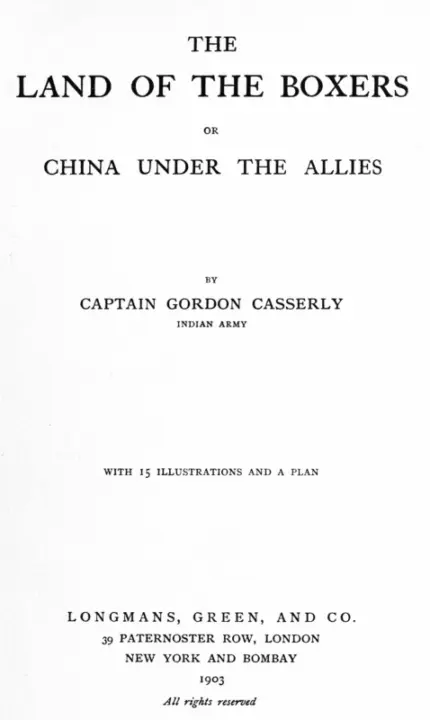
"The Land of the Boxers; or, China under the Allies" by Captain Gordon Casserly is a historical account written in the early 20th century. The narrative chronicles the experiences of Allied forces during the Boxer Rebellion in China, focusing on the interactions and observations of British soldiers, particularly within the context of the military campaigns and the sociopolitical climate of the time. The book seeks to provide insight into the chaos, camaraderie, and cultural clashes faced by the forces engaged in this conflict. The opening of the text introduces readers to the setting as a group of officers aboard a transport ship travels from Wei-hai-wei to Tientsin, offering vivid descriptions of the coastal scenery and military life. We meet a cheerful Irish priest, Mr. Hardy, who provides humor and warmth in the otherwise stark military backdrop. As the ship arrives at Tientsin, the narrative captures the atmosphere of a bustling foreign settlement steeped in the aftermath of conflict, highlighting the juxtaposition between European soldiers and the local Chinese populace. Through these depictions, the beginning of the book effectively establishes a detailed, immersive setting and introduces themes of camaraderie among Allied forces amid the backdrop of war-torn China.
Introduction adapted from the source catalogue; source summaries may be automatically generated.
Free to read · English · 76,093 words · No account needed
MAKE TIME FOR A GOOD BOOK
On by default. Untick to stop anonymous reading totals. Each page counts after 10 seconds in view. How this works.
Anonymous counting is on unless you have switched it off.
A week or two after this false alarm, I obtained permission to cross into Chinese territory and visit Samchun. The town looked very interesting at a distance, with its high walls and two square stone towers, which were in reality pawn‐shops. For these establishments in China are looked upon as safe deposit offices. A rich man about to leave home for any length of time removes his valuables to the nearest pawn‐shop and there stores them. They are the first places attacked when a band of robbers seizes some small town, as frequently happens. So they are built in the form of strong towers with the entrance generally several feet from the ground, in order that the proprietor and his friends may retire within and defend them.
Accompanied by Captain Woolley, I.M.S., I set out to visit the town, having received many injunctions to be careful not to embroil ourselves with the inhabitants or the soldiery, who were not likely to prove over friendly. We were provided with interpreters in the persons of a Chinese policeman in British employ and a Sikh constable who had learned to converse very well in the language of the country. As we intended to make a formal call on the mandarin in command of Samchun and had heard that in China a man’s importance is gauged by the size of his visiting‐card, we wrote our names on sheets of foolscap—the largest pieces of paper we could find. Red, however, is the proper colour. In mufti and taking no weapons, we left the camp and crossed the river in a small, flat‐bottomed ferry‐boat. Landed on the far side, we set off along the tops of the mud banks between the paddy‐fields, the only roads available. Those which are used as general paths are laid with flat stones, which, not being fastened in any way, occasionally tilt up and slide about in a disconcerting manner. As we neared the town we were observed with interest by a number of Chinese soldiers lounging about in front of the principal gateway. We felt a little nervous as to our reception but putting a bold face on the matter directed our way towards them. We were stopped, however, by our Chinese policeman, who told us that we should not approach this entrance as it faced the mandarin’s Yamen and was reserved for important individuals. We being merely foreigners—this although he was in British employment!—must seek admittance through the back gate into the town. Irritated at his insolent tone, the Sikh constable shoved him aside, and we approached the guard. The soldiers, though not openly hostile—for the white tents of our camp, plainly visible across the river, had a sobering effect—treated us with scarcely‐veiled contempt. On our Sikh interpreter informing them that we were English officers who had come to visit their mandarin, they airily replied that that dignitary was asleep and could not see us. Annoyed at their impertinent manner, we ordered them to go and wake him. Rather impressed by our audacity, they held a consultation. Then one went into the Yamen. He returned in a few minutes with a message to the effect that the mandarin regretted that he could not see us as he was not dressed. Seeing the effect of our previous curtness, we haughtily bade the soldier tell the mandarin to put on his clothes at once; see him we must. Visibly impressed this time, he hastened inside again and promptly returned with an invitation to enter the Yamen. We passed through the gate with as important an air as we could assume. It had been a game of bluff on both sides and we had won; for on the verandah of the house inside the entrance we were received by the mandarin, correctly attired. With hands folded over each other, he bowed low and led the way into the interior. The room was small and plainly furnished. High‐backed, uncomfortable chairs stood round a square blackwood table. On the walls hung crude pictures or tablets painted with Chinese characters. Our host, who was really a most courteous old gentleman, bowed again and, pointing to the chairs, begged us—as we judged from his manner—to be seated. We politely refused until he had taken a chair himself. He then addressed us in sing‐song Chinese words, which our Sikh interpreter assured us were an expression of the honour he felt at our condescending to visit such an unworthy individual. We framed our reply in equally humble terms. He then inquired the reason of the coming of our force to the frontier. We informed him that it was merely to guard our territory from invasion and assured him that we had no evil designs on Samchun. He pretended to feel satisfied at this, but doubt evidently still lingered in his mind. The conversation then dragged on spasmodically until we asked his permission to visit the town. He seemed to hail our request with relief as a chance of politely ridding himself of us and ordered four soldiers to get ready to accompany us as an escort. One of the attendants, at a sign from him, then left the room and returned with three little cups covered with brass saucers.
Your reading position is saved on this browser. Take it to another device with a library code. Reading pages adapt to text, rather than matching a printed edition.
BEHIND THE BOOK
This eBook is for the use of anyone anywhere in the United States and most other parts of the world at no cost and with almost no restrictions whatsoever. You may copy it, give it away or re-use it under the terms of the Project Gutenberg License included with this eBook or online at www.gutenberg.org. If you are not located in the United States, you will have to check the laws of the country where you are located before using this eBook. Read the source licence.
The original source file, including credits and licence, is retained by this library. Request an original-format copy at no charge. Please include the book title and Project Gutenberg identifier #50785.
KEEP YOUR CURIOSITY GOING
Wilfrid Scawen Blunt
Wilfrid Scawen Blunt

E. W. (Edgar Watson) Howe
Cécile Tormay

Moritz Busch
John L. Ransom