THE CLASSIC COLLECTION✦An outlaw’s diary: the CommuneCLASSIC FREE BOOKS
An outlaw’s diary: the Commune
Cécile Tormay
THE CLASSIC COLLECTION · 1904
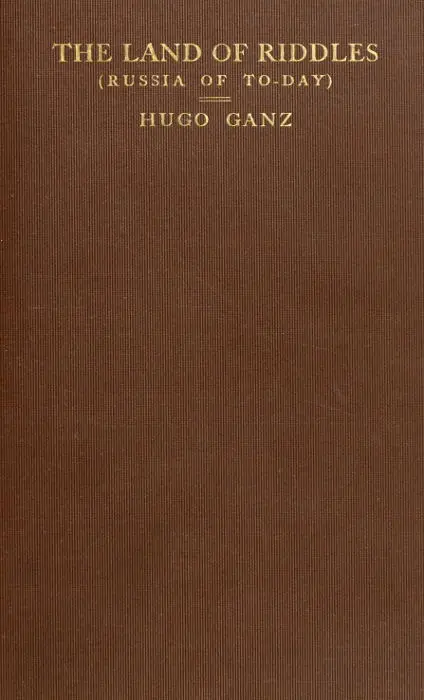
"The Land of Riddles (Russia of To-day)" by Hugo Ganz is a historical and political account written in the early 20th century. The book explores the complexities of Russia under autocracy, juxtaposing the nation's cultural achievements against its oppressive political conditions. Ganz offers insights into contemporary Russian society, commenting on the lives and struggles of various groups, including artists, political dissidents, and the significant Jewish population. The opening of the work introduces Ganz's motivations for traveling to Russia, largely driven by curiosity over the stark contrasts he perceives between its celebrated culture and brutal governance. The preface sets the tone, indicating that Ganz seeks to provide an unbiased account of the real situation in contemporary Russia, addressing the pervasive political oppression that hampers individual freedoms. As he approaches the Russian frontier by train, he shares his apprehensions about entering a country known for its strict police state while expressing a dedication to studying and documenting the realities of Russian life. His reflections reveal his thirst for knowledge and serve as a precursor to the observations that will unfold in the subsequent chapters, which promise to delve deep into the societal and political landscape of early 20th-century Russia.
Introduction adapted from the source catalogue; source summaries may be automatically generated.
Free to read · English · 77,045 words · No account needed
MAKE TIME FOR A GOOD BOOK
On by default. Untick to stop anonymous reading totals. Each page counts after 10 seconds in view. How this works.
Anonymous counting is on unless you have switched it off.
Justice must be done even the basest. It should be mentioned at the outset that in a land of universal venality the reputation of Plehve had this considerable advantage, he was said to be absolutely unbribable. That is a great deal, a very great deal, when one considers that in Russia certain legislative acts are quite openly traceable to the payment of this or that high functionary. Suspicion, which as a rule does not even spare princes, never once tainted him. But little account do the Russians take of this characteristic. Probably they would prefer it if his other evil traits were a bit softened by the vice of venality. For Plehve passes for something far worse than a spendthrift or a wasteling. He is a rascal without scruples, a political Sadist, a bloodhound, an accomplished deceiver; at the same time, a cynic entirely without heart, a "va banque,"[2] a swindler to whom a political career or the playing with human lives means nothing more than a pleasant nerve stimulant--in short, a tiger clothed in a human form. At the same time, he has the most charming manners, is delightful and entertaining, and possesses the most true-hearted face possible. His unbelievable falseness is the next thing about which all complain who have had doings with him. "Every word that he speaks is a lie," is the assertion which one oftenest hears about him. The criminal element in his tactics consists not only in the fact that he persuades the Czar that revolution is at hand, and keeps him in continual, nerve-killing anxiety by means of threatening letters, proclamations, and so forth, which he causes to be smuggled into the Emperor's pockets, but still more in the fact that he actually provokes disorders, in order to be able to use them as arguments and to strengthen his position, and in the further fact that he is continually discovering conspiracies and handling the supposed members in the most fearful way in order to prove his indispensability. The whole store of police tricks which have been played on despots in order to turn autocrats into willing tools of their Prætorians has been pillaged by Plehve in order to bring his system to a state of perfection. In particular the Jews and the Poles must suffer in order to contribute to the danger of the situation--i. e., the indispensability of Plehve. Not a soul in Russia doubts that the Kishinef massacres were the direct result of his commands; the cynicism with which he rewarded Krushevan, the leading agitator from Bessarabia, with which he took under his protection the agitator Pronin, who had been insulted by a congress of teachers, is a shameless acknowledgment of his deed, which, to say more, he only repudiates before foreign countries, not, however, before his confidants. He seizes upon every little thing in order to make some big affair out of it. In Warsaw the widows of the members of a committee which had collected money for a Polish hospital corps were stoned by students. Immediately was sent the telegraphic order to investigate the thing most thoroughly, and if those who were the sufferers had not refused all assistance to the police another couple of dozen would-be rioters would have been sent to Siberia, in order that the existence of a Polish revolution might be proved. A Russian editor, whose paper had been suppressed because of the publication of a revolutionary poem, sought audience of the head of the censorship at the ministry of the interior, in order to obtain permission for the reappearance of the paper. The chief of the department explained to the editor, according to a Russian nobleman, that if he should simply declare to the minister that the revolutionary poem had been smuggled into the paper by Jews, he would immediately obtain permission to publish his paper again! From a source whence I never should have expected such a statement, from a highly conservative aristocrat, an "excellency" in the service of the state, I received in all seriousness the information that only Plehve, in league with Alexeyev, had conjured up the war by holding off the Japanese, simply because in this way he would become so much the more indispensable. Nay, more, it was even indicated to me that the nihilists, who killed Alexander II. at the very moment when the proclamation of a constitution lay upon the table awaiting his signature, could not have found their way to the imperial carriage without help from the police. And the ally of Loris-Melikov, the man who had drawn up the plan, and who best of all knew how near its signature, which must be avoided, the proclamation was, was none other than Plehve! His instinct drove him to the ranks of the reactionaries, for there is little use for people of his caliber in a constitutional state. His anti-Semitic tendencies, which he naturally disavows to every Jewish visitor, are only assumed because people high in position and influence, like the empress dowager, Prince Sergius, and others of the generation of Alexander III., are fanatically anti-Semitic. So even this is not genuine in him. Nothing is but his theatrical ambition to assert himself as long as possible, and to have the nerve-tickling of a tight-rope walker who balances on his wire rope over fixed bayonets.
Your reading position is saved on this browser. Take it to another device with a library code. Reading pages adapt to text, rather than matching a printed edition.
BEHIND THE BOOK
This eBook is for the use of anyone anywhere in the United States and most other parts of the world at no cost and with almost no restrictions whatsoever. You may copy it, give it away or re-use it under the terms of the Project Gutenberg License included with this eBook or online at www.gutenberg.org. If you are not located in the United States, you will have to check the laws of the country where you are located before using this eBook. Read the source licence.
The original source file, including credits and licence, is retained by this library. Request an original-format copy at no charge. Please include the book title and Project Gutenberg identifier #56772.
KEEP YOUR CURIOSITY GOING
Cécile Tormay

Moritz Busch
John L. Ransom
Frances Wright
Cécile Tormay

Mabel Potter Daggett