THE CLASSIC COLLECTION✦An outlaw’s diary: the CommuneCLASSIC FREE BOOKS
An outlaw’s diary: the Commune
Cécile Tormay
THE CLASSIC COLLECTION · 1904
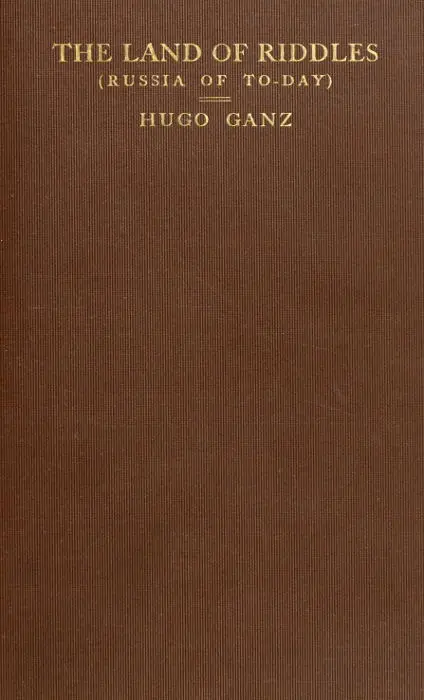
"The Land of Riddles (Russia of To-day)" by Hugo Ganz is a historical and political account written in the early 20th century. The book explores the complexities of Russia under autocracy, juxtaposing the nation's cultural achievements against its oppressive political conditions. Ganz offers insights into contemporary Russian society, commenting on the lives and struggles of various groups, including artists, political dissidents, and the significant Jewish population. The opening of the work introduces Ganz's motivations for traveling to Russia, largely driven by curiosity over the stark contrasts he perceives between its celebrated culture and brutal governance. The preface sets the tone, indicating that Ganz seeks to provide an unbiased account of the real situation in contemporary Russia, addressing the pervasive political oppression that hampers individual freedoms. As he approaches the Russian frontier by train, he shares his apprehensions about entering a country known for its strict police state while expressing a dedication to studying and documenting the realities of Russian life. His reflections reveal his thirst for knowledge and serve as a precursor to the observations that will unfold in the subsequent chapters, which promise to delve deep into the societal and political landscape of early 20th-century Russia.
Introduction adapted from the source catalogue; source summaries may be automatically generated.
Free to read · English · 77,045 words · No account needed
MAKE TIME FOR A GOOD BOOK
On by default. Untick to stop anonymous reading totals. Each page counts after 10 seconds in view. How this works.
Anonymous counting is on unless you have switched it off.
There is, in the first place, the pope (priest), and then the policeman.
The priests and the policemen are the handsomest persons in St. Petersburg. Although the flowing hair of the bearded priest, reaching to his shoulders, is not to be regarded as a characteristic peculiarity, since every third man in Russia displays long hair or profuse locks that would undoubtedly draw to their fortunate possessor in our land the attention of the street boys, still they are carefully chosen human material, tall, graceful men with handsome heads and proud mien. Notwithstanding this they are accorded but little reverence even among the bigoted Russians, for no matter how often and copiously these may cross themselves before every sacred image, they quite often experience, behind the priest, a sort of salvation which compels them suddenly to empty their mouths in a very demonstrative manner. This may be due to various kinds of superstition, which regard the meeting with a priest as very undesirable, but it finds its explanation also in the not always exemplary life of this servant of the Lord. He is especially accredited with a decided predilection for various distilled liquors that at times exert a doubtful influence on a man's behavior. One may see in St. Petersburg men wrapped in costly sable furs make the acquaintance of the street pavements, especially during the "butter-week," yet for spiritual garments the gutter is even less a place of legitimate rest, and, at any rate, it is difficult to acknowledge as the appointed interpreter of God's will a man whose mouth savors of an entirely different spirit than the "spiritus sanctus."
For all this, however, the Russian is filled, outwardly at least, and during divine services, with a devotion which, to us, is scarcely comprehensible. With fanatical fervor he kisses in church the hand of the same priest behind whose back he spat at the church door. His body never rests. As with the orthodox Jew and the howling dervish, his praying consists in an almost unceasing bowing, and a not at all inconsiderable application of gymnastics. He is perpetually crossing himself. Particularly fervent suppliants, of the female gender especially, can hardly satisfy themselves by kissing again and again the stone flags of the floor, the hem of the priest's coat, the sacred images, and the numberless relics. But how effective and mind-ensnaring is the orthodox church service. The glimmer of the innumerable small and large wax candles brought by most of the congregants fills the golden mist of the place with an unearthly light. Rubies, emeralds, and diamonds shine from the silver and gold crowns on the sacred images. The gigantic priest in his gold-embroidered vestments lets sound his deep, powerful, bass voice, and wonderful choirs answer him from both sides of the "ikonostas." Clouds of incense float through the high nave. The faithful, ranged one after another, intoxicate and carry one another by their devotion--a huge general hypnosis in which education and priestly art are equally concerned. The orthodox cult is not to be compared, at least in my opinion, with that of the Roman Catholics in the depth and nobility of the music and in the artistic arrangement of the service. But in its archaic monotony, in its use of the coarsest material stimuli, it is perhaps even more suggestive for the Eastern masses than is the other for the civilized peoples of the West. The quantity of gold, silver, and precious stones offered up, especially in the Isaac cathedral and in the Kazan cathedral--fashioned after that of St. Peter's in Rome--to give the faithful a conception of the just claims of Heaven on treasure and reverence, is beyond the belief of Europeans. The artistically excellent silver ornaments of the Isaac cathedral weigh not less than eleven thousand kilograms. A single copy of the New Testament is bound in twenty kilograms of gold. The sacred image made in commemoration of the catastrophe of Borki is almost entirely covered with diamonds. These endowments came, for the most part, from members of the imperial house. The union of church and state is more intimate here than elsewhere, and, apparently, even more profitable for the guardians of the altar. Among all the sacred relics and trophies of the St. Petersburg church, one impresses the foreigner above the others. It is a collection of silver gifts from the French, ranged along the wall of the Peter-and-Paul cathedral. By the side of the coffins of the Russian emperors and empresses, from Peter the Great to Alexander III., which one cannot pass without a peculiar feeling of historical respect, under innumerable flags and war trophies, there stand, as the greatest triumph that the despotic barbarian state has won from civilized Europe, the silver crowns and the shields of honor which Félix Faure, Casimir-Périer, the senate, the chamber, and the Parisian press presented to the Russian ally of France.
Your reading position is saved on this browser. Take it to another device with a library code. Reading pages adapt to text, rather than matching a printed edition.
BEHIND THE BOOK
This eBook is for the use of anyone anywhere in the United States and most other parts of the world at no cost and with almost no restrictions whatsoever. You may copy it, give it away or re-use it under the terms of the Project Gutenberg License included with this eBook or online at www.gutenberg.org. If you are not located in the United States, you will have to check the laws of the country where you are located before using this eBook. Read the source licence.
The original source file, including credits and licence, is retained by this library. Request an original-format copy at no charge. Please include the book title and Project Gutenberg identifier #56772.
KEEP YOUR CURIOSITY GOING
Cécile Tormay

Moritz Busch
John L. Ransom
Frances Wright
Cécile Tormay

Mabel Potter Daggett