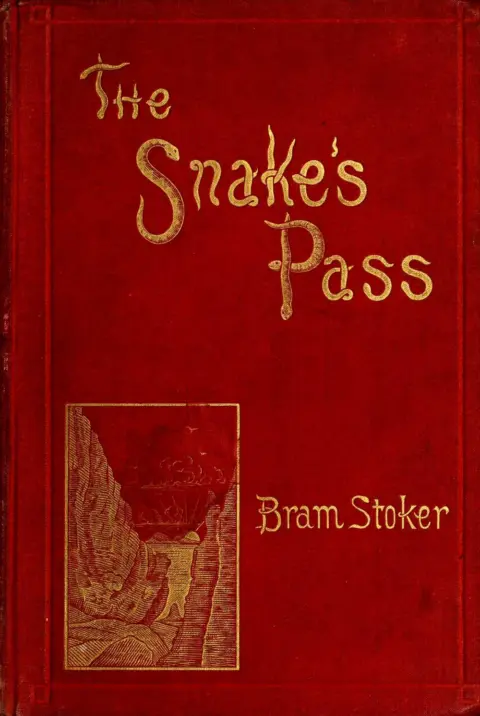
The Snake’s Pass
Bram Stoker
THE CLASSIC COLLECTION · 1909
"The Lady of the Shroud" by Bram Stoker is a novel published in 1909. Rupert Saint Leger must live a year in his uncle's Balkan castle to inherit a fortune. There he encounters a mysterious woman in a shroud who visits at night, leading him to believe she's a vampire. As he falls in love with her, political intrigue and Turkish invasions threaten the region, forcing Rupert to use modern technology and weaponry to protect both his love and his adopted homeland.
Introduction adapted from the source catalogue; source summaries may be automatically generated.
Free to read · English · 127,344 words · No account needed
MAKE TIME FOR A GOOD BOOK
On by default. Untick to stop anonymous reading totals. Each page counts after 10 seconds in view. How this works.
Anonymous counting is on unless you have switched it off.
"Well?" Father had a stern way with servants. When I'm head of the family I'll tread them under my feet. That's the way to get real devotion from servants!
"If you please, sir, I took the young gentleman into my room and ordered a nice breakfast for him, for I could see he was half famished--a growing boy like him, and so tall! Presently it came along. It was a good breakfast, too! The very smell of it made even me hungry. There were eggs and frizzled ham, and grilled kidneys, and coffee, and buttered toast, and bloater-paste--"
"That will do as to the menu," said mother. "Go on!"
"When it was all ready, and the maid had gone, I put a chair to the table and said, 'Now, sir, your breakfast is ready!' He stood up and said, 'Thank you, madam; you are very kind!' and he bowed to me quite nicely, just as if I was a lady, ma'am!"
"Go on," said mother.
"Then, sir, he held out his hand and said, 'Good-bye, and thank you,' and
he took up his cap.
"'But aren't you going to have any breakfast, sir?' I says.
"'No, thank you, madam,' he said; 'I couldn't eat here . . . in this house, I mean!' Well, ma'am, he looked so lonely that I felt my heart melting, and I ventured to ask him if there was any mortal thing I could do for him. 'Do tell me, dear,' I ventured to say. 'I am an old woman, and you, sir, are only a boy, though it's a fine man you will be--like your dear, splendid father, which I remember so well, and gentle like your poor dear mother.'
"'You're a dear!' he says; and with that I took up his hand and kissed it, for I remember his poor dear mother so well, that was dead only a year. Well, with that he turned his head away, and when I took him by the shoulders and turned him round--he is only a young boy, ma'am, for all he is so big--I saw that the tears were rolling down his cheeks. With that I laid his head on my breast--I've had children of my own, ma'am, as you know, though they're all gone. He came willing enough, and sobbed for a little bit. Then he straightened himself up, and I stood respectfully beside him.
"'Tell Mr. Melton,' he said, 'that I shall not trouble him about the
trustee business.'
"'But won't you tell him yourself, sir, when you see him?' I says.
Your reading position is saved on this browser. Take it to another device with a library code. Reading pages adapt to text, rather than matching a printed edition.
Bram Stoker
Bram Stoker
Bram Stoker
Bram Stoker
BEHIND THE BOOK
This eBook is for the use of anyone anywhere in the United States and most other parts of the world at no cost and with almost no restrictions whatsoever. You may copy it, give it away or re-use it under the terms of the Project Gutenberg License included with this eBook or online at www.gutenberg.org. If you are not located in the United States, you will have to check the laws of the country where you are located before using this eBook. Read the source licence.
The original source file, including credits and licence, is retained by this library. Request an original-format copy at no charge. Please include the book title and Project Gutenberg identifier #3095.
KEEP YOUR CURIOSITY GOING
Coulson Kernahan

Maurice Baring
Frances Wright
Cécile Tormay

Frederic Jesup Stimson

W. H. P. (William Henry Pope) Jarvis