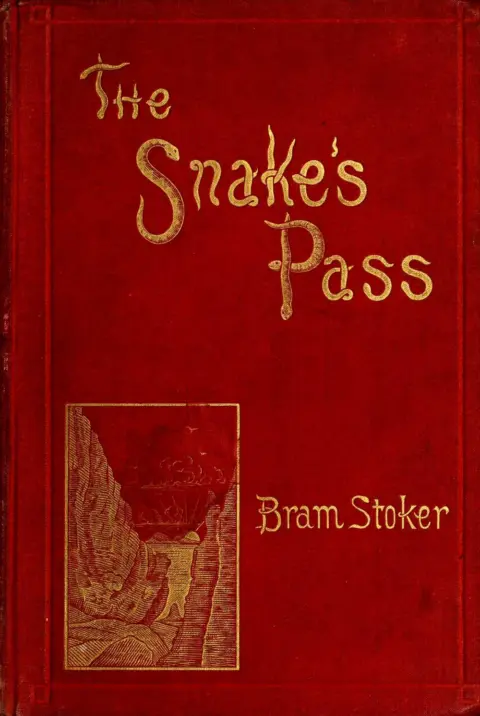
The Snake’s Pass
Bram Stoker
THE CLASSIC COLLECTION · 1909
"The Lady of the Shroud" by Bram Stoker is a novel published in 1909. Rupert Saint Leger must live a year in his uncle's Balkan castle to inherit a fortune. There he encounters a mysterious woman in a shroud who visits at night, leading him to believe she's a vampire. As he falls in love with her, political intrigue and Turkish invasions threaten the region, forcing Rupert to use modern technology and weaponry to protect both his love and his adopted homeland.
Introduction adapted from the source catalogue; source summaries may be automatically generated.
Free to read · English · 127,344 words · No account needed
MAKE TIME FOR A GOOD BOOK
On by default. Untick to stop anonymous reading totals. Each page counts after 10 seconds in view. How this works.
Anonymous counting is on unless you have switched it off.
Letter from Rupert Sent Leger to Roger Melton,
July 5, 1892.
Thank you heartily for your kind letter. I quite understand, and now see that I should not have asked you as a trustee, such a thing. I see your duty clearly, and agree with your view of it. I enclose a letter directed to my trustees, asking them to pay over annually till further direction to Miss Janet MacKelpie at this address whatever sum may remain over from the interest of my mother's bequest after deduction of such expenses as you may deem fit for my maintenance, clothing, and education, together with a sum of one pound sterling per month, which was the amount my dear mother always gave me for my personal use--"pocket-money," she called it.
With regard to your most kind and generous offer to give to my dear Aunt Janet the sum which I would have given myself, had such been in my power, I thank you most truly and sincerely, both for my dear aunt (to whom, of course, I shall not mention the matter unless you specially authorize me) and myself. But, indeed, I think it will be better not to offer it. Aunt Janet is very proud, and would not accept any benefit. With me, of course, it is different, for since I was a wee child she has been like another mother to me, and I love her very much. Since my mother died--and she, of course, was all-in-all to me--there has been no other. And in such a love as ours pride has no place. Thank you again, dear uncle, and God bless you.
Your loving nephew,
RUPERT SENT LEGER.
ERNEST ROGER HALBARD MELTON'S RECORD--Continued.
And now re the remaining one of Sir Geoffrey's children, Roger. He was the third child and third son, the only daughter, Patience, having been born twenty years after the last of the four sons. Concerning Roger, I shall put down all I have heard of him from my father and grandfather. From my grand-aunt I heard nothing, I was a very small kid when she died; but I remember seeing her, but only once. A very tall, handsome woman of a little over thirty, with very dark hair and light-coloured eyes. I think they were either grey or blue, but I can't remember which. She looked very proud and haughty, but I am bound to say that she was very nice to me. I remember feeling very jealous of Rupert because his mother looked so distinguished. Rupert was eight years older than me, and I was afraid he would beat me if I said anything he did not like. So I was silent except when I forgot to be, and Rupert said very unkindly, and I think very unfairly, that I was "A sulky little beast." I haven't forgot that, and I don't mean to. However, it doesn't matter much what he said or thought. There he is--if he is at all--where no one can find him, with no money or nothing, for what little he had he settled when he came of age, on the MacSkelpie. He wanted to give it to her when his mother died, but father, who was a trustee, refused; and Uncle Roger, as I call him, who is another, thought the trustees had no power to allow Rupert to throw away his matrimony, as I called it, making a joke to father when he called it patrimony. Old Sir Colin MacSkelpie, who is the third, said he couldn't take any part in such a permission, as the MacSkelpie was his niece. He is a rude old man, that. I remember when, not remembering his relationship, I spoke of the MacSkelpie, he caught me a clip on the ear that sent me across the room. His Scotch is very broad. I can hear him say, "Hae some attempt at even Soothern manners, and dinna misca' yer betters, ye young puddock, or I'll wring yer snoot!" Father was, I could see, very much offended, but he didn't say anything. He remembered, I think, that the General is a V.C. man, and was fond of fighting duels. But to show that the fault was not his, he wrung my ear--and the same ear too! I suppose he thought that was justice! But it's only right to say that he made up for it afterwards. When the General had gone he gave me a five-pound note.
Your reading position is saved on this browser. Take it to another device with a library code. Reading pages adapt to text, rather than matching a printed edition.
Bram Stoker
Bram Stoker
Bram Stoker
Bram Stoker
BEHIND THE BOOK
This eBook is for the use of anyone anywhere in the United States and most other parts of the world at no cost and with almost no restrictions whatsoever. You may copy it, give it away or re-use it under the terms of the Project Gutenberg License included with this eBook or online at www.gutenberg.org. If you are not located in the United States, you will have to check the laws of the country where you are located before using this eBook. Read the source licence.
The original source file, including credits and licence, is retained by this library. Request an original-format copy at no charge. Please include the book title and Project Gutenberg identifier #3095.
KEEP YOUR CURIOSITY GOING
Coulson Kernahan

Maurice Baring
Frances Wright
Cécile Tormay

Frederic Jesup Stimson

W. H. P. (William Henry Pope) Jarvis