THE CLASSIC COLLECTION✦Lost DiariesCLASSIC FREE BOOKS
Lost Diaries
Maurice Baring
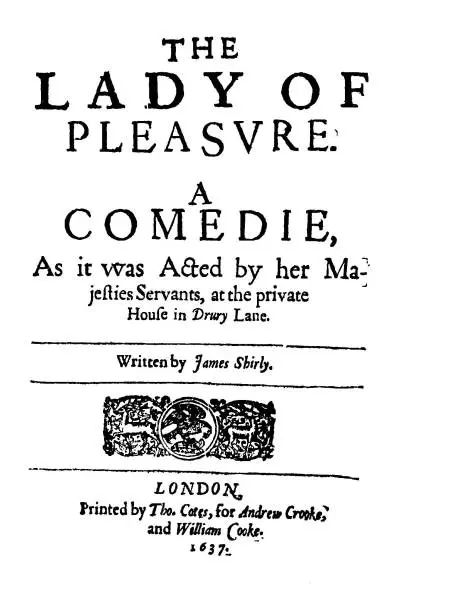
THE CLASSIC COLLECTION · 1637
"The Lady of Pleasure" by James Shirley is a Caroline era comedy of manners written in 1635. The play centers on Lady Bornwell, a wife devoted to courtly pleasures and extravagant spending, and her husband's attempts to reform her conduct. Through a three-level plot structure, Shirley explores themes of excess, moderation, and moral boundaries within aristocratic society. The play departs from typical Renaissance comedy formulas by featuring a philandering female protagonist and contrasting her behavior with the more virtuous young widow Celestina, creating a sophisticated examination of pleasure and propriety.
Introduction adapted from the source catalogue; source summaries may be automatically generated.
Free to read · English · 21,945 words · No account needed
MAKE TIME FOR A GOOD BOOK
On by default. Untick to stop anonymous reading totals. Each page counts after 10 seconds in view. How this works.
Anonymous counting is on unless you have switched it off.
Bo. Madam, I
Am sorry to suspect, and dare revenge.
Cel. No cause of mine. Bor. It must become me to attend you home.
Cel. You are noble--farewell Mushroomes.
Are. Is she gone. Li. I thinke we peperd her.
Al. I am glad tis over,
But I repent no service for you Madam.
Enter servant with a letter.
To me? from whence--a Iewell a good preface,
Be happy the conclusion.
Are. Some love letter----He smiles upont.
Lit. He has a hundred Mistresses, you may
Be charitable Madam I ha none,
He surfets, and I fall away i'th kidnyes.
Al. Ile meete,
Tis some great Lady questionlesse, that has
Taken notice, and would satisfie her appetite.
Are. Now Mr. Alexander, you looke bright o the suddaine,
Another spirit's in your eye.
Al. Not mine Madam,
Onely a summons to meete a friend.
Ar. What friend? Lit. By this Jewell, I know her not!
Ar. Tis a she friend, Ile follow gentlemen,
We may have a game at Sant before you goe.
Al. I shall attend you Madam. Li. Tis our duty.
Are. I blush while I converse with my owne thoughts, Some strange fate governes me, but I must on, The wayes are cast already, and we thrive When our sinne feares no eye nor perspective. Exit.
The fourth Act.
Enter two men leading Alexander, blinded, and goe off suddenly.
Al. I am not hurt, my patience to obey em
Not without feare to ha my throat cut else,
Did me a curtesie whither ha they brought me?
Tis devillish darke, the bottome of a well
At midnight, with but two starres on the top,
Were broad day to this darkenesse, I but thinke
How like a whirlewinde these rogues caught me up
And smoothered my eyesight, let me see,
These may be spirits, and for ought I know
Have brought me hither over twenty steeples,
Pray heaven they were not Bayliefes, thats more worth
My feare, and this a prison, all my debts
Reeke in my nostrill, and may bones beginne
To ake with feare to be made dice, and yet
This is too calme and quiet for a prison;
What if the riddle prove I am robd; and yet
I did not feele em search me? How now? musicke?
Enter Decoy like an old woman with a light.
Your reading position is saved on this browser. Take it to another device with a library code. Reading pages adapt to text, rather than matching a printed edition.
BEHIND THE BOOK
This eBook is for the use of anyone anywhere in the United States and most other parts of the world at no cost and with almost no restrictions whatsoever. You may copy it, give it away or re-use it under the terms of the Project Gutenberg License included with this eBook or online at www.gutenberg.org. If you are not located in the United States, you will have to check the laws of the country where you are located before using this eBook. Read the source licence.
The original source file, including credits and licence, is retained by this library. Request an original-format copy at no charge. Please include the book title and Project Gutenberg identifier #45050.
KEEP YOUR CURIOSITY GOING
Maurice Baring
W. B. (William Butler) Yeats
Edward Martyn

John Brougham & Charlotte Brontë
Marguerite Merington
Leonid Andreyev