
The Residuary Legatee; Or, The Posthumous Jest of the Late John Austin
Frederic Jesup Stimson
THE CLASSIC COLLECTION · 1884
"The King's Men: A Tale of To-morrow" by Robert Grant and others is a novel written in the late 19th century. The story unfolds in an alternate historical setting where England is reeling from the consequences of political upheaval, particularly after the abdication of King George V and the establishment of a republic. The primary character, Geoffrey Ripon, finds himself in a precarious position as the last heir of a once-great lineage, living in diminished circumstances and reflecting on the social changes around him. The beginning of the book introduces Geoffrey Ripon, who is living in a lodge once associated with his noble family, troubled by financial ruin and pondering the shifting social landscape of post-monarchical England. Through his interactions and observations, readers glimpse a society grappling with the consequences of radical change. The narrative sets up significant themes of class, nostalgia for the past, and the social dynamics of a world where titles and power are in disarray, hinting at more personal and political conflicts to come as various characters enter his life, including Margaret Windsor, the daughter of a wealthy American businessman who has taken residence in Ripon House. The opening chapters establish the tone and atmosphere, immersing the reader in a rich tapestry of historical context and character intrigue.
Introduction adapted from the source catalogue; source summaries may be automatically generated.
Free to read · English · 75,041 words · No account needed
MAKE TIME FOR A GOOD BOOK
On by default. Untick to stop anonymous reading totals. Each page counts after 10 seconds in view. How this works.
Anonymous counting is on unless you have switched it off.
"Only too late for supper," was the dry answer of the old banker, but
the tone was pleasant.
Through the hall, where those in waiting stood respectfully as she passed, the banker led her to a small, luxuriously furnished parlor on the ground floor. As she threw aside her wraps and sank into a soft chair, old Bugbee opened the door of an inner room, and turned to her:
"These are your apartments," said he.
The Beauty looked around, but said nothing, only nodding her head.
"You are very tired?" questioned old Bugbee.
"No; not very. But I should like some supper--and a glass of wine."
Mr. Bugbee touched a bell and gave an order.
"It is almost midnight?" she asked.
"It is after twelve--ten minutes. The morning of the great day has
come."
And the old banker looked into the eyes of the young Beauty, and almost smiled in response to her low, derisive laugh.
"He came to-day, then?" she asked.
"Yesterday," corrected Mr. Bugbee; "at noon, he landed from my
steam-yacht, in the very heart of London. So much for the international
police."
"Do they know?" said Mrs. Oswald Carey. "Does Sir John Dacre know?"
"Sir John Dacre helped the King into his carriage when he landed. He knows that he is here, and expects to meet him at Aldershot to-morrow."
While pretending to move and speak as if quite at ease, Mr. Bugbee was obviously nervous and unsettled. Mrs. Carey observed this, but without appearing to do so.
"Where is your husband?" Mr. Bugbee asked quietly, with his face turned from Mrs. Carey, whose side view he had before him in a low mirror. He saw her move in her chair, and slowly look him all over, and then glance down as if considering her answer.
"He is on the Continent--at Nice, I think."
She had dined with him that day, but did not know that from the dinner Oswald Carey had come straight to Mr. Bugbee's house to keep an appointment with the wily "King's Banker," who wished to know how the Beauty had spent the day, and whom she had seen.
"What a liar she is!" muttered old Bugbee, but he smiled at himself in the mirror, as if approving his superior astuteness.
"Then there is no danger of his making a noise about your absence from home to-night. Some husbands would be alarmed, and might apply to the police."
Mrs. Carey looked up to see if Bugbee were serious; and then she laughed heartily and rather loudly, while he held up his hands with an alarmed expression.
Your reading position is saved on this browser. Take it to another device with a library code. Reading pages adapt to text, rather than matching a printed edition.
Frederic Jesup Stimson
Robert Grant
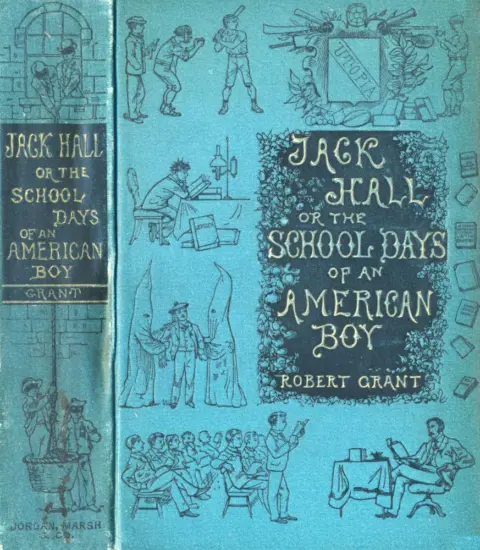
Robert Grant
John T. (John Tyler) Wheelwright
BEHIND THE BOOK
This eBook is for the use of anyone anywhere in the United States and most other parts of the world at no cost and with almost no restrictions whatsoever. You may copy it, give it away or re-use it under the terms of the Project Gutenberg License included with this eBook or online at www.gutenberg.org. If you are not located in the United States, you will have to check the laws of the country where you are located before using this eBook. Read the source licence.
The original source file, including credits and licence, is retained by this library. Request an original-format copy at no charge. Please include the book title and Project Gutenberg identifier #18960.
KEEP YOUR CURIOSITY GOING
Cécile Tormay

Moritz Busch
Coulson Kernahan
John L. Ransom

Maurice Baring
Frances Wright