
The Residuary Legatee; Or, The Posthumous Jest of the Late John Austin
Frederic Jesup Stimson
THE CLASSIC COLLECTION · 1884
"The King's Men: A Tale of To-morrow" by Robert Grant and others is a novel written in the late 19th century. The story unfolds in an alternate historical setting where England is reeling from the consequences of political upheaval, particularly after the abdication of King George V and the establishment of a republic. The primary character, Geoffrey Ripon, finds himself in a precarious position as the last heir of a once-great lineage, living in diminished circumstances and reflecting on the social changes around him. The beginning of the book introduces Geoffrey Ripon, who is living in a lodge once associated with his noble family, troubled by financial ruin and pondering the shifting social landscape of post-monarchical England. Through his interactions and observations, readers glimpse a society grappling with the consequences of radical change. The narrative sets up significant themes of class, nostalgia for the past, and the social dynamics of a world where titles and power are in disarray, hinting at more personal and political conflicts to come as various characters enter his life, including Margaret Windsor, the daughter of a wealthy American businessman who has taken residence in Ripon House. The opening chapters establish the tone and atmosphere, immersing the reader in a rich tapestry of historical context and character intrigue.
Introduction adapted from the source catalogue; source summaries may be automatically generated.
Free to read · English · 75,041 words · No account needed
MAKE TIME FOR A GOOD BOOK
On by default. Untick to stop anonymous reading totals. Each page counts after 10 seconds in view. How this works.
Anonymous counting is on unless you have switched it off.
Dacre walked to and fro with folded arms, while Geoffrey, slipping into his old jacket, which he had been rather surprised to find wrapped round his ancestor's sword, busied himself with the kettle and a bottle he had taken from a cupboard.
"Listen, Ripon--" said Dacre.
"Hold on, hold on, mine ancient friend," said the preoccupied Geoffrey, pouring hot water on the sugar in two glasses; "there's nothing like Irish whiskey when you're talking treason."
"Ah, Geoffrey," said Dacre, sadly, as the friends clinked their glasses, "men can live treason as well as talk it."
"Is that confession or reproach?"
"Reproach, Ripon. The life you live is daily treason to your country. You sit idly by while England descends from the heights of her renown and is clothed in the rags of the banditti who have obtained power over her."
"Banditti--who? The Republicans?"
"Republicans or Anarchists, whatever they be called; the blind and
immoral mob that has been misled by wretches to destroy their
motherland."
"Look here, Dacre, do you really mean to say that Republicanism is
immoral and unnatural?"
"Certainly; that is just what I mean."
"But look at America--the happiest, richest, most orderly and yet the most populous country in the world."
"I speak of Republicanism in England, not in America."
"But where is the difference?" persisted Geoffrey. "If the universal suffrage of the people be virtue in America, how can it be vice in England?"
"As the food of one life may be the poison of another," answered Dacre. "Human society has many forms, and all may be good, but each must be specially protected by its own public morality. England was reared into greatness and flourished in greatness for twenty hundred years on one unvarying order. America has developed under another order, a different but not a better one."
"That may be, but in less than two hundred years America has reached a point of wealth, order and peace that England has never approached in two thousand."
"America," continued Dacre, "had nothing to unlearn. Her people had no royal traditions--we have no democratic ones."
"There is something in that," said Geoffrey.
"There is everything in it. The Americans are true to their past, while we are false to ours. We are trampling on the glorious name and fame of our country. We are recreant to our position, intelligence, to our fathers' memories--or we shall be if we do not--"
"Do not what?" asked Geoffrey, as Dacre paused.
"If we do not unite and have another revolution!" answered Dacre, slowly
and firmly.
Your reading position is saved on this browser. Take it to another device with a library code. Reading pages adapt to text, rather than matching a printed edition.
Frederic Jesup Stimson
Robert Grant
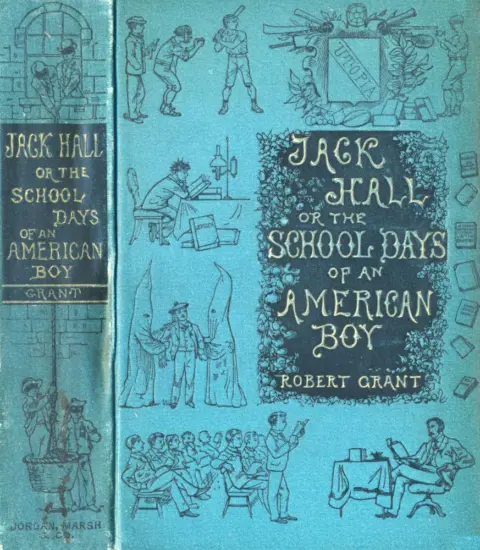
Robert Grant
John T. (John Tyler) Wheelwright
BEHIND THE BOOK
This eBook is for the use of anyone anywhere in the United States and most other parts of the world at no cost and with almost no restrictions whatsoever. You may copy it, give it away or re-use it under the terms of the Project Gutenberg License included with this eBook or online at www.gutenberg.org. If you are not located in the United States, you will have to check the laws of the country where you are located before using this eBook. Read the source licence.
The original source file, including credits and licence, is retained by this library. Request an original-format copy at no charge. Please include the book title and Project Gutenberg identifier #18960.
KEEP YOUR CURIOSITY GOING
Cécile Tormay

Moritz Busch
Coulson Kernahan
John L. Ransom

Maurice Baring
Frances Wright