
The Residuary Legatee; Or, The Posthumous Jest of the Late John Austin
Frederic Jesup Stimson
THE CLASSIC COLLECTION · 1884
"The King's Men: A Tale of To-morrow" by Robert Grant and others is a novel written in the late 19th century. The story unfolds in an alternate historical setting where England is reeling from the consequences of political upheaval, particularly after the abdication of King George V and the establishment of a republic. The primary character, Geoffrey Ripon, finds himself in a precarious position as the last heir of a once-great lineage, living in diminished circumstances and reflecting on the social changes around him. The beginning of the book introduces Geoffrey Ripon, who is living in a lodge once associated with his noble family, troubled by financial ruin and pondering the shifting social landscape of post-monarchical England. Through his interactions and observations, readers glimpse a society grappling with the consequences of radical change. The narrative sets up significant themes of class, nostalgia for the past, and the social dynamics of a world where titles and power are in disarray, hinting at more personal and political conflicts to come as various characters enter his life, including Margaret Windsor, the daughter of a wealthy American businessman who has taken residence in Ripon House. The opening chapters establish the tone and atmosphere, immersing the reader in a rich tapestry of historical context and character intrigue.
Introduction adapted from the source catalogue; source summaries may be automatically generated.
Free to read · English · 75,041 words · No account needed
MAKE TIME FOR A GOOD BOOK
On by default. Untick to stop anonymous reading totals. Each page counts after 10 seconds in view. How this works.
Anonymous counting is on unless you have switched it off.
"An eccentric Victorian poet," said the young man, "of much account in his own day, if I mistake not."
"I never heard of him," said Maggie, "but I am little of an antiquarian.
It is pretty, though."
"I remember," said he, "that we as children used to act theatricals here in those old clothes, duds we ransacked from the closets."
"But where is the ghost? I want to see the ghost!" cried the girl, tossing aside the last bit of tarnished finery. "What is this?" she continued, seizing the end of a beam which had become loosened and projected from the wall.
"You will have the house about our ears if you persist," he cried, as a shower of crumbled stone and mortar followed her investigation.
"Well, it is my house, Lord Brompton; I have the right if I choose to."
"Why remind me of my misfortunes, Miss Windsor?"
"Come and help me, then."
"I wish I might be your helpmate forever," he said. She turned and looked at him, slightly disconcerted, and then said: "I was wrong. The women of to-day need no help from any one."
She gave the beam a strong wrench, as though to vindicate her assertion. It yielded and disclosed a kind of box or recess set into the wall. She plunged therein her hand, and drew forth a handsome sword of rich and subtle workmanship and antique design. "There," she cried, "am I not right?"
Maggie took it to the light. Around the hilt was wrapped a scroll, which she was about to read, when, with a sudden fancy, she paused and said, "What am I doing? These are family secrets, and meant, perhaps, only for your eyes, Lord Brompton."
"Read it, I beg," said he. She obeyed him. In a faint, feminine hand, which resembled a field of corn bowed by the wind, were written these words:
"My grandfather's sword. MARIAN RIPON."
"The ghost--it is the ghost's own work," they cried together.
"And this sword," said he, "belonged to my namesake, the cavalier."
"But look--look." Maggie had been staring at the opposite side of the
paper.
Geoffrey took it from her hand.
"Kind hearts are more than coronets
And simple faith than Norman blood."
For a moment they looked at one another in speechless surprise.
"Kneel, Lord Brompton," she said at length. He did so, and taking a scarf from among the pile of vestments she girded the sword about him with fantastic grace. "Rise, Geoffrey Ripon, knight, and Earl of Brompton."
Your reading position is saved on this browser. Take it to another device with a library code. Reading pages adapt to text, rather than matching a printed edition.
Frederic Jesup Stimson
Robert Grant
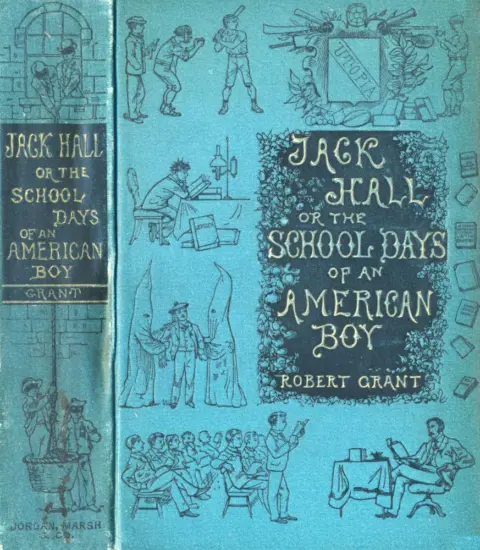
Robert Grant
John T. (John Tyler) Wheelwright
BEHIND THE BOOK
This eBook is for the use of anyone anywhere in the United States and most other parts of the world at no cost and with almost no restrictions whatsoever. You may copy it, give it away or re-use it under the terms of the Project Gutenberg License included with this eBook or online at www.gutenberg.org. If you are not located in the United States, you will have to check the laws of the country where you are located before using this eBook. Read the source licence.
The original source file, including credits and licence, is retained by this library. Request an original-format copy at no charge. Please include the book title and Project Gutenberg identifier #18960.
KEEP YOUR CURIOSITY GOING
Cécile Tormay

Moritz Busch
Coulson Kernahan
John L. Ransom

Maurice Baring
Frances Wright