
The Residuary Legatee; Or, The Posthumous Jest of the Late John Austin
Frederic Jesup Stimson
THE CLASSIC COLLECTION · 1884
"The King's Men: A Tale of To-morrow" by Robert Grant and others is a novel written in the late 19th century. The story unfolds in an alternate historical setting where England is reeling from the consequences of political upheaval, particularly after the abdication of King George V and the establishment of a republic. The primary character, Geoffrey Ripon, finds himself in a precarious position as the last heir of a once-great lineage, living in diminished circumstances and reflecting on the social changes around him. The beginning of the book introduces Geoffrey Ripon, who is living in a lodge once associated with his noble family, troubled by financial ruin and pondering the shifting social landscape of post-monarchical England. Through his interactions and observations, readers glimpse a society grappling with the consequences of radical change. The narrative sets up significant themes of class, nostalgia for the past, and the social dynamics of a world where titles and power are in disarray, hinting at more personal and political conflicts to come as various characters enter his life, including Margaret Windsor, the daughter of a wealthy American businessman who has taken residence in Ripon House. The opening chapters establish the tone and atmosphere, immersing the reader in a rich tapestry of historical context and character intrigue.
Introduction adapted from the source catalogue; source summaries may be automatically generated.
Free to read · English · 75,041 words · No account needed
MAKE TIME FOR A GOOD BOOK
On by default. Untick to stop anonymous reading totals. Each page counts after 10 seconds in view. How this works.
Anonymous counting is on unless you have switched it off.
"However, I have become resigned. I was born under an unlucky star, and the uninvited bad fairy at my christening, after the others had given me beauty, riches, and wit, hopped in malevolently upon her crutch and shouted in a disagreeable falsetto: 'He shall have all these, to be sure, but he shall have a poor digestion and the gout!' and whirled away on the evening wind astride her broomstick."
Mr. Windsor laughed out loud; the Duke seemed annoyed at this, and, begging not to be interrupted again, continued his reading in a rather offended tone:
"Since your escape I have been under the strictest surveillance, and as I have recovered from my gout I have been set to work upon the ignoble task of breaking stone into small bits with a hammer. I am known as No. 5, and am called by no other name. Imagine me, who found it so difficult to look out for Number One, having to care for No. 5. Indeed, I should find it well-nigh impossible were it not for the assistance which I have from the warders and turnkeys, who look after me with a touching solicitude. No physician could have kept me to a regimen so suitable for my health as strictly as they. You remember how I used to enjoy lying abed in the morning. What a pleasure it was to wake up, to feel that the busy world was astir around you, and lie half awake, half asleep, stretching your toes into cool recesses of a soft, luxurious bed. But it made me idle, very idle. But now I must be off my hard cot, be dressed and have my cot made up by half-past five; then I breakfast off a piece of bread, washed down with a pint of unsweetened rye coffee innocent of milk, drunk au naturel out of a tin pail. And how I miss my after-breakfast cigar and the Times, as I put my hands upon a fellow-convict's shoulder and march in slow procession to my task. The work of breaking a large piece of stone into smaller bits with a hammer is not an intellectual one; but it has got me into tolerable training; I have lost twenty pounds already, and am, as we used to say at the university, as 'hard as nails.' I am afraid that my old trousers, which my tailor used to let out year by year, would be a world too large for my shrunk shanks now. I dine at noon, as you remember, and for the first time in my life I do not dress for dinner; indeed, a white cravat and a dress coat would be inappropriate, when one sits down to bean porridge and boiled beef served in the same tin plate. But I have a good appetite after my pulverizing of the morning, and I am not compelled to set the table in a roar under duress. I am surprised what good things I think of now that I am not expected to and have no one to whom to say them. Jawkins would double my salary could he get me out. Rye coffee is a poor substitute for Chambertin, but it does not aggravate my gout. After dinner I return to my stone-breaking, and feel with delight my growing biceps muscle, and after my supper, which is monotonously like my breakfast, I tackle the tracts, which are left with me by kindly souls. They are of a class of literature which I have neglected since childhood, having, as you may remember, a leaning toward 'facetiae.' In fact, since my great-aunt's withdrawal to another world, where it may be hoped that the stones are more brittle and the coffee better, I have seen none. I cannot say that I have been comforted by the tracts, but I have been interested by them, and I spend the brief hours of leisure which are vouchsafed to me in annotating my editions. And yet, my dear Duke, unfortunate as my situation is, I would not exchange places with my old self, a hired jester at rich men's tables, selling myself for a dinner which I could not digest, nor with that wretched monarch, in whose cause we all suffered, who left his gallant gentleman to die for his cause while he pursued his selfish pleasures. If it were chance that I get out of here, I shall strive to earn my bread, in the appointed way, by the sweat of my brow, and to work with my fellow-men. Present my kindest regards to our good friend Mr. Windsor, who has dared so much for our sake, and believe me, my dear old friend,
Your reading position is saved on this browser. Take it to another device with a library code. Reading pages adapt to text, rather than matching a printed edition.
Frederic Jesup Stimson
Robert Grant
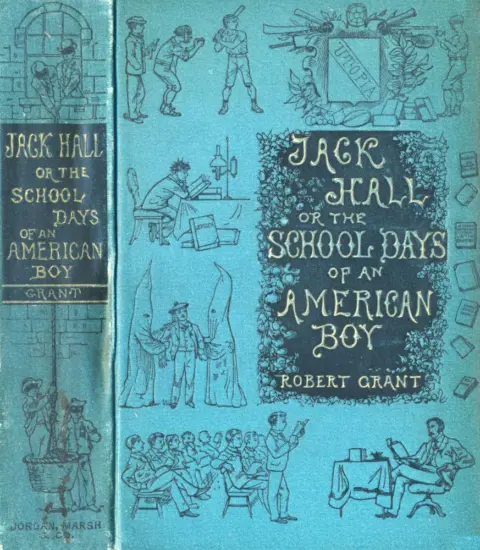
Robert Grant
John T. (John Tyler) Wheelwright
BEHIND THE BOOK
This eBook is for the use of anyone anywhere in the United States and most other parts of the world at no cost and with almost no restrictions whatsoever. You may copy it, give it away or re-use it under the terms of the Project Gutenberg License included with this eBook or online at www.gutenberg.org. If you are not located in the United States, you will have to check the laws of the country where you are located before using this eBook. Read the source licence.
The original source file, including credits and licence, is retained by this library. Request an original-format copy at no charge. Please include the book title and Project Gutenberg identifier #18960.
KEEP YOUR CURIOSITY GOING
Cécile Tormay

Moritz Busch
Coulson Kernahan
John L. Ransom

Maurice Baring
Frances Wright