
The Residuary Legatee; Or, The Posthumous Jest of the Late John Austin
Frederic Jesup Stimson
THE CLASSIC COLLECTION · 1884
"The King's Men: A Tale of To-morrow" by Robert Grant and others is a novel written in the late 19th century. The story unfolds in an alternate historical setting where England is reeling from the consequences of political upheaval, particularly after the abdication of King George V and the establishment of a republic. The primary character, Geoffrey Ripon, finds himself in a precarious position as the last heir of a once-great lineage, living in diminished circumstances and reflecting on the social changes around him. The beginning of the book introduces Geoffrey Ripon, who is living in a lodge once associated with his noble family, troubled by financial ruin and pondering the shifting social landscape of post-monarchical England. Through his interactions and observations, readers glimpse a society grappling with the consequences of radical change. The narrative sets up significant themes of class, nostalgia for the past, and the social dynamics of a world where titles and power are in disarray, hinting at more personal and political conflicts to come as various characters enter his life, including Margaret Windsor, the daughter of a wealthy American businessman who has taken residence in Ripon House. The opening chapters establish the tone and atmosphere, immersing the reader in a rich tapestry of historical context and character intrigue.
Introduction adapted from the source catalogue; source summaries may be automatically generated.
Free to read · English · 75,041 words · No account needed
MAKE TIME FOR A GOOD BOOK
On by default. Untick to stop anonymous reading totals. Each page counts after 10 seconds in view. How this works.
Anonymous counting is on unless you have switched it off.
"Colonel Gardener, take command here," said Devereux to an officer in the horror-struck staff; "and you, gentlemen," designating three or four of the staff by a motion of his hand, "follow me." He wheeled his horse and rode straight for the mess-tent, where the royal banner was flying.
A young artillery officer, with one Gatling gun and a dozen troopers, were galloping toward the place from another direction. They reached the tent at the same moment as Colonel Devereux.
"Halt!" he shouted to the gunners, and the mounted party stopped as if
turned to stone.
"Haul down that flag!" he ordered Dacre, pointing with his naked sword.
"Never!" answered Dacre, standing at the foot of the mast.
Colonel Devereux gave a stern command to the officer of the gun; the piece was trained on the flagstaff, and next instant, with a hellish roar, its sixty bullets tore the flag-pole into shreds, and the enormous banner cumbered the wet earth.
Before the discharge Geoffrey had bodily seized Dacre and dragged him out of range. Better, perhaps, had he left him to his fate, for death at that moment, with his duty done, his sword in hand and his flag above him, would have saved him the deeper agony of shame and disappointment, which walked with him like shadows henceforward to the grave.
The officer in charge of the gun ordered his troopers and drivers to ride across the fallen banner; and the hoofs and muddy wheels rent it to pieces and befouled it in the mire.
"You are a coward!" cried Dacre, and rushing to the front he crossed swords with the mounted officer, wounding him in the arm. Next moment he was stretched senseless on the ill-fated flag, a gunner having struck him down with the stock of his carbine.
The others yielded without a word. The artillery officer, his hand dripping blood, took their swords one by one and flung them contemptuously on the flag, beside John Dacre's senseless body.
As they were marched off, surrounded by a cavalry guard, to be taken to London, Mr. Sydney, seeing that the Duke of Bayswater could hardly keep up, gave his arm to the infirm old man.
"This is a grim joke," said Sydney; "I wonder what they will do with our
friend Dacre."
"Thanks," said the poor old fellow, leaning heavily on Sydney, and putting up his collar to keep out the rain. Then he turned a last look at Dacre, still lying as he had fallen. "If he is dead, I suppose they will bury him like a Christian gentleman, as he was." And, raising his hat, the courtly old man saluted the fallen soldier.
Your reading position is saved on this browser. Take it to another device with a library code. Reading pages adapt to text, rather than matching a printed edition.
Frederic Jesup Stimson
Robert Grant
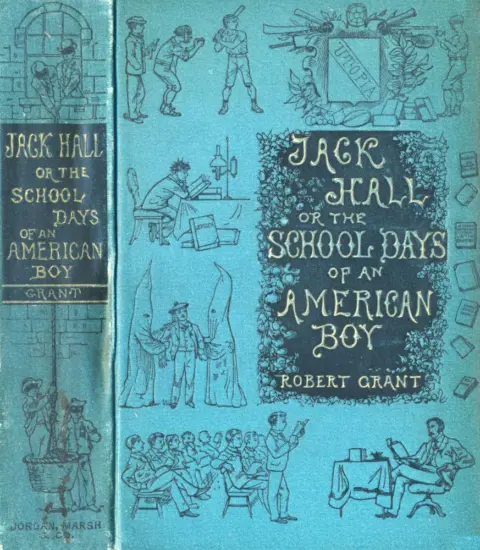
Robert Grant
John T. (John Tyler) Wheelwright
BEHIND THE BOOK
This eBook is for the use of anyone anywhere in the United States and most other parts of the world at no cost and with almost no restrictions whatsoever. You may copy it, give it away or re-use it under the terms of the Project Gutenberg License included with this eBook or online at www.gutenberg.org. If you are not located in the United States, you will have to check the laws of the country where you are located before using this eBook. Read the source licence.
The original source file, including credits and licence, is retained by this library. Request an original-format copy at no charge. Please include the book title and Project Gutenberg identifier #18960.
KEEP YOUR CURIOSITY GOING
Cécile Tormay

Moritz Busch
Coulson Kernahan
John L. Ransom

Maurice Baring
Frances Wright