THE CLASSIC COLLECTION✦My diaries, being a personal narrative of events 1888-1914, Part 2 (1900-1914)CLASSIC FREE BOOKS
My diaries, being a personal narrative of events 1888-1914, Part 2 (1900-1914)
Wilfrid Scawen Blunt
THE CLASSIC COLLECTION · 1898
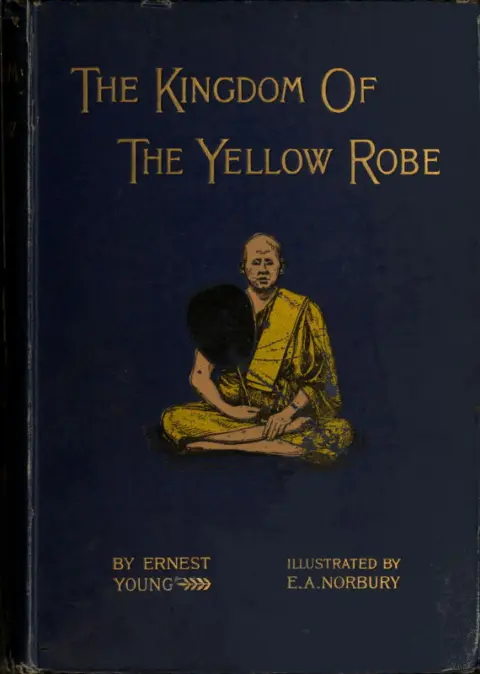
"The Kingdom of the Yellow Robe" by Ernest Young is a collection of sketches focused on the domestic and religious rites and ceremonies of the Siamese, written in the late 19th century. This work emerges from the author's extensive firsthand observations during his years of residence in Bangkok, offering readers insights into the cultural fabric of Siam. The book vividly explores various aspects of Siamese life, including the social dynamics, customs, and religious practices of the people. At the start of the book, the author introduces Bangkok, portrayed as the "Venice of the East," and provides a historical backdrop regarding the transition of the capital from Ayuthia. Young describes the bustling street life, populated predominantly by the working Chinese, amidst the vibrant chaos of vendors, priests, and local characters. This section paints a lively picture of the sights, sounds, and smells of the city while hinting at the cultural nuances that will be explored further in the book, including domestic life, marriage customs, and religious ceremonies, all interwoven with the author's keen observations and engaging narrative style.
Introduction adapted from the source catalogue; source summaries may be automatically generated.
Free to read · English · 97,493 words · No account needed
MAKE TIME FOR A GOOD BOOK
On by default. Untick to stop anonymous reading totals. Each page counts after 10 seconds in view. How this works.
Anonymous counting is on unless you have switched it off.
The four roads to Iddhi are the four bases of Saintship by which it is obtained. They are: (1) the will to acquire it; (2) the necessary exertion; (3) the necessary preparation of the heart; (4) investigation.
The five moral Powers are--Faith, Energy, Recollection, Contemplation,
Intuition.
The seven kinds of Wisdom are--Energy, Recollection, Contemplation, Investigation of Scripture, Joy, Repose and Serenity.
The noble Eightfold Path which leads to Nirvana comprises: (1) Right belief; (2) Right aims; (3) Right words; (4) Right behaviour; (5) Right mode of livelihood; (6) Right exertion; (7) Right mindfulness; (8) Right meditation and tranquillity.
All these different Powers, Laws, etc., are again subdivided and re-subdivided; but the above lines will be sufficient to outline the moral philosophy of that system which not only the priests should bear out in their lives, but to which every true believer in Buddhism is expected to conform. Practically, however, these counsels are so many obsolete laws, long since dead and forgotten. Outside the permanent priests and a few students, the vast majority of the people know nothing whatever about the system, and if some of the learned writers upon Buddhism in Europe were to preach their Buddhist sermons to the subjects of the only independent Buddhist king remaining, the people would stare in wonder at their new teachers and ask one another what strange doctrines were these that were being preached unto them.
Buddha's own sermons as to the duties of the priesthood are worth a moment's notice, though the priests as a rule have never heard them, or heard them with indifferent ears. The following passages are quoted from the book mentioned above, and are translations of passages in those sermons whose authenticity is established.
"He who, himself not stainless,
Would wrap the yellow-stained robe around him,
He, devoid of self-control and honesty
Is unworthy of the yellow robe."
"But he who, cleansed from stains,
Is well grounded in the Precepts,
And full of honesty and self-restraint
'Tis he who's worthy of the yellow robe."
"The restrained in hand, restrained in foot, Restrained in speech, the best of self-controlled; He whose delight is inward, who is tranquil And happy when alone--him they call mendicant."
"The mendicant who controls his tongue, speaking
Wisely, and is not puffed up,
Who throws light on worldly and on Heavenly things,
His word is sweet."
"Let his livelihood be kindliness,
His conduct righteousness,
Then, in the fulness of gladness,
He will make an end of grief."
"As the Vassika plant casts down its withered blossoms So cast out utterly, O mendicants, ill-will and lust."
"Do no violence to a Brahman,
But neither let him fly at his aggressor.
Woe to him who strikes a Brahman;
More woe to him who strikes the striker."
Your reading position is saved on this browser. Take it to another device with a library code. Reading pages adapt to text, rather than matching a printed edition.
BEHIND THE BOOK
This eBook is for the use of anyone anywhere in the United States and most other parts of the world at no cost and with almost no restrictions whatsoever. You may copy it, give it away or re-use it under the terms of the Project Gutenberg License included with this eBook or online at www.gutenberg.org. If you are not located in the United States, you will have to check the laws of the country where you are located before using this eBook. Read the source licence.
The original source file, including credits and licence, is retained by this library. Request an original-format copy at no charge. Please include the book title and Project Gutenberg identifier #48111.
KEEP YOUR CURIOSITY GOING
Wilfrid Scawen Blunt
Wilfrid Scawen Blunt

E. W. (Edgar Watson) Howe

David Patterson (Spirit) Hatch

David Patterson (Spirit) Hatch

David Patterson (Spirit) Hatch