THE CLASSIC COLLECTION✦My diaries, being a personal narrative of events 1888-1914, Part 2 (1900-1914)CLASSIC FREE BOOKS
My diaries, being a personal narrative of events 1888-1914, Part 2 (1900-1914)
Wilfrid Scawen Blunt
THE CLASSIC COLLECTION · 1888
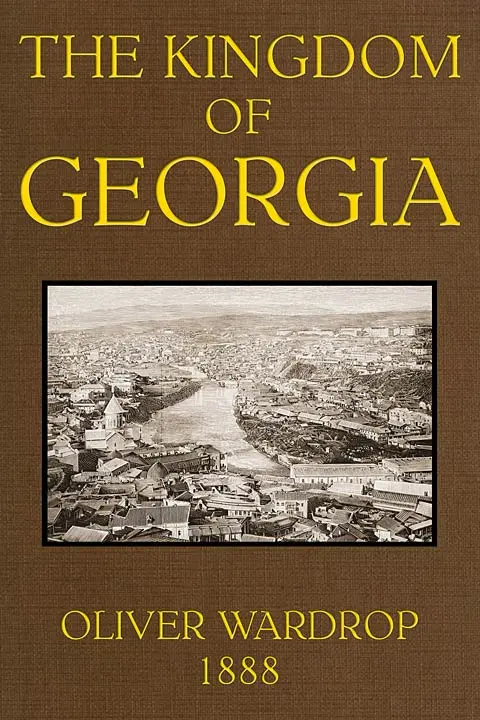
"The Kingdom of Georgia: Notes of Travel in a Land of Women, Wine, and Song" by Oliver Wardrop is a historical travelogue written in the late 19th century. This work chronicles Wardrop's observations and experiences during his travels through Georgia, a region rich in culture, literature, and scenic beauty. The narrative explores the social landscape of Georgia, including its distinct peoples, traditions, and the allure of its natural settings, while highlighting lesser-known aspects of the country's history and politics. The opening of the travelogue sets the stage for Wardrop's exploration by providing an overview of his journey, beginning with his arrival at Batum. He describes the town's mixed surroundings, noting both its charm and its shortcomings, while also detailing his interactions and experiences upon arrival. From the bustling streets filled with diverse peoples to the beautiful landscapes contrasted with squalor, Wardrop paints a vivid picture of Georgian life. His observations extend to societal norms, local governance, and the geographical significance of places he visits, such as Tiflis and Mtzkhet, which serve as key highlights in understanding not only the country’s spiritual heritage but also its complex historical narratives.
Introduction adapted from the source catalogue; source summaries may be automatically generated.
Free to read · English · 42,618 words · No account needed
MAKE TIME FOR A GOOD BOOK
On by default. Untick to stop anonymous reading totals. Each page counts after 10 seconds in view. How this works.
Anonymous counting is on unless you have switched it off.
It is sincerely to be hoped that the present good feeling between the Georgian and Russian peoples may continue. If they were kindly treated, and trusted with some measure of local government, I am sure that the Christian peoples of the Caucasus would never cause the Tsar's ministers any trouble; but if an attempt be made to crush the national spirit, the descendants of the men who fought under Irakli will, at least, show despots how men can die.
The standard work on Transcaucasian bibliography is Miansarov (M.), Bibliographia Caucasica et Transcaucasica. S. Pbg., 1874-76, 8vo, 804 pp., 4840 refs. It is rather scarce, as the edition was limited to 600 copies. Only one volume has been published, although a second was promised. Most of the works mentioned are in Russian or Armenian, and as far as European publications are concerned, Miansarov is very incomplete. In the following pages I have referred to comparatively few Russian books.
After Miansarov, the following, among many others, may with advantage
be consulted:--
Catalogue de la Section des Russica, published by Bibl. imp. publ. de St. Pbg., 1873. 2 vols. 8vo. Semenov (P.), Geografichsko-statistichskii slovar Rosiiskoi Imperii. Pbg., 1863-1885. 5 vols. 4to. Stuckenberg (J. Ch.), Versuch eines Quellen-Anzeigers ... fuer das Studium der Geographie ... des Russischen Reichs. Pbg., 1849-1852. 2 vols. 8vo.
I am fully conscious of the shortcomings of this essay, and shall be glad to find it extended and corrected by later writers, to whom it may serve as a groundwork.
Works of special interest are marked *.
* Brosset (M. F.), Description géographique de la Géorgie par le Tsarévitch Wakhoucht. Texte géorgien suivi d'une traduction française. Avec 6 cartes lith. S. Pbg. Acad. Scient., 1842. 4 to.
Wakhoucht wrote to the local authorities all over the country, asking each for information about his own district; the present standard work was the result of his inquiries.
Ancient Geography.
Cf. Apollonius Rhodius, Strabo, Plinius, Arrianus, Ptolemæus, C. Rommel's Caucasiarum Regionum et gentium straboniana descriptio. Lipsiæ, 1804. 8vo.
Luenemann (G. H.), Descriptio Caucasi. Lipsiæ, 1803. 4to.
Carli (Joh. Rinaldi), De expeditione Argonautorum in Colchidem. Venet.,
1745. 2 vols. 4to.
Vivien de St. Martin (Louis), Mémoire historique sur la géographie ancienne du Caucase. Paris, 1848.
---- ----, Etude géographique sur le Caucase de Strabon. In Etudes
de Géogr. Anc. Paris, 1852.
Preller (E.), Bedeutung des schwarzen Meeres fuer die Handel und Verkehr der alten Welt. Dorpat, 1842. 8vo.
Mediæval Geography.
Stephanus Byzantinus, Massudi, Abulfeda.
Defrémery, Fragments de géographes et d'historiens arabes et persans inédits, relatifs aux anciens peuples du Caucase. In Nouv. Journ. Asiat., 1849-1851. Paris.
Your reading position is saved on this browser. Take it to another device with a library code. Reading pages adapt to text, rather than matching a printed edition.
BEHIND THE BOOK
This eBook is for the use of anyone anywhere in the United States and most other parts of the world at no cost and with almost no restrictions whatsoever. You may copy it, give it away or re-use it under the terms of the Project Gutenberg License included with this eBook or online at www.gutenberg.org. If you are not located in the United States, you will have to check the laws of the country where you are located before using this eBook. Read the source licence.
The original source file, including credits and licence, is retained by this library. Request an original-format copy at no charge. Please include the book title and Project Gutenberg identifier #48403.
KEEP YOUR CURIOSITY GOING
Wilfrid Scawen Blunt
Wilfrid Scawen Blunt

E. W. (Edgar Watson) Howe
Cécile Tormay

Moritz Busch
John L. Ransom