THE CLASSIC COLLECTION✦The story of Keedon BluffsCLASSIC FREE BOOKS
The story of Keedon Bluffs
Charles Egbert Craddock
THE CLASSIC COLLECTION · 1897
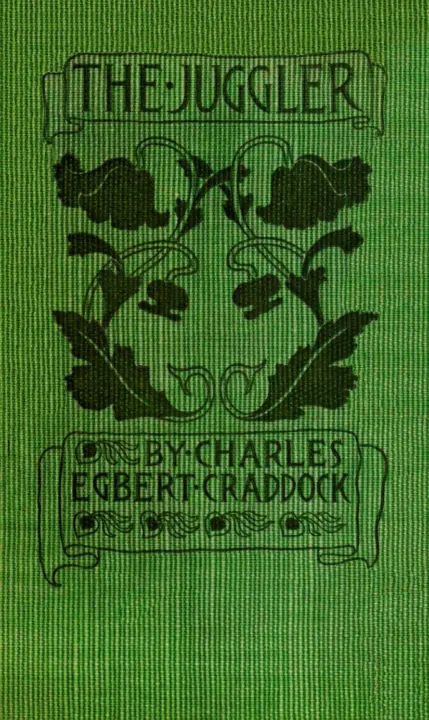
"The Juggler" by Charles Egbert Craddock is a novel written in the late 19th century. Set in a remote mountain community in Tennessee, it revolves around a mysterious juggler who arrives in Etowah Cove, surprising the locals with his extraordinary performances. The story explores themes of superstition, the clash between tradition and the unknown, and the complexities of human interaction in a close-knit society. At the start of the narrative, the arrival of the juggler heralds a significant change in the mundane lives of the inhabitants of Etowah Cove, who have only been accustomed to religious gatherings and schooling in their little log schoolhouse. His initial act, which includes swallowing a bayonet and the ensuing chaos among the audience, sets a tone of both curiosity and conflict, especially as it draws the ire of a local preacher condemning such antics as devilish. As the juggler navigates the reactions of the crowd, his internal turmoil and past hauntings surface, hinting at deeper issues that may threaten his safety in this superstitious community. With the excitement of the show juxtaposed against the juggler’s own anxieties, the opening chapters lay a rich foundation for exploring the intricate dynamics at play in the story.
Introduction adapted from the source catalogue; source summaries may be automatically generated.
Free to read · English · 101,421 words · No account needed
MAKE TIME FOR A GOOD BOOK
On by default. Untick to stop anonymous reading totals. Each page counts after 10 seconds in view. How this works.
Anonymous counting is on unless you have switched it off.
“And now you’ll live forever!” cried the disappointed speculator, suddenly recognizing, in the uncertain light on the platform of the car, the features of the stalwart cestui que vie. Once more he was chewing hard on his cigar, once more inveighing against his accursed luck, as he stretched the newspaper toward the dull lamp of the car, indicating with a trembling hand the big head-lines chronicling the discovery, while the cumbrous vehicle went gliding along through the blue haze of the dusk and the smoke and the dust,--the medium through which the looming blocks of buildings and the long double file of electric lights were visible down the avenue. “You’ll live forever, while those men make millions on the tract they euchred me out of at ten dollars an acre! It would be a charity for you to fall off the car and break your backbone. They tell me concussion of the brain is painless. I’ll swear I’d feel justified if I should hide in a dark alley, some night, and garrote you as you go by to the club.”
“There’s another case of garroting in the paper,” observed a mutual acquaintance by way of diversion.
“I noticed it. That’s what reminded me of it. It’s like lassoing. I lived a long time in Texas,” he said, as he swung himself off at a side-street, and disappeared in the closing haze that baffled the incandescent lights showing upon its density in yellow blurs without illuminating it.
“You’d better look out for that man, sure enough,” the literal-minded mutual acquaintance warned Lucien Royce. “He feels mighty sore. This company is going to make ‘big money’ on his land.”
But Royce laughed it off. “I am the one who lives,” he boasted.
He found it not altogether so careless an existence since it was worth so much financially. His acute sensibilities realized a sort of espionage before he was definitely aware of it. He came to know that he was reckoned up. What he did, where he went, how he felt, were matters in which other people were concerning themselves. He resented the irksome experience as an attack on his liberty. He felt no longer a free man. And this impression grew as the yield from the property promised more and more. The Bonley Company had gone to heavy expenses. They had put in costly machinery. They had hired gangs and gangs of men. They had built miles of narrow-gauge railroad, to convey the stone by land as well as by water. It had become a gigantic venture. The jocose “Take care!” “Live for my sake!” “Be good to yourself!” which had at first formed the staple of the injunctions to him when he chanced to encounter any member of the company, changed to serious solicitous inquiry which affronted him. More than once Mr. Bonley called upon him to remonstrate about late hours, heavy suppers, and the disastrous effects upon the constitution of drinking wine and strong waters. Thus the rubicund Mr. Gerault Bonley, whose countenance was brilliant with the glow of old Rye! In one instance, when Royce’s somewhat cavalier and scornful reception of these kind attentions served to rouse Mr. Bonley to the realization that the cestui que vie claimed the right to have other objects in existence than merely to live for the corporation’s sake, the president of the company apologized, but urged him to consider, for the justification of this anxiety, what large financial interests and liabilities hung upon the thread of his life. There was a panic among the company whenever he went to the seashore for a short vacation, and once he allowed himself to be persuaded out of a trip to Europe, of which acquiescence he was afterward ashamed,--so much so that when a place in the office of the Bonley Company was offered him, with a large increase of salary, but with the unavowed purpose of keeping him under surveillance, that he might always be at hand and easily reckoned up, he declined it with such peremptoriness as to cause the company to relax this unwise exhibition of solicitude for the time, and greatly to please his own firm, Greenhalge, Gould & Fife, who had not relished the effort to decoy a confidential clerk from their employ. On one occasion when, in training for a boat-race, he was suddenly prostrated by the heat, the anxiety of the Gerault Bonley Marble Company knew no bounds, and its manifestation more than verged upon the ridiculous; it was the joke of the whole town. The claims of his own personal friends--he had no near relatives--were set at naught. The company took possession of him. He came to himself in one of the well-appointed guest-chambers of Mr. Bonley’s own house; and when he rallied, which he did almost immediately, with the recuperative powers of youth and his great strength, he was detained there several days longer than was necessary by his host’s insistence, until indeed the physician in charge laughed in the face of Mr. Gerault Bonley, the broker.
Your reading position is saved on this browser. Take it to another device with a library code. Reading pages adapt to text, rather than matching a printed edition.
Charles Egbert Craddock
Charles Egbert Craddock
Charles Egbert Craddock
Charles Egbert Craddock
BEHIND THE BOOK
This eBook is for the use of anyone anywhere in the United States and most other parts of the world at no cost and with almost no restrictions whatsoever. You may copy it, give it away or re-use it under the terms of the Project Gutenberg License included with this eBook or online at www.gutenberg.org. If you are not located in the United States, you will have to check the laws of the country where you are located before using this eBook. Read the source licence.
The original source file, including credits and licence, is retained by this library. Request an original-format copy at no charge. Please include the book title and Project Gutenberg identifier #72930.
KEEP YOUR CURIOSITY GOING
Coulson Kernahan

Maurice Baring
Frances Wright
Cécile Tormay

Frederic Jesup Stimson

W. H. P. (William Henry Pope) Jarvis