THE CLASSIC COLLECTION✦The story of Keedon BluffsCLASSIC FREE BOOKS
The story of Keedon Bluffs
Charles Egbert Craddock
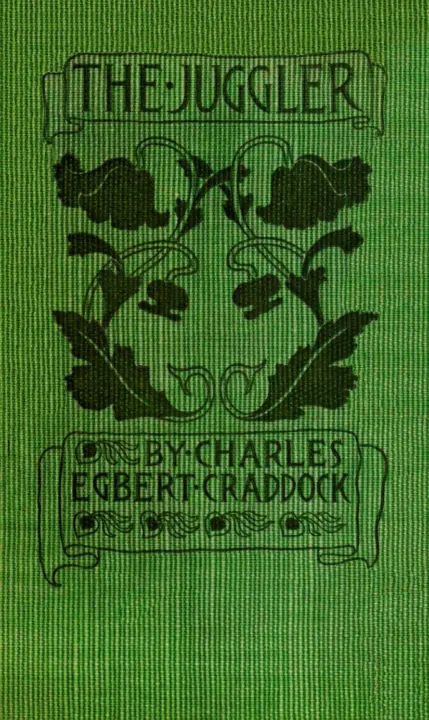
THE CLASSIC COLLECTION · 1897
"The Juggler" by Charles Egbert Craddock is a novel written in the late 19th century. Set in a remote mountain community in Tennessee, it revolves around a mysterious juggler who arrives in Etowah Cove, surprising the locals with his extraordinary performances. The story explores themes of superstition, the clash between tradition and the unknown, and the complexities of human interaction in a close-knit society. At the start of the narrative, the arrival of the juggler heralds a significant change in the mundane lives of the inhabitants of Etowah Cove, who have only been accustomed to religious gatherings and schooling in their little log schoolhouse. His initial act, which includes swallowing a bayonet and the ensuing chaos among the audience, sets a tone of both curiosity and conflict, especially as it draws the ire of a local preacher condemning such antics as devilish. As the juggler navigates the reactions of the crowd, his internal turmoil and past hauntings surface, hinting at deeper issues that may threaten his safety in this superstitious community. With the excitement of the show juxtaposed against the juggler’s own anxieties, the opening chapters lay a rich foundation for exploring the intricate dynamics at play in the story.
Introduction adapted from the source catalogue; source summaries may be automatically generated.
Free to read · English · 101,421 words · No account needed
MAKE TIME FOR A GOOD BOOK
On by default. Untick to stop anonymous reading totals. Each page counts after 10 seconds in view. How this works.
Anonymous counting is on unless you have switched it off.
He made haste to leave the trading-boat as soon as he could stand, however unsteadily, on his feet. And the boatmen were not ill pleased to see him go. The humane search for all survivors of the wreck and the rescue of the bodies had been in progress for some days, but with a vague terror of implication in crime which must indeed be appalling to the poor, who believe that justice is meted out according to the price the victim can pay for it, the flatboatmen were drifting night and day further and further away from the dreaded locality. When they had chanced to meet the skiffs sent out by the search-parties for victims of the disaster, they had said naught of the man whom they had rescued, who lay between life and death in the bunk. They had even relinquished the opportunity of “scrapping” about the waters for floating articles, of scant value in themselves, hardly worth the gathering of them together by the owners, but precious indeed to those of so restricted opportunities,--tins of edibles, cutlery, bedding, cooking utensils, bits of furniture, table-ware, garments, and the like. Once a stranger had boarded the craft, but he came no further than the door of the store, where he was furnished with a flask of whiskey needed for a half-drowned man lying hard by on a sand-bar. So when their guest was at last on his feet again they bade him farewell with a right good will, and the trifle of change that was in the pocket of poor John Grayson’s knickerbockers was a superfluity to their satisfaction.
They set Royce ashore one night at a point which they stated was half a mile from the railroad; it seemed a league or more through the dense oak forests, clear of undergrowth, level as a park, before he sighted a red lantern and an empty box car on a siding near a great tank. There was apparently not another soul in the world, so unutterably lonely was the spot. He clambered into the car, knowing that he could not well play the rôle of tramp on any discerning train-man while wearing Grayson’s expensive russet shoes, albeit somewhat the worse for water, and his natty knickerbockers and blazer. He would invent some story and beg a ride. He lay down behind a pile of bagging, and when he awoke he saw that the car was moving rapidly, that it was half full of freight, that an afternoon sun was streaming in dusty bars through the chinks in the door, that he must have traversed many a mile of the inland country from the scene of the disaster; so many miles that, the next morning, when the car was opened in the yard of the freight depot of a small town, the whole landscape was as strange to him as if he had entered a new world. Great purple mountains, wooded to their crests, encircled the horizon, itself seeming lifted to a great height, in contrast with the low-lying skies of the swamp country; and now and again, where the summit-lines were broken by gaps, further visions of enchanted heights in ethereal tints of blue and alluring sun-flooded slopes met his gaze. There was a river, too, narrow, smoothly flowing, but cliff-bound, crystal-clear in a rocky channel that curved between the mountains it reflected. The sunshine was so dazzling that he made scant shift to see the men, who, in moving the freight, discovered him. The first demonstration of the yardmaster was wrathful bluster because of the impudent device of the supposed tramp and his success in stealing a ride. But as Lucien Royce rose to his feet, and his costume that of a young gentleman of bucolic proclivities taking his ease and dispensing with ceremony, became visible, he was received with banter and laughter. He was presumed to be engaged in some kind of adolescent escapade,--stealing a ride for a wager, perhaps; and as, with his quick intelligence, he perceived this fact, he answered in the same vein. He leaped out of the car, made his way from the yard and up the main street of the town, and when, reaching its opposite extremity, he was out in the country, he walked as if for his life. All day long he trudged at the top of his speed. Pedestrianism had been one of his many fads, and he wished more than once for his pedometer, that he might have his score to boast of and break the record of the pedestrian club of which he was an active member; and then he would check himself suddenly, remembering that it was decreed that he should never see his old comrades again. He was dead! His safety imperatively required that he should remain dead.
Your reading position is saved on this browser. Take it to another device with a library code. Reading pages adapt to text, rather than matching a printed edition.
Charles Egbert Craddock
Charles Egbert Craddock
Charles Egbert Craddock
Charles Egbert Craddock
BEHIND THE BOOK
This eBook is for the use of anyone anywhere in the United States and most other parts of the world at no cost and with almost no restrictions whatsoever. You may copy it, give it away or re-use it under the terms of the Project Gutenberg License included with this eBook or online at www.gutenberg.org. If you are not located in the United States, you will have to check the laws of the country where you are located before using this eBook. Read the source licence.
The original source file, including credits and licence, is retained by this library. Request an original-format copy at no charge. Please include the book title and Project Gutenberg identifier #72930.
KEEP YOUR CURIOSITY GOING
Coulson Kernahan

Maurice Baring
Frances Wright
Cécile Tormay

Frederic Jesup Stimson

W. H. P. (William Henry Pope) Jarvis