THE CLASSIC COLLECTION✦The story of Keedon BluffsCLASSIC FREE BOOKS
The story of Keedon Bluffs
Charles Egbert Craddock
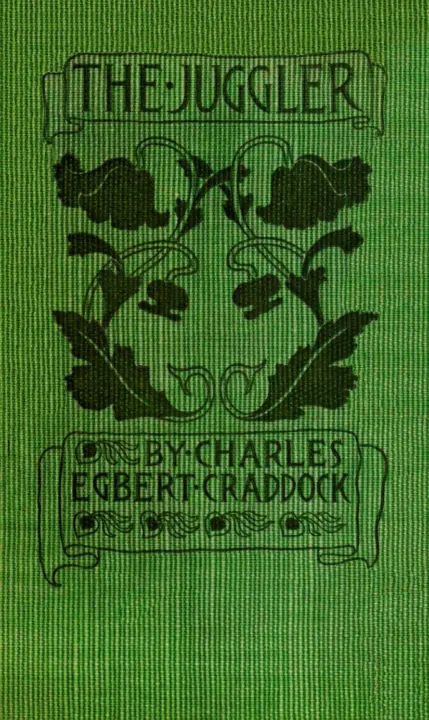
THE CLASSIC COLLECTION · 1897
"The Juggler" by Charles Egbert Craddock is a novel written in the late 19th century. Set in a remote mountain community in Tennessee, it revolves around a mysterious juggler who arrives in Etowah Cove, surprising the locals with his extraordinary performances. The story explores themes of superstition, the clash between tradition and the unknown, and the complexities of human interaction in a close-knit society. At the start of the narrative, the arrival of the juggler heralds a significant change in the mundane lives of the inhabitants of Etowah Cove, who have only been accustomed to religious gatherings and schooling in their little log schoolhouse. His initial act, which includes swallowing a bayonet and the ensuing chaos among the audience, sets a tone of both curiosity and conflict, especially as it draws the ire of a local preacher condemning such antics as devilish. As the juggler navigates the reactions of the crowd, his internal turmoil and past hauntings surface, hinting at deeper issues that may threaten his safety in this superstitious community. With the excitement of the show juxtaposed against the juggler’s own anxieties, the opening chapters lay a rich foundation for exploring the intricate dynamics at play in the story.
Introduction adapted from the source catalogue; source summaries may be automatically generated.
Free to read · English · 101,421 words · No account needed
MAKE TIME FOR A GOOD BOOK
On by default. Untick to stop anonymous reading totals. Each page counts after 10 seconds in view. How this works.
Anonymous counting is on unless you have switched it off.
He had gone out on the hurricane deck. The wind blew fresh from the opposite shore; he was sensible of a certain attraction in the aspect of the gloom which was as above a darkling sea, for the further bank was hardly visible by day, and utterly effaced by night. The stars were in the water as well as in the sky. He looked up at them above the two dusky columns of the boat’s chimneys, which were bejeweled now with swinging lights. The sudden stillness of the machinery gave one to hear the sounds from the land. A crane clanged out a wild woodsy cry from somewhere in the darkness. An owl, hooting from the bank, sent its voice of ill omen far along the currents of the great deep silent river. The clamor from the landing caught his attention, and he turned back to look down at the cluster of twinkling lights,--for the place was a mere hamlet. And but for the shifting of his attitude,--oh, could he but have contented his gaze with the sad spring night by the riverside, the lonely woods, the waste of waters, the reflection of the stars in the depths and the stars themselves in the infinite heights of the dark sky,--could this have sufficed, he said to himself as the girl read aloud the story of his fate, he might be living now.
For alive as the man looked, he was dead!
And the end of Lucien Royce--for this was his real name--came to pass
in this way.
That night, as he shifted his position on the hurricane deck, a young fellow coming up the broad landing-stage amongst the neighborhood loafers bound to take a drink at the bar of every passing steamboat, caught sight of him in the steady pervasive radiance of the electric search-light now aflare on the boat, and lifted his voice in a friendly hail. This young fellow was very visible in the warm spring afternoon in the far-away mountains, where he had never been. The juggler inadvertently glanced down at the russet shoes on his feet, for this man had then stood in them. It was he who wore, that night, the long blue hose, the blue flannel shirt, the black-and-red blazer, the knickerbockers, and the tan-colored belt, which was drawn an eyelet or so tighter now, for the juggler was slighter of build. Notified by the whistle of the boat of its approach, he had come down to the landing on his bicycle, merely for the break in the monotony of a long visit at a relative’s plantation. Royce remembered how this other fellow had looked in this toggery, grown so familiar, as they stood together at the bar, and he asked of the newcomer more than once what he would take. Very jolly they were together at the bar. It was hard to part. Lucien Royce could scarcely resist the pressing insistence to return at an early day and visit this friend at his sister’s place, a few miles back from the river, where he himself was a guest. But John Grayson was the prodigal son in an otherwise irreproachable family, and Royce preferred more responsible introduction to make his welcome good. With this hampering thought in mind he was not apt at excuses. John Grayson, noting that he was ill at ease, instantly attributed it to commercial anxiety, and asked, with rude curiosity, how his firm was weathering the flurry. For this was a time of extreme financial stress. A general panic was in progress. Assignments were announced by the dozen daily. The banks were going down one upon another, like a row of falling bricks. With business much extended, with heavy margins to cover and notes for large amounts about to fall due, the cotton commission firm, Greenhalge, Gould & Fife, of St. Louis, of which his late father had been a partner, and of which he was an employee, had made great efforts to collect all the money due them in the lower country, and Lucien Royce had been sent south on this mission. He had succeeded beyond their expectations. Owing to the prevalent total lack of confidence in the banks, he had been instructed to transmit a considerable sum by express. This, however, was promptly attached in the express office at St. Louis to satisfy a claim against the firm; and although they were advised it could not be sustained in court, the proceeding greatly embarrassed them, being, in fact, designed at this crisis to force a compromise in order to release the surplus funds. To furnish security proved impossible under the circumstances; and the firm being thus balked, Royce telegraphed in cipher to them for authority to bring the remainder home on his person, that it might be in readiness to take up their paper. Although he was rarely troubled by the weight of the money-belt which he thus wore, containing a large sum in bills and specie, he was very conscious of it now when Grayson, who with all the rest of St. Louis had heard of the attachment suit, abruptly demanded, with a knitting of his brow, “How in the world do you get your collections to them, if you can’t send the money by express or draft?”
Your reading position is saved on this browser. Take it to another device with a library code. Reading pages adapt to text, rather than matching a printed edition.
Charles Egbert Craddock
Charles Egbert Craddock
Charles Egbert Craddock
Charles Egbert Craddock
BEHIND THE BOOK
This eBook is for the use of anyone anywhere in the United States and most other parts of the world at no cost and with almost no restrictions whatsoever. You may copy it, give it away or re-use it under the terms of the Project Gutenberg License included with this eBook or online at www.gutenberg.org. If you are not located in the United States, you will have to check the laws of the country where you are located before using this eBook. Read the source licence.
The original source file, including credits and licence, is retained by this library. Request an original-format copy at no charge. Please include the book title and Project Gutenberg identifier #72930.
KEEP YOUR CURIOSITY GOING
Coulson Kernahan

Maurice Baring
Frances Wright
Cécile Tormay

Frederic Jesup Stimson

W. H. P. (William Henry Pope) Jarvis