THE CLASSIC COLLECTION✦The story of Keedon BluffsCLASSIC FREE BOOKS
The story of Keedon Bluffs
Charles Egbert Craddock
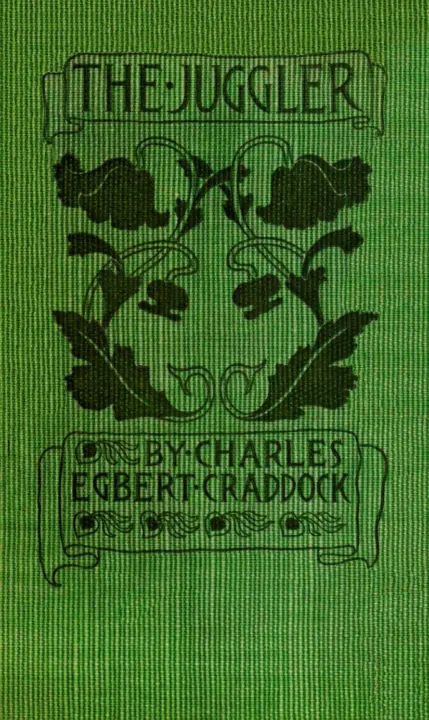
THE CLASSIC COLLECTION · 1897
"The Juggler" by Charles Egbert Craddock is a novel written in the late 19th century. Set in a remote mountain community in Tennessee, it revolves around a mysterious juggler who arrives in Etowah Cove, surprising the locals with his extraordinary performances. The story explores themes of superstition, the clash between tradition and the unknown, and the complexities of human interaction in a close-knit society. At the start of the narrative, the arrival of the juggler heralds a significant change in the mundane lives of the inhabitants of Etowah Cove, who have only been accustomed to religious gatherings and schooling in their little log schoolhouse. His initial act, which includes swallowing a bayonet and the ensuing chaos among the audience, sets a tone of both curiosity and conflict, especially as it draws the ire of a local preacher condemning such antics as devilish. As the juggler navigates the reactions of the crowd, his internal turmoil and past hauntings surface, hinting at deeper issues that may threaten his safety in this superstitious community. With the excitement of the show juxtaposed against the juggler’s own anxieties, the opening chapters lay a rich foundation for exploring the intricate dynamics at play in the story.
Introduction adapted from the source catalogue; source summaries may be automatically generated.
Free to read · English · 101,421 words · No account needed
MAKE TIME FOR A GOOD BOOK
On by default. Untick to stop anonymous reading totals. Each page counts after 10 seconds in view. How this works.
Anonymous counting is on unless you have switched it off.
He looked anxiously up from his bent posture, carrying the bag well up on his shoulders, at the quickly disappearing figure of the young mountaineer. He did not doubt that Ormsby knew that Euphemia’s domestic errands would probably bring her to the mill at this hour, and the bearing home of the bag of “seconds” was his precious dévoir most ruthlessly usurped. “I only wish, my friend,” thought the juggler, “that you had the heavy thing now with all its tender associations.” He glanced with some solicitude at the delicate lovely face of the girl. It was placidity itself. He had begun to be able to read it. There was an implication of exactions in its soft firmness. She would make no concessions. She would assume no blame not justly and fairly to be laid at her door. She would not rend her heart with those tender lies of false self-accusation common to loving women who find it less bitter to censure themselves than those they love, and sometimes indeed more politic. She would not bewail herself that she had not lingered, that Ormsby, who came daily to examine his fish-traps, might have had the opportunity of a long talk with her which he coveted, and the precious privilege of going home like a mule with a flour-bag on his back. It was his own fault that he was too late. She could not heft the bag. If he were angry he was a fool. On every principle it is a bad thing to be a fool. If God Almighty has not seen fit to make a man a fool, it is an ill turn for a man to make one of himself.
As the juggler divined her mental processes and the possible indifference of her sentiments toward the disappointed Ormsby, he realized that naught was to be hoped from her, but that probably Ormsby himself might be less obdurate. Doubtless he had had experience of the stern and unyielding quality of her convictions, and had learned that it was the part of wisdom to accommodate himself to them. Surely he would not indulge so futile an anger, for it would not move her. After an interval of solitary sulking in the dank cool woods his resentment would wane, his jealousy would prompt a more zealous rivalry, and he would come to her father’s house as the evening wore on with an incidental expression of countenance and a lamblike manner. The juggler made haste because of this sanguine expectation to leave the field clear for the reconciliation of the parties in interest. He deprecated the loss of one of the very few friends, among the many enemies, he had made since his advent into Etowah Cove. The frank, bold, kindly young mountaineer had, in the absence of all other prepossessions, somewhat won the good opinion of the juggler. With that attraction which mere youth has for youth, he valued Ormsby above the other denizens of the Cove. Jane Ann Sims was possessed of more sterling worth as a friend than a battalion of such as Ormsby. But the juggler was a man of prejudices. Mrs. Sims’s unwieldy bulk offended his artistic views of proportion. The slow shuffle of her big feet on the floor as she went about irritated his nerves. The creases and dimples of her broad countenance obscured for him its expression of native astuteness and genuine good will. Therefore, despite her appreciation of the true intent of the feats of a prestidigitator he was impatient of her presence and undervalued her hearty prepossessions in his favor. He heard with secret annoyance her voice vaguely wheezing a hymn, much off the key, as after supper she sat knitting a shapeless elephantine stocking beside the dying embers, for the night was chilly. Her husband now and again yawned loudly over his pipe, as much from perplexity as fatigue. Outside Euphemia was sitting alone on the step of the passage. The juggler had no inclination to linger by her side. Except for a lively appreciation of the difference in personal appearance she was not more attractive to him than was her mother. He passed stiffly by, with a sense of getting out of harm’s way, and ascended to his room in the roof, where for a long time he lay in the floundering instabilities of the feather-bed, which gave him now and again a sensation as of drowning in soft impalpable depths,--a sensation especially revolting to his nerves. Nevertheless, it was but vaguely that he realized that Ormsby did not come, that he heard the movements downstairs as the doors were closed, and when he opened his eyes again it was morning, and the new day marked a change.
Your reading position is saved on this browser. Take it to another device with a library code. Reading pages adapt to text, rather than matching a printed edition.
Charles Egbert Craddock
Charles Egbert Craddock
Charles Egbert Craddock
Charles Egbert Craddock
BEHIND THE BOOK
This eBook is for the use of anyone anywhere in the United States and most other parts of the world at no cost and with almost no restrictions whatsoever. You may copy it, give it away or re-use it under the terms of the Project Gutenberg License included with this eBook or online at www.gutenberg.org. If you are not located in the United States, you will have to check the laws of the country where you are located before using this eBook. Read the source licence.
The original source file, including credits and licence, is retained by this library. Request an original-format copy at no charge. Please include the book title and Project Gutenberg identifier #72930.
KEEP YOUR CURIOSITY GOING
Coulson Kernahan

Maurice Baring
Frances Wright
Cécile Tormay

Frederic Jesup Stimson

W. H. P. (William Henry Pope) Jarvis