THE CLASSIC COLLECTION✦The story of Keedon BluffsCLASSIC FREE BOOKS
The story of Keedon Bluffs
Charles Egbert Craddock
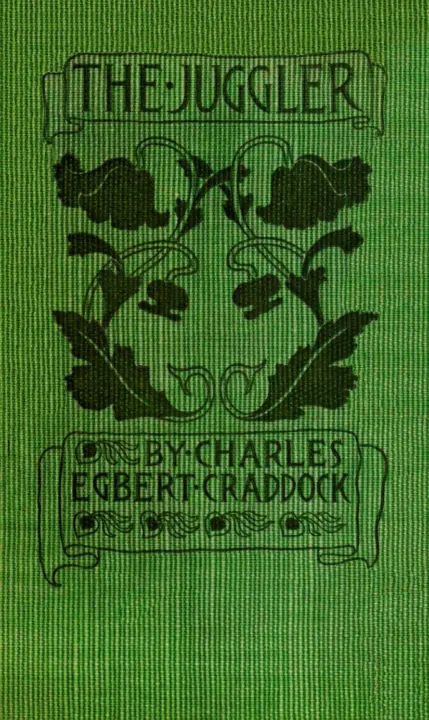
THE CLASSIC COLLECTION · 1897
"The Juggler" by Charles Egbert Craddock is a novel written in the late 19th century. Set in a remote mountain community in Tennessee, it revolves around a mysterious juggler who arrives in Etowah Cove, surprising the locals with his extraordinary performances. The story explores themes of superstition, the clash between tradition and the unknown, and the complexities of human interaction in a close-knit society. At the start of the narrative, the arrival of the juggler heralds a significant change in the mundane lives of the inhabitants of Etowah Cove, who have only been accustomed to religious gatherings and schooling in their little log schoolhouse. His initial act, which includes swallowing a bayonet and the ensuing chaos among the audience, sets a tone of both curiosity and conflict, especially as it draws the ire of a local preacher condemning such antics as devilish. As the juggler navigates the reactions of the crowd, his internal turmoil and past hauntings surface, hinting at deeper issues that may threaten his safety in this superstitious community. With the excitement of the show juxtaposed against the juggler’s own anxieties, the opening chapters lay a rich foundation for exploring the intricate dynamics at play in the story.
Introduction adapted from the source catalogue; source summaries may be automatically generated.
Free to read · English · 101,421 words · No account needed
MAKE TIME FOR A GOOD BOOK
On by default. Untick to stop anonymous reading totals. Each page counts after 10 seconds in view. How this works.
Anonymous counting is on unless you have switched it off.
His anxiety was not quelled, but a great relief came upon him when Peter Knowles echoed his own thought, which seemed thus the natural sequence of the event, and not some far-fetched fantasy.
“That thar man hev killed somebody, ez sure ez ye live!” exclaimed Peter Knowles. “‘But the one who lives!’ An’ who is the one who died?”
“Jes’ so, jes’ so,” interpolated Sims, reassured to see his own mental process so definitely duplicated in the thoughts of a man held to be of experienced and just judgment, and much regarded in the community.
“He be a-runnin’ from jestice,” resumed Knowles. “He ain’t no juggler, ez he calls hisself.”
There was a general protest.
“Shucks, Pete, ye oughter seen him swaller a bay’net.”
“An’ Mis’ Sims tole him she’d resk her shears on it, she jes’ felt so reckless an’ plumb kerried away. An’ he swallered them, too, an’ then tuk ’em out’n his throat, sharp ez ever.”
“An’ he swallered a paper o’ needles an’ a spool o’ thread, an’ brung ’em out’n his mouth all threaded.”
There was a delighted laugh rippling round the circle.
“Look-a-hyar, my frien’s,” remonstrated Peter Knowles in a solemn, sepulchral voice, “I never viewed none o’ these doin’s, but ye air all ’bleeged ter know ez they air on-possible, the devices o’ the devil. An’ hyar ye be, perfessin’ Christians, a-laffin’ at them wiles ez air laid ter delude the onwary.”
There was a general effort to recover a sobriety of demeanor, and one of the men then observed gravely that on the occasion when these wonders were exhibited Parson Benias Greenought taxed the performer with this supposition.
“Waal,” remarked Ormsby, “ye air ’bleeged ter hev tuk notice, ef ye war thar las’ night, ez old Benias never moved toe or toe-nail till arter all the jinks war most over. He seen nigh all thar war ter see ’fore he ’lowed how the sinners war enj’yin’ tharse’fs, an’ called up the devil ter len’ a han’.”
“What the man say?” demanded Peter Knowles.
“He ’peared cornsider’ble set back a-fust, an’ then he tried ter laff it off,” replied Gideon Beck. “He ’lowed he could l’arn sech things ter folks ez he had l’arnt ’em, too.”
“Now tell me one thing,” argued Peter Knowles; “how’s a man goin’ ter l’arn a pusson ter put a persimmon seed in a pail o’ yearth, an’ lay a cloth over it, an’ sing some foolishness, an’ take off’n the cloth, an’ thar’s a persimmon shoot with a root ez long ez my han’ a-growin’ in that yearth?”
Your reading position is saved on this browser. Take it to another device with a library code. Reading pages adapt to text, rather than matching a printed edition.
Charles Egbert Craddock
Charles Egbert Craddock
Charles Egbert Craddock
Charles Egbert Craddock
BEHIND THE BOOK
This eBook is for the use of anyone anywhere in the United States and most other parts of the world at no cost and with almost no restrictions whatsoever. You may copy it, give it away or re-use it under the terms of the Project Gutenberg License included with this eBook or online at www.gutenberg.org. If you are not located in the United States, you will have to check the laws of the country where you are located before using this eBook. Read the source licence.
The original source file, including credits and licence, is retained by this library. Request an original-format copy at no charge. Please include the book title and Project Gutenberg identifier #72930.
KEEP YOUR CURIOSITY GOING
Coulson Kernahan

Maurice Baring
Frances Wright
Cécile Tormay

Frederic Jesup Stimson

W. H. P. (William Henry Pope) Jarvis