THE CLASSIC COLLECTION✦The story of Keedon BluffsCLASSIC FREE BOOKS
The story of Keedon Bluffs
Charles Egbert Craddock
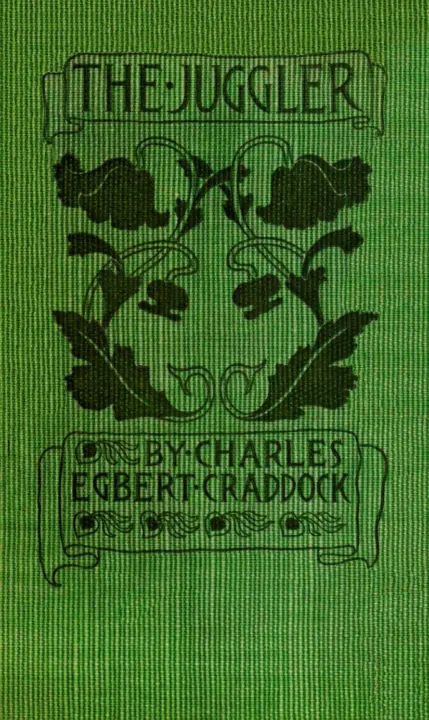
THE CLASSIC COLLECTION · 1897
"The Juggler" by Charles Egbert Craddock is a novel written in the late 19th century. Set in a remote mountain community in Tennessee, it revolves around a mysterious juggler who arrives in Etowah Cove, surprising the locals with his extraordinary performances. The story explores themes of superstition, the clash between tradition and the unknown, and the complexities of human interaction in a close-knit society. At the start of the narrative, the arrival of the juggler heralds a significant change in the mundane lives of the inhabitants of Etowah Cove, who have only been accustomed to religious gatherings and schooling in their little log schoolhouse. His initial act, which includes swallowing a bayonet and the ensuing chaos among the audience, sets a tone of both curiosity and conflict, especially as it draws the ire of a local preacher condemning such antics as devilish. As the juggler navigates the reactions of the crowd, his internal turmoil and past hauntings surface, hinting at deeper issues that may threaten his safety in this superstitious community. With the excitement of the show juxtaposed against the juggler’s own anxieties, the opening chapters lay a rich foundation for exploring the intricate dynamics at play in the story.
Introduction adapted from the source catalogue; source summaries may be automatically generated.
Free to read · English · 101,421 words · No account needed
MAKE TIME FOR A GOOD BOOK
On by default. Untick to stop anonymous reading totals. Each page counts after 10 seconds in view. How this works.
Anonymous counting is on unless you have switched it off.
Here also he came to a halt, looking at the surly building with recognizing eyes. And to it too these years had not been vacant. All the time of his absence, in the far-away liberties of the mountains, with the unshackled wind and the free clouds and the spontaneous growths of the earth out of its own untrammeled impulse, this grim place had been making its record of constraints, and captives, and limits, and locks, and longing bursting hearts, and baffled denied eyes, and yearning covetings of freedom, the bitterness of which perhaps no free creature can know. Surely, surely, these darkening elements of the moral atmosphere had turned the bricks to their dingy hue. The barred windows gave on vague black interiors. A cloud was in the air above, with now and then a mutter of thunder, and the sullen jail lay in a shadow, and the water ran black in the green-fringed creek at the foot of the hill, while behind him at its summit, where the street intersected the open square, the sunlight fell in such golden suffusions that a clay-bank horse with his rider motionless against the blue sky beyond might have seemed an equestrian statue in bronze, commemorating the valiance of some bold cavalry leader. Tubal Cain wondered to see the jail so still and solitary; and where could be the man whom he had pictured sitting in all the luxury of possession on the front doorsteps, smoking his pipe?
This man of his imagination was the sheriff of the county, who did not avail himself of his privilege to appoint a jailer, but turned the keys himself and dwelt in his stronghold. He was of an over-exacting cast of mind. He could never believe a prisoner secure unless with his own hands he had drawn the bolts. On account of the great vogue attained by various crimes at this period, and the consequent overcrowding of the prisons throughout the State, a considerable number of captured moonshiners had been billeted on the Kildeer County jail while awaiting trial in the Federal Court, and by reason of this addition to his charge his vigilance was redoubled. In all the details of his office he carried the traits of a precisian, and was in some sort a thorn in the side of the more easy-going county officers with whom his official duties brought him into contact. Even the judge in his high estate on the bench was now and again nettled by the difficult questions of punctilio with which this servant of the court could contrive to invest some trifling matter, and was known to incline favorably to the salutary theory of rotation in office,--barring, of course, the judicial office. But the sheriff had three minie balls in him which he had collected on various battlefields in the South; and although he had fought on a side not altogether popular in this region, they counted for him at the polls in successive elections, without the formalities of statutory qualifications and with a wondrous power of reduplication in the number of resulting votes. He was reputed of an extraordinary valor on those hard-contested fields where he had found his bullets, but there were advanced occasionally caviling criticisms of his record on the score that, being incapable of originating a course of action, it never occurred to him to run away when his command was ordered to advance, and that his bravery was simply the fixed stolidity of adhering to another man’s idea in default of any ideas of his own. In proof of this it was cited that when he was among a guard detailed to hold a gin-house full of cotton, and the enemy surprised the sentinel and captured the building, he alone stood like a stock with his rifle still at a serene “shoulder-arms,” where it was ordered to be, while his comrades undertook a deploying evolution of their own invention at a mad double-quick, without a word of command, showing the cleanest of nimble heels across the country. But he was esteemed by these depreciators a lucky fool, for since the war, having an affinity for the office of sheriff, he had more than once been obliged to decline to make the race, and lie off a term or two, because of the law which will not permit the office to be held by the same person eight years without an interval. His fad for being in the direct line of the enemy’s fire had not resulted more disastrously than to give him some painful hospital experience; the balls had come to stay, and apparently the hard metal of his constitution served to assimilate them easily enough, for he was hale and hearty, and bade fair to live to a green old age, and they never made themselves heard of save at election times, when in effect they stuffed the ballot-box.
Your reading position is saved on this browser. Take it to another device with a library code. Reading pages adapt to text, rather than matching a printed edition.
Charles Egbert Craddock
Charles Egbert Craddock
Charles Egbert Craddock
Charles Egbert Craddock
BEHIND THE BOOK
This eBook is for the use of anyone anywhere in the United States and most other parts of the world at no cost and with almost no restrictions whatsoever. You may copy it, give it away or re-use it under the terms of the Project Gutenberg License included with this eBook or online at www.gutenberg.org. If you are not located in the United States, you will have to check the laws of the country where you are located before using this eBook. Read the source licence.
The original source file, including credits and licence, is retained by this library. Request an original-format copy at no charge. Please include the book title and Project Gutenberg identifier #72930.
KEEP YOUR CURIOSITY GOING
Coulson Kernahan

Maurice Baring
Frances Wright
Cécile Tormay

Frederic Jesup Stimson

W. H. P. (William Henry Pope) Jarvis