THE CLASSIC COLLECTION✦The story of Keedon BluffsCLASSIC FREE BOOKS
The story of Keedon Bluffs
Charles Egbert Craddock
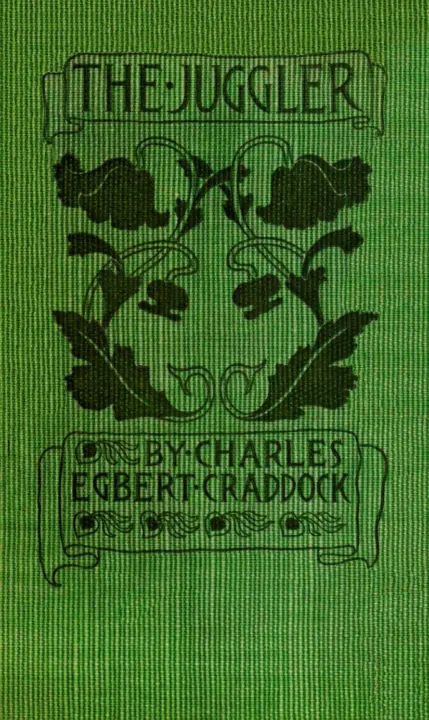
THE CLASSIC COLLECTION · 1897
"The Juggler" by Charles Egbert Craddock is a novel written in the late 19th century. Set in a remote mountain community in Tennessee, it revolves around a mysterious juggler who arrives in Etowah Cove, surprising the locals with his extraordinary performances. The story explores themes of superstition, the clash between tradition and the unknown, and the complexities of human interaction in a close-knit society. At the start of the narrative, the arrival of the juggler heralds a significant change in the mundane lives of the inhabitants of Etowah Cove, who have only been accustomed to religious gatherings and schooling in their little log schoolhouse. His initial act, which includes swallowing a bayonet and the ensuing chaos among the audience, sets a tone of both curiosity and conflict, especially as it draws the ire of a local preacher condemning such antics as devilish. As the juggler navigates the reactions of the crowd, his internal turmoil and past hauntings surface, hinting at deeper issues that may threaten his safety in this superstitious community. With the excitement of the show juxtaposed against the juggler’s own anxieties, the opening chapters lay a rich foundation for exploring the intricate dynamics at play in the story.
Introduction adapted from the source catalogue; source summaries may be automatically generated.
Free to read · English · 101,421 words · No account needed
MAKE TIME FOR A GOOD BOOK
On by default. Untick to stop anonymous reading totals. Each page counts after 10 seconds in view. How this works.
Anonymous counting is on unless you have switched it off.
“I wish you would move farther back from the edge,” he said, with a corrugated brow. “I am afraid you may slip over, you are so little, and”--
“That would put an e-end to the readings mighty quick,” she said, as she still leaned over to peer down at the tops of the trees in the valley, and he turned sick and dizzy at her very gesture. He hardly dared to speak lest an unconsidered word might flutter her nerves and cause her to lose her hold. She had no intention of thus teasing his vicarious fright, but drew back presently to a safe distance. “Wouldn’t it?” she asked, recurring to her remark as she executed this manœuvre.
“You mean if you should slip over into this dreadful abyss? I should never, never have the heart to read another word as long as I should live!” he protested.
He caught the look of exultant joy in her surprised and widely opened eyes for one moment, and then she turned them discreetly on the splendid vastness of that great landscape in its happiest mood. He realized that she had no difficulty in comprehending the obvious inference. Her experience as a rural beauty and belle heretofore had doubtless served to acquaint her with the hyperbole of a lover’s language. There were Haines and Ormsby within his own knowledge, and he could not guess how many suitors hitherto,--confound them all! he muttered as he thought of them. He had not intended to win her heart. In view of her feeling for Owen Haines he had not deemed it possible. With the suspicion, which he would fain call realization, for it had all the importunacy of hope, he experienced a rush of elation, of soft delight, which amazed him, while it almost swept him off his feet. Had not he too fallen in love during his “readings”?--for thus they both called his recitals. He knew that he had only to look into her eyes to make his heart flutter; but then it was a susceptible heart and easily stirred. She had grown dear to him in many ways, and he had learned this even when he did not dream of other result of their companionship than the broadcast impression that he lingered here for her sake. He began to strive to separate his ideal of womanhood from those merely arbitrary values which fashion and artificial life bestow. Is it a French man milliner only who establishes the criterion of beauty? He had but to glance at the face and form beside him. She was beautiful; she was good; she was of a singularly strong and individual character; her natural mind was quick and retentive and discerning, and of a remarkable aptness. She was so endowed with a keen perception of real excellence that knowledge had but to open its doors to her, for she possessed as a gift the capacity of worthy choice. She loved with spontaneous affection those things which other people are trained to love; she seized on the best of her own devout accord, unaware of aught of significance save her own preference. She could easily acquire all he could teach her. With her quick grasp and greed of learning there would soon be little disparity. He began to meditate on the arbitrary methods of appraisement in the world. How sadly do we richly rate, not our own preference, but that which is valued by others: hence the vyings, the heart-burnings, the ignoble strife, the false pride, of many mundane miseries. He knew her real identity. Her nature would befit any station. Her beauty,--even the reference to the immutable standards of his own world could avail no detraction here,--it was preëminent. Having lived his life in one sphere, why should he, being dead to it forever, let its rigid conventionalities follow him into his new world? As to the coming years and the monotony of rounding out a long life in this narrow circuit, let the coming years take thought for themselves. For a moment the words pressed to his lips. Then he realized that this was no ordinary self-committal. To pledge himself to marry a woman of her degree in life--an ignorant mountain girl of an inexpressible rusticity and lack of sophistication, as far removed from a comprehension of the conventions in which he had been reared and the cultivated ideals still dear to him as if she were a denizen of a different planet--was a serious step indeed; he winced, and was silent.
Your reading position is saved on this browser. Take it to another device with a library code. Reading pages adapt to text, rather than matching a printed edition.
Charles Egbert Craddock
Charles Egbert Craddock
Charles Egbert Craddock
Charles Egbert Craddock
BEHIND THE BOOK
This eBook is for the use of anyone anywhere in the United States and most other parts of the world at no cost and with almost no restrictions whatsoever. You may copy it, give it away or re-use it under the terms of the Project Gutenberg License included with this eBook or online at www.gutenberg.org. If you are not located in the United States, you will have to check the laws of the country where you are located before using this eBook. Read the source licence.
The original source file, including credits and licence, is retained by this library. Request an original-format copy at no charge. Please include the book title and Project Gutenberg identifier #72930.
KEEP YOUR CURIOSITY GOING
Coulson Kernahan

Maurice Baring
Frances Wright
Cécile Tormay

Frederic Jesup Stimson

W. H. P. (William Henry Pope) Jarvis