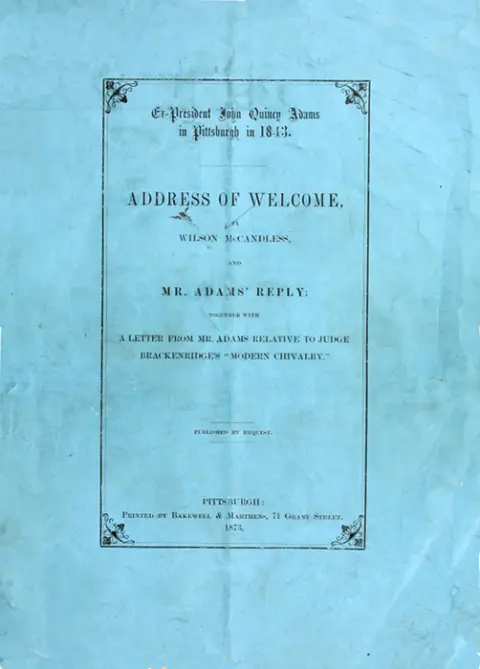
Ex-President John Quincy Adams in Pittsburgh in 1843 Address of Welcome, by Wilson McCandless, and Mr. Adams’ Reply; together with a letter from Mr. Adams Relative to Judge Brackenridge’s “Modern Chivalry.”
Wilson McCandless & John Quincy Adams
THE CLASSIC COLLECTION · 1839
"The Jubilee of the Constitution" by John Quincy Adams is a historical oration delivered in the early 19th century, specifically commemorating the 50th anniversary of the United States Constitution. This significant piece reflects on the founding principles of American governance, emphasizing themes of liberty, sovereignty, and national unity. Given its context, the work serves both as a celebration of the Constitution's impact and a critical reflection on the political evolution of the United States since its inception. In this powerful oration, Adams recounts the tumultuous journey of the American colonies from individual governance to the formation of a federal Constitution. He discusses the ideals embodied in the Declaration of Independence, arguing that the sovereignty of the people—rather than fragmented state powers—was crucial for establishing a stable government. Through a detailed examination of historical events and decisions leading up to the adoption of the Constitution, Adams emphasizes the necessity for unity and cooperation among the states to preserve the freedoms and rights of citizens. The address not only aims to honor the founding figures of the Republic but also seeks to remind contemporary audiences of the importance of adhering to the principles that undergird the nation's foundation.
Introduction adapted from the source catalogue; source summaries may be automatically generated.
Free to read · English · 8,743 words · No account needed
MAKE TIME FOR A GOOD BOOK
On by default. Untick to stop anonymous reading totals. Each page counts after 10 seconds in view. How this works.
Anonymous counting is on unless you have switched it off.
As the attempt to establish among themselves the community of goods was a seal of that sacred bond which knit them so closely together, so the conduct they observed toward the natives of the country displays their steadfast adherence to the rules of justice and their faithful attachment to those of benevolence and charity.
No European settlement ever formed upon this continent has been more distinguished for undeviating kindness and equity toward the savages. There are, indeed, moralists who have questioned the right of the Europeans to intrude upon the possessions of the aboriginals in any case, and under any limitations whatsoever. But have they maturely considered the whole subject? The Indian right of possession itself stands, with regard to the greater part of the country, upon a questionable foundation. Their cultivated fields; their constructed habitations; a space of ample sufficiency for their subsistence, and whatever they had annexed to themselves by personal labor, was undoubtedly, by the laws of nature, theirs. But what is the right of a huntsman to the forest of a thousand miles over which he has accidentally ranged in quest of prey? Shall the liberal bounties of Providence to the race of man be monopolized by one of ten thousand for whom they were created? Shall the exuberant bosom of the common mother, amply adequate to the nourishment of millions, be claimed exclusively by a few hundreds of her offspring? Shall the lordly savage not only disdain the virtues and enjoyments of civilization himself, but shall he control the civilization of a world? Shall he forbid the wilderness to blossom like a rose? Shall he forbid the oaks of the forest to fall before the axe of industry, and to rise again, transformed into the habitations of ease and elegance? shall he doom an immense region of the globe to perpetual desolation, and to hear the howlings of the tiger and the wolf silence forever the voice of human gladness? Shall the fields and the valleys, which a beneficent God has formed to teem with the life of innumerable multitudes, be condemned to everlasting barrenness? Shall the mighty rivers, poured out by the hand of nature, as channels of communication between numerous nations, roll their waters in sullen silence and eternal solitude of the deep? Have hundreds of commodious harbors, a thousand leagues of coast, and a boundless ocean, been spread in the front of this land, and shall every purpose of utility to which they could apply be prohibited by the tenant of the woods? No, generous philanthropists! Heaven has not been thus inconsistent in the works of its hands. Heaven has not thus placed at irreconcilable strife its moral laws with its physical creation. The Pilgrims of Plymouth obtained their right of possession to the territory on which they settled, by titles as fair and unequivocal as any human property can be held. By their voluntary association they recognized their allegiance to the government of Britain, and in process of time received whatever powers and authorities could be conferred upon them by a charter from their sovereign. The spot on which they fixed had belonged to an Indian tribe, totally extirpated by that devouring pestilence which had swept the country shortly before their arrival. The territory, thus free from all exclusive possession, they might have taken by the natural right of occupancy. Desirous, however, of giving amply satisfaction to every pretence of prior right, by formal and solemn conventions with the chiefs of the neighboring tribes, they acquired the further security of a purchase. At their hands the children of the desert had no cause of complaint. On the great day of retribution, what thousands, what millions of the American race will appear at the bar of judgment to arraign their European invading conquerors! Let us humbly hope that the fathers of the Plymouth Colony will then appear in the whiteness of innocence. Let us indulge in the belief that they will not only be free from all accusation of injustice to these unfortunate sons of nature, but that the testimonials of their acts of kindness and benevolence toward them will plead the cause of their virtues, as they are now authenticated by the record of history upon earth.
Your reading position is saved on this browser. Take it to another device with a library code. Reading pages adapt to text, rather than matching a printed edition.
BEHIND THE BOOK
This eBook is for the use of anyone anywhere in the United States and most other parts of the world at no cost and with almost no restrictions whatsoever. You may copy it, give it away or re-use it under the terms of the Project Gutenberg License included with this eBook or online at www.gutenberg.org. If you are not located in the United States, you will have to check the laws of the country where you are located before using this eBook. Read the source licence.
The original source file, including credits and licence, is retained by this library. Request an original-format copy at no charge. Please include the book title and Project Gutenberg identifier #896.
KEEP YOUR CURIOSITY GOING

David Patterson (Spirit) Hatch

David Patterson (Spirit) Hatch

David Patterson (Spirit) Hatch
Cécile Tormay

Moritz Busch
John L. Ransom