THE CLASSIC COLLECTION✦An outlaw’s diary: the CommuneCLASSIC FREE BOOKS
An outlaw’s diary: the Commune
Cécile Tormay
THE CLASSIC COLLECTION · 1885
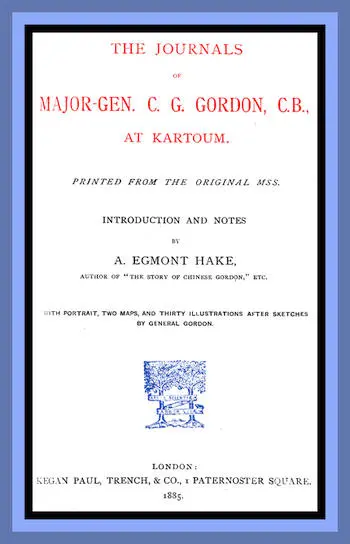
"The Journals of Major-Gen. C. G. Gordon, C.B., at Kartoum" by Charles George Gordon is a historical account written in the late 19th century. This work details the journals of General Gordon during his time in Kartoum, shedding light on the challenging conditions in Sudan and his efforts to navigate the complex political and military landscape of the region. At the start of the book, the author presents Gordon's initial observations and experiences following his appointment as Governor-General of the Sudan. The opening chapters describe his reflections on the dire circumstances faced by the local population, the oppressive regime in place, and his commitment to assisting the Soudanese people while opposing the slave trade. Gordon expresses a blend of hope and concern as he documents the precarious situation around Kartoum, emphasizing both his sense of duty and the moral complexities of his mission amidst rising tensions and rebellion from groups like the Mahdi. The tone suggests a deep introspection as he grapples with the responsibilities thrust upon him and the challenges of implementing meaningful reform.
Introduction adapted from the source catalogue; source summaries may be automatically generated.
Free to read · English · 174,578 words · No account needed
MAKE TIME FOR A GOOD BOOK
On by default. Untick to stop anonymous reading totals. Each page counts after 10 seconds in view. How this works.
Anonymous counting is on unless you have switched it off.
[201] Suakin was at this time besieged on the land side.—ED.
[202] The lines extended from the Blue to the White Nile, i.e. from Bourré to the Mogrim Fort.—ED.
[203] General Gordon had great admiration and affection for the Black
Regulars.—ED.
[204] Baring to Lord Granville, March 6th, 1884.
“With reference to General Graham’s message communicated to Her Majesty’s Secretary of State for War relative to the opening out of the Berber-Suakin route, I wish to say that I do not recommend any English troops being sent to Berber.”—Egypt, No. 12, 1884, No. 214.
[205] i.e. to be removed from my position as Governor-General.—ED.
[206] “In fact, things are not serious, although they may become so if delay occurs in sending Zebehr (Zubair). My weakness is that of being foreign and Christian and peaceful; and it is only by sending Zebehr that prejudice can be removed.”—General Gordon to Sir E. Baring, Kartoum, March 4th, 1884. Egypt, No. 12. Enclosure 5, in No. 202.
[207] See accounts of slave hunting in the Bahr Gazelle, App. U, b.
[208] I.e. driving the cows down with the view to their exploding the
mines.—ED.
[209] The steamers General Gordon sent to Metemma to assist the
relieving force.—ED.
Sir E. Baring to Lord Granville.
“Cairo, March 13th, 1884.
“I have instructed him (General Gordon) to hold on at Kartoum, until I can communicate further with Her Majesty’s Government, and have told him that he should on no account proceed to the Bahr Gazelle and Equatorial Provinces.”—Egypt, 1884, Nos. 12-242.—ED.
[211] The English Government has, in the most liberal manner, stated it will meet any bills that General Gordon may have drawn upon it on his private account, and of which General Gordon has given a list. The Egyptian Government has acted in a similar manner with regard to moneys spent by General Gordon at Kartoum.—ED.
[212] i.e. the Viziers.—ED.
[213] Whenever General Gordon deals with this subject, he shows how thoroughly angry he is, and his anger increases as he proceeds. Hence the frequent reiterations of his resolve not to leave.—ED.
[214] Briefly summarised, what General Gordon says is: “If the expeditionary force has come for me alone, I will not return with it: it may go back, while I will remain here as Governor-General, and make the best use I can of the war material which belongs to me while I hold that position. If I am removed from that position by a Firman from the Khedive, I will still remain here, in a private capacity, and devote my life and energy to those people who have devoted their lives to me.”—ED.
[215] Not received from the Government.
[216] Appendix Y.
Your reading position is saved on this browser. Take it to another device with a library code. Reading pages adapt to text, rather than matching a printed edition.
BEHIND THE BOOK
This eBook is for the use of anyone anywhere in the United States and most other parts of the world at no cost and with almost no restrictions whatsoever. You may copy it, give it away or re-use it under the terms of the Project Gutenberg License included with this eBook or online at www.gutenberg.org. If you are not located in the United States, you will have to check the laws of the country where you are located before using this eBook. Read the source licence.
The original source file, including credits and licence, is retained by this library. Request an original-format copy at no charge. Please include the book title and Project Gutenberg identifier #49224.
KEEP YOUR CURIOSITY GOING
Cécile Tormay

Moritz Busch
John L. Ransom
Frances Wright
Cécile Tormay

Mabel Potter Daggett