THE CLASSIC COLLECTION✦An outlaw’s diary: the CommuneCLASSIC FREE BOOKS
An outlaw’s diary: the Commune
Cécile Tormay
THE CLASSIC COLLECTION · 1885
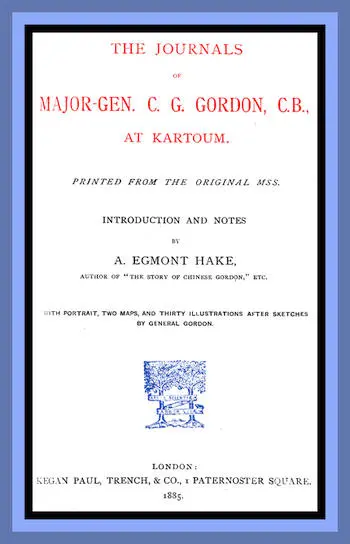
"The Journals of Major-Gen. C. G. Gordon, C.B., at Kartoum" by Charles George Gordon is a historical account written in the late 19th century. This work details the journals of General Gordon during his time in Kartoum, shedding light on the challenging conditions in Sudan and his efforts to navigate the complex political and military landscape of the region. At the start of the book, the author presents Gordon's initial observations and experiences following his appointment as Governor-General of the Sudan. The opening chapters describe his reflections on the dire circumstances faced by the local population, the oppressive regime in place, and his commitment to assisting the Soudanese people while opposing the slave trade. Gordon expresses a blend of hope and concern as he documents the precarious situation around Kartoum, emphasizing both his sense of duty and the moral complexities of his mission amidst rising tensions and rebellion from groups like the Mahdi. The tone suggests a deep introspection as he grapples with the responsibilities thrust upon him and the challenges of implementing meaningful reform.
Introduction adapted from the source catalogue; source summaries may be automatically generated.
Free to read · English · 174,578 words · No account needed
MAKE TIME FOR A GOOD BOOK
On by default. Untick to stop anonymous reading totals. Each page counts after 10 seconds in view. How this works.
Anonymous counting is on unless you have switched it off.
“I am naturally very averse to this, but if, as his Excellency assures me, it is a fact that the posts will not be supplied from the base at Duem, and supplies will not be forwarded through them, I should, in garrisoning these posts, be only weakening my fighting force without gaining any advantage. I have therefore called a Council, have had the matter explained, and requested the members to record their opinions.”[337]
[Sidenote: 1883.]
No news of the Expeditionary Force having been heard for several weeks, anxiety began to be felt as to its fate. Messengers were despatched from Duem along the various routes to Kordofan, but, for a long while, none of the few who returned brought any authentic information.
[Sidenote: 30th October. Rumoured defeat of the Mahdi.]
On the 30th October, rumours were spread in Kartoum that the Mahdi had been defeated in several important engagements, and that General Hicks was master of the whole of Kordofan. No official confirmation of the reported victories was, however, received, and after a few days the authenticity of the news began to be doubted.
[Sidenote: 5th November.]
[Sidenote: Battle of Kazghil. Annihilation of General Hicks’s army.]
[Sidenote: 1883.]
At length, on the 19th November, a messenger, who had failed to deliver his despatches to Al-ed-Deen Pasha, returned to Duem, bringing news of the total destruction of General Hicks’s army. These sad tidings were soon confirmed by other persons arriving from Kordofan. Their accounts differ in detail, but most of them agree that the greater part, if not the whole, of the army was annihilated by the insurgent forces on the 4th or 5th November. The events which culminated in this terrible disaster are still shrouded in a certain amount of mystery. Nothing has been heard from any of the Europeans who accompanied the expedition, nor from any of the Egyptian Staff Officers, of a later date than General Hicks’s despatch of the 3rd October. Probably the most trustworthy account of the fighting is that given by a camel-driver, who went as servant to a native officer. He states that the army, on leaving Duem, soon met the rebels, and engaged in skirmishes with them, the Mahdi’s men being beaten, and the Egyptians losing a few Bashi-Bazouks and Shaggyehs. Thus the army arrived at Rahad, where there is a lake. There it filled up with water, and then marched towards Alouba. At the latter place there was an encounter with the rebels, in which General Hicks was victorious. On the 2nd November the army left Alouba, taking what water it could, and, while marching through a forest, was surprised by a large force of rebels. The Egyptians formed square, and, after fighting all day, finally defeated them and drove them off. On Saturday, the 3rd November, the march was resumed. Water was already becoming scarce. The rebels again appeared in force, and surrounded the army. A serious engagement ensued, in which heavy losses were suffered on both sides, but the rebels were once more beaten. That night was passed on the field of battle, and next day the army moved towards Kazghil. After proceeding for four hours, it suddenly came under a heavy fusillade from large numbers of the enemy. The troops were suffering great torments from thirst, but nevertheless fought throughout the whole day. On the 5th, when they were approaching the wells, which were only half an hour distant, the rebels, who had been concealed in the forest, again suddenly attacked the column on all sides. The Egyptians returned their fire, and a great battle raged. Towards mid-day the entire force of the rebels made a general charge with guns, swords, and spears, and General Hicks and his whole army perished, except 200 Egyptian soldiers and a few negro servants, most of whom were wounded.[338]
Your reading position is saved on this browser. Take it to another device with a library code. Reading pages adapt to text, rather than matching a printed edition.
BEHIND THE BOOK
This eBook is for the use of anyone anywhere in the United States and most other parts of the world at no cost and with almost no restrictions whatsoever. You may copy it, give it away or re-use it under the terms of the Project Gutenberg License included with this eBook or online at www.gutenberg.org. If you are not located in the United States, you will have to check the laws of the country where you are located before using this eBook. Read the source licence.
The original source file, including credits and licence, is retained by this library. Request an original-format copy at no charge. Please include the book title and Project Gutenberg identifier #49224.
KEEP YOUR CURIOSITY GOING
Cécile Tormay

Moritz Busch
John L. Ransom
Frances Wright
Cécile Tormay

Mabel Potter Daggett