THE CLASSIC COLLECTION✦An outlaw’s diary: the CommuneCLASSIC FREE BOOKS
An outlaw’s diary: the Commune
Cécile Tormay
THE CLASSIC COLLECTION · 1885
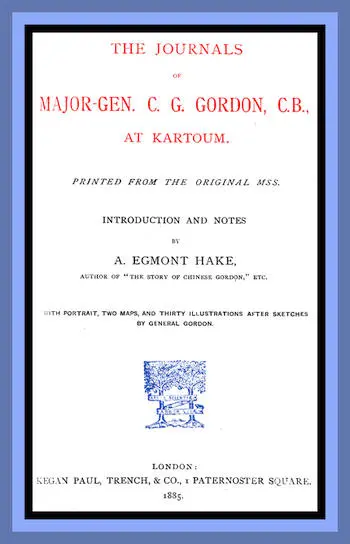
"The Journals of Major-Gen. C. G. Gordon, C.B., at Kartoum" by Charles George Gordon is a historical account written in the late 19th century. This work details the journals of General Gordon during his time in Kartoum, shedding light on the challenging conditions in Sudan and his efforts to navigate the complex political and military landscape of the region. At the start of the book, the author presents Gordon's initial observations and experiences following his appointment as Governor-General of the Sudan. The opening chapters describe his reflections on the dire circumstances faced by the local population, the oppressive regime in place, and his commitment to assisting the Soudanese people while opposing the slave trade. Gordon expresses a blend of hope and concern as he documents the precarious situation around Kartoum, emphasizing both his sense of duty and the moral complexities of his mission amidst rising tensions and rebellion from groups like the Mahdi. The tone suggests a deep introspection as he grapples with the responsibilities thrust upon him and the challenges of implementing meaningful reform.
Introduction adapted from the source catalogue; source summaries may be automatically generated.
Free to read · English · 174,578 words · No account needed
MAKE TIME FOR A GOOD BOOK
On by default. Untick to stop anonymous reading totals. Each page counts after 10 seconds in view. How this works.
Anonymous counting is on unless you have switched it off.
On the 4th March Colonel Hicks[311] reached Kartoum, and with him the undermentioned English Officers, viz.:—Lieut.-Colonel Hon. J. Colborne,[312] Lieut.-Colonel de Coetlogon,[313] Major Martin,[314] Major Farquhar,[315] Captain Warner, Captain Massey,[316] Captain Evans, Captain Walker,[317] and Surgeon-Major Rosenberg.
Colonel Hicks had been appointed Chief of the Staff of the Army of the Soudan, with local rank of Major-General, but it was intended that he should direct, and be responsible for, all preparations and operations—in fact, that he should in reality be the Commander-in-Chief, while nominally holding a subordinate post.
The Mahdi’s movement being, at any rate ostensibly, a religious one, it was deemed inadvisable to place at the head of the Egyptian Army of the Soudan a foreigner and a non-Mussulman, lest the insurgent leader might make capital out of this to arouse still further the fanaticism of his followers.
Suleiman Nyasi, whose military career dates back to the days of Mahomet Ali and the Crimean War, was consequently named to the chief command, but on the understanding that he was to pay strict attention to, and carefully follow out General Hicks’s instructions and plans, but his indolence, apathy, ignorance, and in many instances apparent malignity and jealousy, caused him frequently to act in anything but the spirit of the instructions given him at Cairo.
[Sidenote: 1883.]
[Sidenote: 8th March.]
[Sidenote: Departure of Lieut.-Col. Stewart for Egypt.]
On the 8th March, Lieut.-Colonel Stewart left Kartoum for Egypt, travelling by way of Sennaar, Katarif, Kassala, and Massowah.
[Sidenote: 18th March.]
On the 18th March, Major Farquhar, who had been on a reconnaissance up the White Nile, returned to Kartoum. He reported the inhabitants along the western bank of the river to be hostile.
Four thousand five hundred rebels and 1800 Baggara Arab Cavalry were assembled about Marabieh and Abu Djuma, and at Jebel Ain there was a considerable body, which had lately been reinforced from Kordofan. The Baggaras had quarrelled with the Mahdi regarding the booty taken at El Obeyed, and had seized and carried off some of it. The troops at the posts along the river were in rags, and from four to six months in arrears of pay.
News from Kordofan stated that the Mahdi’s force was about one hundred thousand strong, that it had dispersed for the moment, but could be quickly reassembled. The chiefs met at El Obeyed every Friday for orders, but the Sheiks of the Baggara did not attend.
Taking advantage of this discontent, General Hicks was trying to open communications with the last-mentioned, and hoped to arrange a meeting at Dem.
[Sidenote: 26th March.]
[Sidenote: Proclamation of Al-ed-Deen Pasha as Governor-General of the
Soudan.]
Your reading position is saved on this browser. Take it to another device with a library code. Reading pages adapt to text, rather than matching a printed edition.
BEHIND THE BOOK
This eBook is for the use of anyone anywhere in the United States and most other parts of the world at no cost and with almost no restrictions whatsoever. You may copy it, give it away or re-use it under the terms of the Project Gutenberg License included with this eBook or online at www.gutenberg.org. If you are not located in the United States, you will have to check the laws of the country where you are located before using this eBook. Read the source licence.
The original source file, including credits and licence, is retained by this library. Request an original-format copy at no charge. Please include the book title and Project Gutenberg identifier #49224.
KEEP YOUR CURIOSITY GOING
Cécile Tormay

Moritz Busch
John L. Ransom
Frances Wright
Cécile Tormay

Mabel Potter Daggett