THE CLASSIC COLLECTION✦An outlaw’s diary: the CommuneCLASSIC FREE BOOKS
An outlaw’s diary: the Commune
Cécile Tormay
THE CLASSIC COLLECTION · 1885
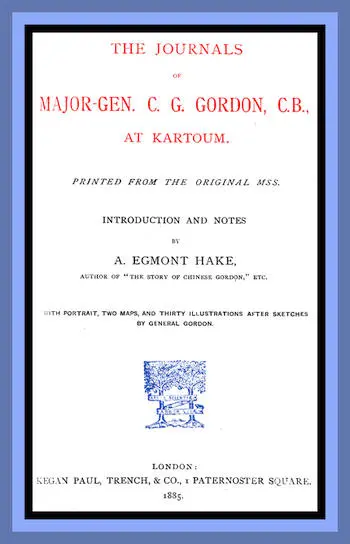
"The Journals of Major-Gen. C. G. Gordon, C.B., at Kartoum" by Charles George Gordon is a historical account written in the late 19th century. This work details the journals of General Gordon during his time in Kartoum, shedding light on the challenging conditions in Sudan and his efforts to navigate the complex political and military landscape of the region. At the start of the book, the author presents Gordon's initial observations and experiences following his appointment as Governor-General of the Sudan. The opening chapters describe his reflections on the dire circumstances faced by the local population, the oppressive regime in place, and his commitment to assisting the Soudanese people while opposing the slave trade. Gordon expresses a blend of hope and concern as he documents the precarious situation around Kartoum, emphasizing both his sense of duty and the moral complexities of his mission amidst rising tensions and rebellion from groups like the Mahdi. The tone suggests a deep introspection as he grapples with the responsibilities thrust upon him and the challenges of implementing meaningful reform.
Introduction adapted from the source catalogue; source summaries may be automatically generated.
Free to read · English · 174,578 words · No account needed
MAKE TIME FOR A GOOD BOOK
On by default. Untick to stop anonymous reading totals. Each page counts after 10 seconds in view. How this works.
Anonymous counting is on unless you have switched it off.
Hearing of this, the Pasha, having been joined by the 3rd Battalion, 1st Regiment, determined to advance against a large body of rebels, reported to be about eight hours’ march from his camp.
[Sidenote: 27th January.]
[Sidenote: Defeat of the rebels near Maatuk.]
Early on the 27th he moved towards the village of Maatuk. When about three hours from it, the rebels were observed on a plain on the further side of a small wood. The troops were at once halted in the open, about 500 yards from the wood, and formed into square.
The rebels, after a short halt for prayer, advanced through the wood, but, contrary to expectation, halted again at the near edge, and Wad Eyoub, a revolted Benluk Bashi of irregulars, with some negroes, opened fire on the troops, killing one and wounding five. The square then fired, and after some minutes the rebels commenced to retire, pursued by the irregular cavalry. In this affair Faki Moosa was wounded. The losses of the rebels are estimated at 600 killed and wounded.
[Sidenote: 1883.]
In the retreat the rebels broke up into two parties, one, under Sheikh Wad-el-Kerif, went in a south-westerly direction towards Göz Abu Djuma,[307] and the other, under Faki Moosa and Faki Mohammed Abu Shneb, retired to the village of Baatuk on the road to Kawa.
[Sidenote: 28th January.]
Against the latter, the Pasha directed the whole of his available cavalry and camel corps, altogether about 300 men. This force came up with the rebels at 3 A.M. on the 28th, and totally defeated them, killing Abu Shneb.
[Sidenote: 1st February.]
On the 1st February Abdel-Kader, with his two battalions, reached Kawa, where he met the 1st Battalion, 1st Regiment, from Shawal. On the 3rd February this force was increased by the arrival of the 1st and 2nd battalions 2nd Regiment, which had marched along the river bank from Karasah, performing, according to their own account, prodigies of valour on the road.
[Sidenote: 3rd February.]
On the 3rd February Abdel-Kader left Kawa by steamer for Kartoum
leaving orders—
(1.) That the three battalions of the 1st Regiment were to march at once to Wad el Medinet on the Blue Nile, where he would join them about the 15th for an advance on Sennaar; and
(2.) That the two battalions of the 2nd Regiment, under the Kaimakan, were to attack the rebels at Abu Djuma.
[Sidenote: Disaffection among the Kababish Arabs.]
Your reading position is saved on this browser. Take it to another device with a library code. Reading pages adapt to text, rather than matching a printed edition.
BEHIND THE BOOK
This eBook is for the use of anyone anywhere in the United States and most other parts of the world at no cost and with almost no restrictions whatsoever. You may copy it, give it away or re-use it under the terms of the Project Gutenberg License included with this eBook or online at www.gutenberg.org. If you are not located in the United States, you will have to check the laws of the country where you are located before using this eBook. Read the source licence.
The original source file, including credits and licence, is retained by this library. Request an original-format copy at no charge. Please include the book title and Project Gutenberg identifier #49224.
KEEP YOUR CURIOSITY GOING
Cécile Tormay

Moritz Busch
John L. Ransom
Frances Wright
Cécile Tormay

Mabel Potter Daggett