THE CLASSIC COLLECTION✦An outlaw’s diary: the CommuneCLASSIC FREE BOOKS
An outlaw’s diary: the Commune
Cécile Tormay
THE CLASSIC COLLECTION · 1885
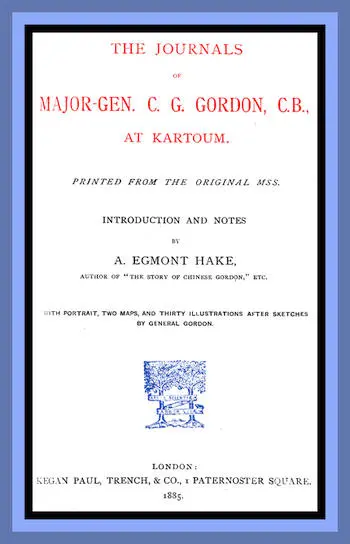
"The Journals of Major-Gen. C. G. Gordon, C.B., at Kartoum" by Charles George Gordon is a historical account written in the late 19th century. This work details the journals of General Gordon during his time in Kartoum, shedding light on the challenging conditions in Sudan and his efforts to navigate the complex political and military landscape of the region. At the start of the book, the author presents Gordon's initial observations and experiences following his appointment as Governor-General of the Sudan. The opening chapters describe his reflections on the dire circumstances faced by the local population, the oppressive regime in place, and his commitment to assisting the Soudanese people while opposing the slave trade. Gordon expresses a blend of hope and concern as he documents the precarious situation around Kartoum, emphasizing both his sense of duty and the moral complexities of his mission amidst rising tensions and rebellion from groups like the Mahdi. The tone suggests a deep introspection as he grapples with the responsibilities thrust upon him and the challenges of implementing meaningful reform.
Introduction adapted from the source catalogue; source summaries may be automatically generated.
Free to read · English · 174,578 words · No account needed
MAKE TIME FOR A GOOD BOOK
On by default. Untick to stop anonymous reading totals. Each page counts after 10 seconds in view. How this works.
Anonymous counting is on unless you have switched it off.
Even to-day we have received your letter and proclamation, both sealed and signed by you, which are not satisfactory answers to our letter. But you put in them nonsense—like unto dreams.
But we are better informed than you; for the hands (power) of the Mahdi, on whom be peace, are over the whole world; and he receives news from all parts thereof.
We are not inside a fortress listening to the sayings of hypocrites, who run away like slaves, and the like—on whose authority you issue lying and deceitful proclamations.
You mention in your answer[275] that you have received a letter from the troops; but on looking at it we find (that it is) a proclamation from you, with your own seal, and not from the army.
How can you say so, and contradict yourself? From this we learn that all your sayings are lies. And after this let there be no more letters or communications between us and you; but (only) war.
The proclamation is enclosed (returned).
(Signed) ABDERRAHHMÂN EN NAJOOMI,
ABDALLAH EN NOOR.
This letter is without any of the usual forms of civility at the top, and is addressed simply “to Gordon,” without any title, and on the back of his own letter. It is also written high up, near the top of the sheet, as from a superior to one greatly his inferior.
Letter from Lieut-Colonel Stewart, C.M.G., to General Gordon.
Island of El Hassa Heya, 4 miles south of Berber,
14th September, 1884.
You will no doubt be surprised at our not having yet passed Berber, but the fact is, we had several vicissitudes the first couple of days. You know already what happened the first day, how through the ignorance of the captain and the Reis, we ran into the bank and damaged our wheel. The second day the captain ran us on to a mud bank, where we stuck for four hours, and were with difficulty got off by the Saphia. This was too much for my patience. I am sorry to say I lost my temper and rather severely handled the individual, turned him out and put the second in command; on the 11th we passed safely through the Shoboloha defile. We saw the broken end of the telegraph cable which is to the south of the defile. Anchored for the night opposite the village of Om Ghirka, and on the right bank, at a small cultivated island inhabited by Shaggyeh, whose chief is Bab Bekr el Mek, a brother of Cassim el Moos. His people received us very well; supplied us with all the wood they could get. The chief came on board, complained greatly of the dervishes, but said, with the exception of the Shaggyehs all the tribes were wholly with the Mahdi. I enclose a letter which he has written you. He begs you will send soldiers, rifles, etc., when he will openly declare himself for the Government. So far as I am able to judge, the Shaggyehs are strong for the Government. At the Shaggyeh villages we passed, the people all showed their joy at our appearance by dancing and shouting. The villages were all along the right bank. The left bank was sullen, if not openly hostile. Bab Bekr reported that a boat full of dervishes had been recently up the river, collecting tithes; the Fascher steamer also appears to come up now and then. The Arabs also appear to have received news of our expedition. During that night war drums were being beaten on the left bank. On the 12th we received some shots from the left bank, and about mid-day halted at a Shaggyeh island for an hour or so, where we got some wood. The people were again friendly. Beyond this island we got into the Djaalen country. Passed Metemma, where we saw crowds of people and several flags; were fired on, but distance too great to do any harm. Soon after reached Shendy. Here we were also fired on. The Government house has been loop-holed, and there is a small breastwork wall in front of it. The Saphia threw a couple of shells into the town. Saw a man with a letter making signs to us, so stopped a little below the town, but he did not come on. Halted again at an island and looted the village on it; killed a lot of cattle and pulled the houses and Sakkéyés down. We were again fired on from the left bank, and the war drums were beaten all night. On the 13th we found both banks of the river openly hostile. Close to the low hills of Om Ali, on right bank, we saw a gathering of horse and foot; fired at them and knocked over a horseman. Below this point we had to hug the right bank very closely, and some Arabs turned out, ran alongside the steamer, waving swords and lances. We could have knocked them over with the greatest ease, but refrained, as they were so plucky. In the afternoon looted a boat going up with sugar. Halted on right bank about an hour and a half above El Duem. War drums going on all night. On the 14th we spent the day destroying Sakkéyés in a systematic manner, taking them one after another. They gave us a fine supply of wood, without which it would be absurd to go on to Berber. Should think we have destroyed fifteen to twenty Sakkéyés. This evening, when halted, have noticed a number of horse and foot come from the north to the village opposite on right bank. After looking at us for some time they retired, apparently in the direction of Damr. I suppose they came to reconnoitre, and perhaps to attack us while destroying Sakkéyés. To-morrow we shall start before daybreak, and the steamers will escort us to the other side of Berber. I think everything now is in fair working train, and am sanguine of getting through all right.
Your reading position is saved on this browser. Take it to another device with a library code. Reading pages adapt to text, rather than matching a printed edition.
BEHIND THE BOOK
This eBook is for the use of anyone anywhere in the United States and most other parts of the world at no cost and with almost no restrictions whatsoever. You may copy it, give it away or re-use it under the terms of the Project Gutenberg License included with this eBook or online at www.gutenberg.org. If you are not located in the United States, you will have to check the laws of the country where you are located before using this eBook. Read the source licence.
The original source file, including credits and licence, is retained by this library. Request an original-format copy at no charge. Please include the book title and Project Gutenberg identifier #49224.
KEEP YOUR CURIOSITY GOING
Cécile Tormay

Moritz Busch
John L. Ransom
Frances Wright
Cécile Tormay

Mabel Potter Daggett